
Enterprise Modelling
Workflow
Reference Content ID: #LEAD-ES20017ALL
Introduction to Workflow
Workflow orchestrates tasks, decisions, and hand-offs to deliver outcomes. It provides a shared operating rhythm aligning people, data, and systems.
Its core principles are clear purpose, explicit ownership, standardised pathways, and measurable flow. These reduce ambiguity and cycle time while improving quality.
Key components include triggers, inputs, roles, rules, tasks, and checkpoints supported by tools. Together they define sequence, dependencies, and controls from intake to completion.
Applicable across on-site, hybrid, and remote teams, workflow coordinates work regardless of location. It lifts productivity, strengthens collaboration, supports well-being through predictability, and enables digital workflows by integrating apps, data, and automation.
Well-designed workflows make outcomes repeatable, auditable, and scalable. They create a resilient foundation for continuous improvement and reliable service delivery.
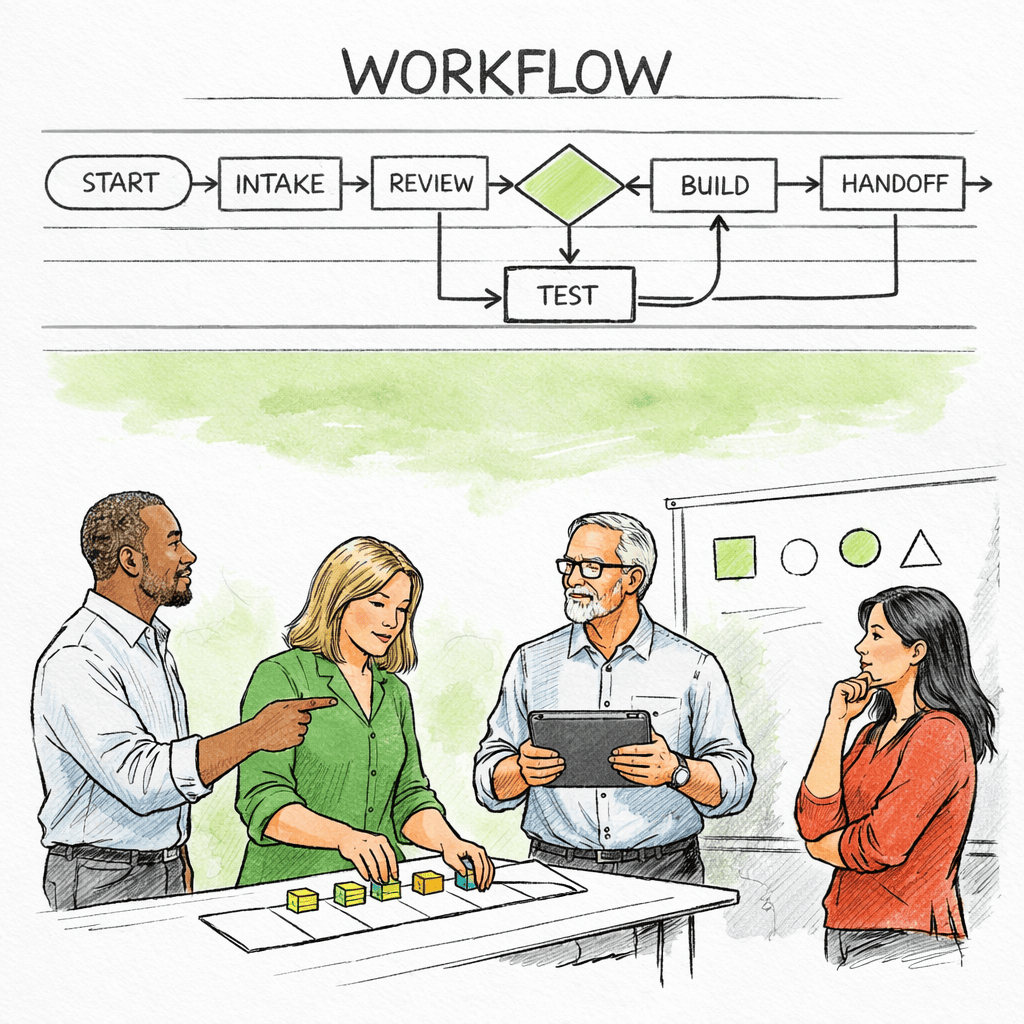
Definition and Scope
This subsection defines workflow and its boundaries. It clarifies core concepts and the domains that operationalise execution.
Workflow is the governed sequence of tasks, decisions, and handoffs turning demand into outcomes. Scope covers roles, rules, artefacts, and service levels on a repeatable path. It excludes strategy, organisation design, and one-off initiatives—workflow orchestrates execution, not direction.
Core domains are triggers and intake, data objects, tasks and dependencies, decision rules, controls, and monitoring. They interact via people and systems: ticketing and BPM route work; ERP/CRM add context; automation and APIs accelerate flow; exception handling preserves compliance.
Clear scope delivers consistent, auditable execution without overreach. Defined components enable scalable improvement and pragmatic technology choices.
Why Workflow Matters
Workflow matters because it converts strategy into reliable execution and reveals where value is created or lost. Done well, it aligns goals, resources, and controls.
At the strategic level, workflows operationalise priorities—customer experience, cost, and compliance—turning objectives into measurable throughput, quality, and risk signals leaders can steer.
As markets digitise, workflows absorb change: new channels, AI, and regulation. Standardised yet adaptable patterns enable rapid reconfiguration without reorganisation, while automation and APIs scale capacity safely.
Workflows tackle everyday friction—handoff errors, unclear ownership, and tool sprawl—by clarifying roles, rules, and data. Executives gain visibility, managers gain control, and end users gain predictability.
- Faster Cycle Time: Reduced lead times through clear sequencing, SLAs, and removal of bottlenecks.
- Better Decisions: Embedded rules and telemetry surface exceptions and enable real-time governance.
- Innovation Runway: Modular steps and reusable services let teams pilot and scale new ideas quickly.
Across functions and locations, workflow becomes the backbone for consistent service and continuous improvement. It provides a repeatable path that helps organisations pivot without chaos.
Business Case and Strategic Justification
Workflow merits investment because it translates strategic intent into consistent delivery while reducing execution risk. It aligns resources, controls, and data to accelerate outcomes.
Within corporate objectives—growth, customer experience, resilience, and ESG—workflow standardises how value is produced and governed. It resolves fragmented ownership, manual handoffs, and tool sprawl, enabling end-to-end flow without restructuring. It also provides auditability required in regulated environments.
Expected returns blend cost avoidance and value creation. Typical gains include 20–40% cycle-time reduction, 10–25% productivity uplift, and fewer defects; revenue improves through faster fulfilment and higher conversion. Metrics include lead time, throughput, first-time-right, SLA adherence, cost-per-transaction, and employee NPS.
The most typical benefits include:
- Cycle-Time Reduction: Streamlined steps and automation shorten lead times.
- Productivity Uplift: Clear roles and reusable components raise throughput per FTE.
- Quality & Compliance: Embedded rules and checks improve first-time-right and audit readiness.
- Customer Experience: Consistent handoffs increase responsiveness and reliability.
- Scalable Change: Modular workflows adopt new tech and regulations quickly.
Investment should target high-volume, error-prone flows with measurable baselines. A staged roadmap—prove, scale, optimise—captures benefits while building capability.
DON’T REINVENT THE WHEEL!
Get access to our Enterprise Standards to Drive Performance, Minimise Cost and Maximise Value.
How is Workflow Used?
Workflow is applied through a pragmatic framework that aligns structure, risk control, and continuous improvement. It combines process staging, deliberate avoidance of pitfalls, and adoption of exemplar practices to turn intent into repeatable outcomes.
Process stages define how demand moves from intake to completion, clarifying triggers, roles, sequencing, SLAs, and controls. Pitfalls highlight failure modes—ambiguous ownership, excessive variants, and tool sprawl—so mitigation is designed in. Exemplar practices showcase patterns from outperformers—standardisation, automation, and embedded analytics—that accelerate adoption and scale.
Key Phases and Process Steps outlines the end-to-end path and decision points. Identifying Pitfalls and Challenges surfaces risks, early indicators, and countermeasures. Learning from Outperformers translates proven patterns into actionable design choices.
Together these perspectives guide disciplined implementation, balancing speed with governance. They equip teams to deliver consistent value while adapting to market, regulatory, and technology change.
Key Phases and Process Steps
This ten-step approach shows how work moves from demand to delivered value. Each phase clarifies purpose, sequence, controls, and ownership to ensure predictable outcomes.
1. Intake & Triage
Capture requests, validate completeness, and route to the right queue.
2. Qualification & Prioritisation
Assess value, urgency, and risk; rank against capacity and SLAs.
3, Scoping & Definition
Specify outcomes, requirements, constraints, and acceptance criteria.
4. Assignment & Capacity Planning
Allocate roles, skills, and time; confirm availability and dependencies.
5. Orchestration & Task Design
Break work into tasks; set sequence, rules, and handoffs.
6. Execution & Collaboration
Perform tasks, share context, resolve issues, and update status.
7. Quality Control & Approvals
Apply checks, testing, and sign-offs to ensure fitness for purpose.
8. Handover & Fulfilment
Transfer outputs to customers or downstream teams; complete documentation.
9. Measurement & Compliance
Track SLAs, throughput, cost, and risk; log exceptions and audits.
10. Feedback & Continuous Improvement
Capture learnings, refine standards, and automate stable steps.
This flow reduces ambiguity, bottlenecks, and rework while improving speed and quality. It provides a consistent backbone that scales across teams and tools.
Identifying Pitfalls and Challenges: Antipatterns and Worst Practices
Avoiding the wrong patterns is as important as adopting the right ones. The following antipatterns and worst practices commonly undermine workflow performance.
5 Antipattern Examples:
5 Worst Practice Examples:
Treat them as early warning signs and design countermeasures. Standardise, minimise variants, stabilise before automating, and institutionalise feedback to sustain flow.
Learning from Outperformers: Best Practices and Leading Practices
Outperformers treat workflow as a managed system, pairing disciplined foundations with scalable, tech-enabled patterns. The following practices reflect what consistently works in mature organisations.
5 Best Practice Examples:
5 Leading Practice Examples:
Start with the foundations, then graduate to advanced patterns. Expect faster cycles, fewer errors, and adaptable execution.
Who is Typically Involved with Workflow?
Clear ownership and decision rights make workflows accountable, fast, and compliant. Understanding who plans, executes, and oversees the flow prevents gaps, duplicated effort, and control failures.
Primary roles include:
- Executive Sponsor: Sets strategic intent, secures funding, and removes organisational barriers; chairs governance with the process owner.
- Process Owner: Defines standards, rules, and KPIs; approves variants and continuous improvement backlog.
- Workflow Lead: Designs the end-to-end flow, coordinates roles and dependencies, and manages change impact.
- Operations Manager: Runs day-to-day execution, balances capacity, and resolves escalations with teams.
- Platform Engineer: Configures BPM/automation, integrations, and controls; ensures reliability and auditability.
Stakeholder influence and benefits:
- Executives: Gain visibility to steer investment; portfolio dashboards link strategy to throughput.
- Middle Management: Uses SLAs and queues to allocate capacity; faster escalations reduce outages.
- End Users: Clear tasks and guidance reduce cognitive load; fewer handoffs improve well-being.
Clear role definitions, cadenced governance, and shared metrics align decisions and behaviours. With accountable owners and empowered teams, workflows scale reliably across functions and locations.
Where is Workflow Applied?
Workflow spans core and support functions, coordinating people, systems, and controls. It delivers traceability and pace across regulated and fast-changing environments.
Primary domains where workflow is applied:
- Finance: Standardises close, AP/AR, and controls; improves audit readiness and cost-per-transaction.
- IT & Digital: Orchestrates incidents, changes, releases, and requests; integrates tools; cuts MTTR.
- Operations & Supply Chain: Coordinates production, scheduling, and logistics; enforces quality gates; raises OTIF.
- Customer Service: Routes and resolves cases omnichannel; applies SLAs; boosts NPS/CSAT.
- HR & People Ops: Guides hiring, onboarding, and moves; embeds policy; ensures compliance.
Illustrative scenarios:
- Major Incident Response: Auto-triage triggers on-call, communications, and rollback; mean-time-to-restore drops.
- Quote-to-Cash Acceleration: Guided approvals, e-signature, and straight-through billing shorten cycle and DSO.
These patterns work in on-site, hybrid, and remote settings with shared standards and local flexibility. Organisations gain speed, predictability, and insight without sacrificing control.
When Should You Embrace Workflow?
Timing matters: implementing workflow when signals converge accelerates value and reduces disruption. Adopt too early and you create overhead; too late and you scale chaos. The guidance below helps set the pace.
Key scenarios to adopt workflow:
- Rapid Growth or Scaling: Standardises operations to protect quality during scale.
- Market or Regulatory Change: Reconfigure steps quickly with embedded controls and traceability.
- Technology Refresh or Cloud Shift: Redesign flow, then automate; avoid tooling the current state.
- High Variance and Rework: Eliminate ambiguity and rework; stabilise handoffs and roles.
- Multi-Site or Remote Expansion: Align roles, SLAs, and tools across locations and timezones.
Prerequisites to have in place:
- Executive Sponsorship: Clear mandate, budget, and decision cadence.
- Process Ownership: Named owner, KPIs, and change authority.
- Baseline & Data: Current metrics, volumes, and pain points.
- Platform Readiness: Tooling, integration paths, security, and audit readiness.
- People & Skills: Capacity, training, and adoption support.
Use these signals to choose a high-value starting flow with measurable outcomes. Meet the prerequisites, run a short pilot, and scale iteratively to lock in benefits while managing risk.
Most Common Workflow Artefacts
Effective workflow practice relies on a concise set of artefacts that make work visible, governable, and measurable. These assets standardise how teams plan, execute, and improve across on-site, hybrid, and remote settings.
The core artefacts and tools are:
- Workflow Blueprint (BPMN map): Visualises steps, decisions, data objects, and integrations to align sequence and controls.
- Service Catalogue & SLA Matrix: Defines request types, channels, priorities, and service levels to set clear expectations.
- RACI & Decision Rights Matrix: Clarifies ownership, approvals, and escalation paths to prevent ambiguity at handoffs.
- SOPs & Control Checklists: Codify work instructions, quality gates, and evidence capture to ensure consistency and compliance.
- Flow Metrics Dashboard: Tracks lead time, throughput, WIP, first-time-right, and SLA adherence to drive improvement.
Together these artefacts define the path, clarify accountability, set service expectations, enforce quality, and expose performance. Maintained as living assets, they accelerate onboarding, simplify audits, and provide the foundation for continuous optimisation and automation.
The Artefacts Table
| Artefact | Description | Practical use |
|---|---|---|
| Blueprint (BPMN) | A visual map of steps, decisions, data objects, and integrations that defines the governed path from intake to completion. | Model an employee onboarding flow to align HR, IT, and Finance on sequence, handoffs, and system touchpoints. |
| Service Catalogue & SLA Matrix | A catalogue of standard request types with priorities and target service levels that set expectations and routing rules. | Configure password resets, access requests, and urgent incidents with defined priorities and response/resolve targets in the ticketing tool. |
| RACI & Decision Rights | A role and accountability matrix that clarifies who is responsible, accountable, consulted, and informed for each step and decision. | Assign change approvals to the process owner and define escalation paths for incidents to avoid delays and ambiguity. |
| SOPs & Control Checklists | Concise instructions and mandatory checks that standardise execution and evidence compliance at quality gates. | Guide invoice processing with required validations, segregation-of-duties checks, and audit evidence capture. |
| Flow Metrics Dashboard | A live view of lead time, throughput, work-in-progress, first-time-right, and SLA adherence that drives improvement. | Monitor a customer support queue to spot bottlenecks, rebalance capacity, and trigger root-cause analysis. |