
Enterprise Modelling
Value Model
Reference Content ID: #LEAD-ES20008BCPG
Introduction to Value Model
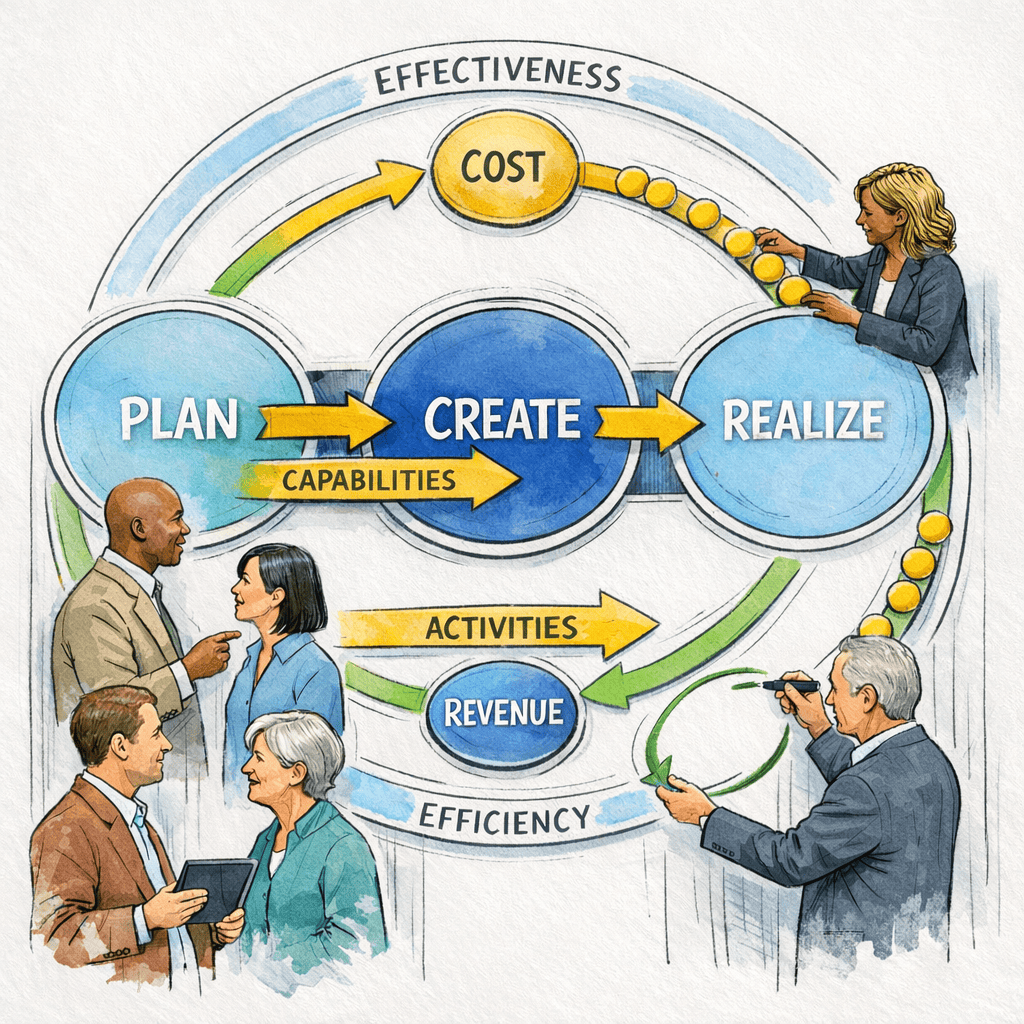
Value Model explains how an organisation creates, delivers, and captures value across processes and services. It provides a shared language that aligns strategy, operations, and investment.
Rooted in stakeholder outcomes, it connects capabilities, processes, data, and technology to measurable benefits. Principles: explicit value streams, evidence-based prioritisation, metric-led governance, continuous improvement.
Core components: value streams and use cases; benefit hypotheses; KPIs; enabling capabilities and platforms; costs, risks, assumptions. Together they link strategy to execution through reusable templates.
Applicable across IT, operations, finance, HR, and customer functions—in change programmes and BAU. It lifts productivity via flow optimisation, strengthens collaboration with shared artefacts, supports well-being through workload clarity, and powers digital workflows for on-site, hybrid, and remote teams.
It sustains measurable performance. It de-risks change.
Definition and Scope
Value Model defines how an enterprise creates, delivers, and captures value across its processes, products, and services. It establishes a common structure for aligning strategy, execution, and outcomes.
It covers value streams, stakeholder outcomes, benefits logic, and the metrics evidencing progress within a governance cadence. In scope: capability and process mapping, cost–benefit assumptions, risk and dependency visibility. Out of scope: pricing tactics, solution design, vendor selection, individual performance appraisal.
Primary domains include outcomes, KPIs, capabilities, processes, data, platforms, cost/risk/assumptions, and the initiative roadmap. These connect via value-stream mapping and hypothesis tracking to support agile delivery, service management, and change portfolios across cloud, on-premises, and hybrid landscapes.
It provides clear boundaries while remaining practical and reusable. It keeps the focus on governable value while excluding adjacent specialist activities.
Why Value Model Matters
Value Model turns strategy into measurable outcomes and directs investment to real benefits. Amid volatility and rapid technology shifts, it is an evidence-based compass.
It clarifies goals, links them to value streams, and aligns funding, capacity, and roadmaps.
It accelerates response to change by testing hypotheses, stopping low-yield work, and scaling what works.
It tackles siloed priorities and initiative sprawl with transparent metrics, governance, and accountability.
- Portfolio Focus: shifts spend to high-return bets; stops value-diluting projects.
- Flow Efficiency: cuts handoffs and cycle time for on-site, hybrid, and remote teams.
- Experience Uplift: clearer workflows and better tools improve well-being and adoption.
With value discipline, organisations make better bets, move faster, and de-risk change. Value Model is the shared language that sustains measurable performance.
Business Case and Strategic Justification
Value Model links strategy, investment, and delivery with a single logic for creating, delivering, and capturing value. It offers an auditable basis for prioritising portfolios and proving benefits.
It aligns corporate objectives—growth, customer experience, resilience, cost optimisation—with value streams and funding. It addresses common issues such as initiative sprawl, opaque benefits, slow decision cycles, and misaligned capacity, while surfacing opportunities from automation, data, and new business models.
The ROI case combines reduced waste, faster time-to-value, and uplift in revenue or service quality. Typical metrics include cost avoided, cycle-time reduction, adoption and satisfaction scores, throughput, and contribution margin; benchmarks are set per value stream and tracked through a governance cadence.
Typical benefits include:
- Portfolio Focus: directs spend to high-return initiatives; stops low-yield work.
- Flow Efficiency: fewer handoffs; shorter lead times.
- Experience Uplift: higher adoption and employee well-being.
- Risk Transparency: earlier identification of dependencies and controls.
- Scalable Reuse: templates and platforms accelerate delivery.
This business case enables confident prioritisation and accountable delivery. Next steps: stand up governance, define value streams, and baseline metrics.
DON’T REINVENT THE WHEEL!
Get access to our Enterprise Standards to Drive Performance, Minimise Cost and Maximise Value.
How is Value Model Used?
Applying Value Model requires a practical framework that turns intent into action. We use three complementary perspectives—process stages, pitfalls, and exemplar practices—to guide design, delivery, and improvement.
Key Phases and Process Steps sets out a staged path from framing outcomes, mapping value streams, and defining benefit hypotheses to governance, measurement, and continuous optimisation. Identifying Pitfalls and Challenges highlights common failure modes—unclear ownership, metric drift, tool-led thinking—and how to prevent them before they erode benefits. Learning from Outperformers distils proven patterns—lightweight governance, metric-led backlog shaping, platform reuse—that raise flow efficiency and adoption across on-site, hybrid, and remote teams.
Together these perspectives ensure clarity on what to do, what to avoid, and what to emulate. They provide a repeatable way to scale value discipline across portfolios and contexts while reducing risk.
Key Phases and Process Steps
The Value Model advances through ten disciplined phases, moving from strategic framing to measurable outcomes across portfolios. The sequence safeguards traceability, risk control, and reusable practice across on-site, hybrid, and remote teams.
1. Value Intent & Scope
Clarify purpose, boundaries, and success criteria.
2. Stakeholder & Outcome Mapping
Identify beneficiaries and define target outcomes.
3. Value Stream Discovery
Map flows from demand to realised benefits.
4. Benefit Hypotheses
Articulate cause–effect logic linking initiatives to outcomes.
5. KPI & Baseline Definition
Select metrics and establish current performance.
6. Capability & Process Alignment
Determine changes to people, process, data, and technology.
7. Investment & Roadmap Shaping
Set decision rights, controls, and cadence across teams.
8. Delivery Governance
Set decision rights, controls, and cadence across teams.
9. Measurement & Learning
Track benefits, test assumptions, and adapt backlogs.
10. Continuous Improvement & Scaling
Standardise patterns, templates, and platform reuse.
Together these steps connect strategy to execution with transparent accountability and credible evidence of value. Teams can adopt them end-to-end or iterate by phase to manage change at pace.
Identifying Pitfalls and Challenges: Antipatterns and Worst Practices
Robust value discipline falters when teams adopt shortcuts and cosmetic governance. Avoid these recurring failure modes to preserve credibility and impact.
5 Antipattern Examples:
5 Worst Practice Examples:
Address them with clear ownership, lean artefacts, and metric-led governance. Emphasise outcomes, credible baselines, and a cadence that scales what works and stops what does not.
Learning from Outperformers: Best Practices and Leading Practices
Outperformers treat value as an operating discipline, not a project. They embed lean governance, measurable outcomes, and scalable patterns.
5 Best Practice Examples:
5 Leading Practice Examples:
Together, these practices accelerate flow, raise productivity, and strengthen collaboration. They reduce risk, support well-being, and enable digital workflows across on-site, hybrid, and remote teams.
Who is Typically Involved with Value Model?
Clear roles and accountabilities are essential to govern value end to end. Value Model depends on a compact, coordinated team that aligns strategy, funding, and delivery. The following roles and stakeholders provide pace, evidence, and control.
Primary roles:
- Executive Sponsor: Sets direction, unlocks funding, removes barriers; convenes cross-functional leadership.
- Value Owner: Owns outcomes and KPIs; aligns backlog, scope, and benefits across teams.
- Portfolio Manager (PMO): Runs prioritisation, dependency management, and governance cadence across initiatives.
- Value Architect: Maps value streams; aligns capabilities, processes, data, and platforms to outcomes.
- Data & Metrics Lead: Establishes baselines, telemetry, and dashboards; safeguards metric quality and learning.
Stakeholder influence and benefits:
- Executives: Gain line-of-sight from strategy to realised benefits; make faster trade-offs.
- Middle Management: Balance capacity and risk; improve flow via standard cadence and templates.
- Technical Teams & End Users: Co-design workflows; adopt tools with clear metrics and feedback loops.
Clear ownership accelerates decisions, reduces rework, and protects benefits. With shared artefacts and a metric-led cadence, collaboration improves across on-site, hybrid, and remote settings. This clarity scales value discipline across portfolios.
Where is Value Model Applied?
Value Model is applied wherever organisations need disciplined alignment between strategy, delivery, and measurable outcomes. It cuts across functions, enabling consistent prioritisation, governance, and learning. Its artefacts are reusable across on-site, hybrid, and remote teams.
Primary domains and functions:
- Finance: Links budgets to value streams; tracks benefits, cost avoided, and contribution margin.
- IT & Digital: Prioritises platforms and features by outcome; shapes backlogs with KPIs and telemetry.
- Operations & Supply Chain: Improves flow, quality, and throughput; reduces cycle time and waste.
- Customer Service & Experience: Aligns journeys, SLAs, and tooling to adoption, NPS, and resolution metrics.
- HR & Workplace: Connects workforce initiatives to productivity, capability uplift, and well-being indicators.
Illustrative scenarios:
- Cloud Modernisation: Funds value streams, sequences releases, and verifies efficiency and resilience gains.
- Omnichannel Service Reboot: Re-maps journeys, sets KPIs, and scales platform reuse to raise CSAT and first-contact resolution.
Value Model’s versatility lies in its clear logic, lean artefacts, and metric-led cadence. It provides common language and controls, enabling faster, lower-risk improvement across varied contexts and operating models.
When Should You Embrace Value Model?
Right-timing Value Model maximises impact and reduces change risk. It works best when triggers are clear and foundations are in place. These signals and prerequisites help decide when to proceed.
Signals to adopt Value Model:
- Growth Inflection: Scaling requires disciplined prioritisation and funding alignment.
- Market or Regulatory Shift: New rules or rivals demand fast, evidence-led reprioritisation.
- Technology Modernisation: Cloud, data, or platform refresh needs value-shaped backlogs.
- Performance Drift: Stalled KPIs call for baseline, hypotheses, and corrective flow.
- Portfolio Overload: Initiative sprawl and capacity strain need transparent trade-offs.
Prerequisites:
- Executive Sponsorship: Clear mandate, decision rights, and protection from churn.
- Named Value Owner: Accountable for outcomes, KPIs, and benefits logic.
- Credible Baselines: Agreed measures, telemetry, and data quality.
- Governance Cadence: Routine for prioritisation, risk, and learning.
- Delivery Capacity: Teams, funding, and enablement to act on decisions.
Aligned triggers and readiness accelerate adoption and results. Proceed when both exist; otherwise, close gaps first and start with a pilot value stream.
Most Common Value Model Artefacts
Reliable artefacts convert intent into repeatable practice. In the Value Model, they align outcomes, funding, and delivery while enabling evidence-led decisions across on-site, hybrid, and remote teams.
Core artefacts used in Value Model:
- Value Stream Map: Visualises end-to-end flow from demand to realised benefits; exposes delays, handoffs, waste.
- Benefit Hypothesis Canvas: Links initiatives to outcomes with assumptions, leading indicators, tests; frames scale-or-stop decisions.
- KPI & Baseline Dashboard: Consolidates targets, baselines, and trends; underpins prioritisation, governance, learning.
- Portfolio Prioritisation Matrix: Ranks initiatives by value, risk, effort; guides sequencing and funding.
- Governance Cadence Playbook: Defines decision rights, rituals, and artefacts by frequency; ensures consistent control and escalation.
These artefacts keep value traceable from strategy to operations. They cut ambiguity, speed flow, and support auditability and reuse across toolsets and operating models.
The Artefacts Table
This page summarises the core artefacts used in Value Model and clarifies their role in aligning strategy, delivery, and measurable outcomes. Use it as a quick reference when establishing governance, prioritisation, and measurement across on-site, hybrid, and remote teams.
| Artefact | Description | Practical use |
|---|---|---|
| Value Stream Map | A visual model of the end-to-end flow from demand to realised benefits that reveals delays, handoffs, and waste. | Used in discovery and improvement workshops to target bottlenecks, redesign workflows, and raise throughput. |
| Benefit Hypothesis Canvas | A structured statement linking an initiative to outcomes via assumptions, leading indicators, and test methods. | Applied during planning to validate value logic, run pilots, and decide whether to scale, pivot, or stop. |
| KPI & Baseline Dashboard | A consolidated view of targets, current performance, and trends that evidences progress and issues. | Used in governance reviews to prioritise work, course-correct underperforming areas, and demonstrate benefits. |
| Portfolio Prioritisation Matrix | A comparative ranking of initiatives by value, risk, effort, and readiness to inform sequencing and funding. | Employed in quarterly planning to shift spend to higher-return bets and defer or drop low-yield items. |
| Governance Cadence Playbook | A clear schedule of decision rights, forums, artefacts, and rituals that standardises oversight. | Implemented across teams to synchronise planning, risk management, and benefits tracking at predictable intervals. |
Together, these artefacts provide a repeatable mechanism to connect intent with evidence and accelerate decision-making. They reduce ambiguity, enable traceability from strategy to operations, and support scalable reuse across varied technologies and operating models.