
Enterprise Modelling
Technology Consolidation
Reference Content ID: #LEAD-ES20021ALL
Introduction to Technology Consolidation
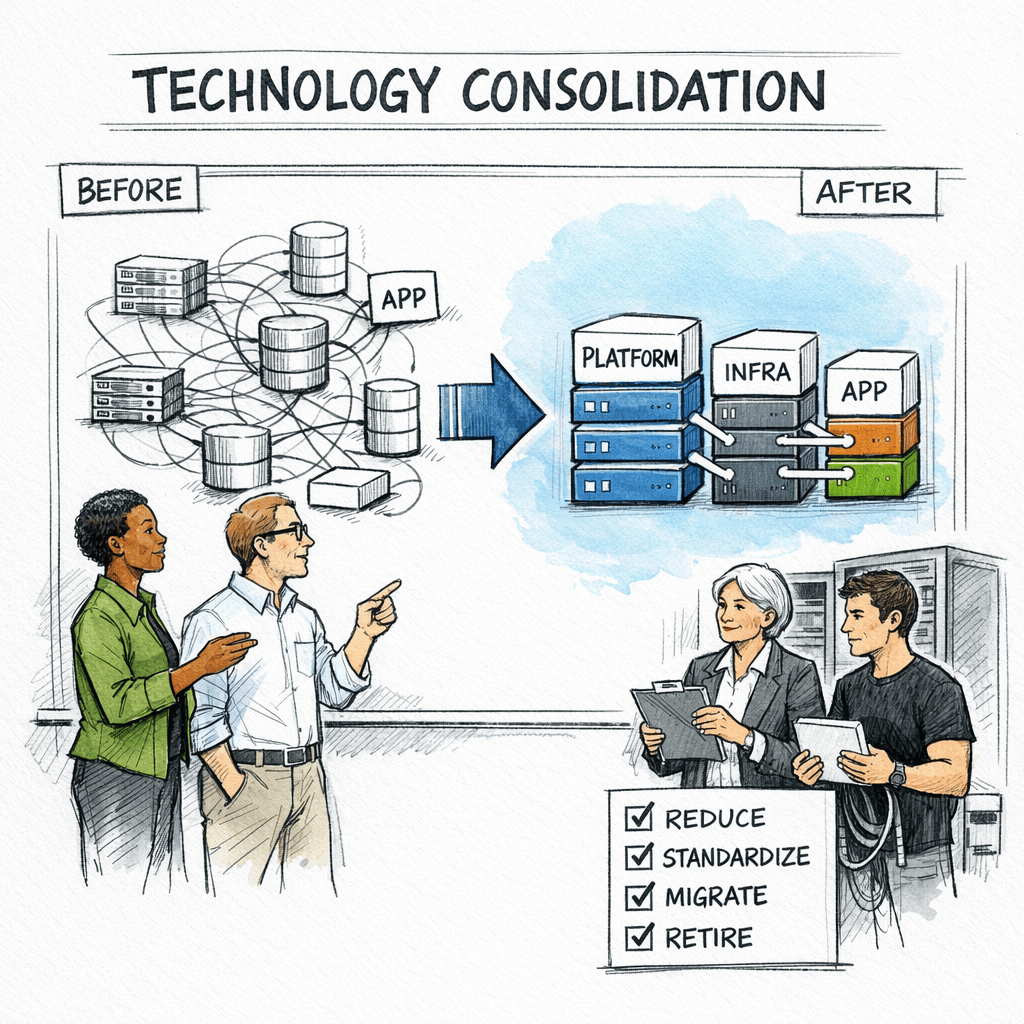
Technology Consolidation aligns fragmented systems into a coherent, scalable estate. It removes redundancy and standardises platforms to improve control and speed.
- Principles: simplification, standardisation, and integration, governed by lifecycle economics. Choices prioritise total cost, risk, resilience, and time-to-value.
- Focus areas: application and platform rationalisation; data and integration; infrastructure and workplace; security and compliance; vendor and licence portfolios; and the operating model.
Across on-site, hybrid, and remote teams, consolidation boosts productivity and collaboration by cutting tool sprawl and access friction. It supports well-being with clearer workflows and enables digital acceleration through automation, APIs, and AI-ready data.
Handled deliberately, it provides a secure, modern foundation that scales with demand. The result is a disciplined platform for innovation and measurable value.
Definition and Scope
Technology Consolidation is the systematic rationalisation and harmonisation of an organisation’s technology estate to a secure set of platforms. It removes duplicative tools, integrates data flows, and aligns architectures with business priorities.
- In scope: applications, platforms, workplace and infrastructure, identity and security, integration, vendors and licences.
- Out of scope: non-technology organisation design, one-off experiments, and bespoke builds that increase fragmentation.
Core domains include application and platform portfolios; data, integration and APIs; workplace and infrastructure; identity, security and compliance; vendor, licence and cost management. These are orchestrated through architecture standards, operating models and governance, adapting to cloud, hybrid or regulated settings. The result is fewer platforms, consistent controls, and reusable capabilities that reduce risk and cost while improving agility. Governance is decisive.
Why Technology Consolidation Matters
Technology Consolidation matters because fragmented estates slow growth and raise risk. Unifying platforms creates the conditions for scale, control, and continuous improvement.
Strategically, consolidation aligns the technology portfolio to business outcomes, compresses time-to-value, and frees capital from maintenance to innovation.
It enables rapid response to shifts—cloud economics, AI adoption, cyber threats, and regulatory change—through common services, shared data, and consistent controls.
Operationally, it tackles tool sprawl, data silos, brittle integrations, and skills duplication, improving reliability, supportability, and service experience.
- Executives—Portfolio Visibility: one roadmap, comparable TCO, clearer risk posture.
- Managers—Simplified Delivery: standard stacks cut handoffs, defects, and lead times.
- Employees—Frictionless Work: unified identity and apps reduce context switching.
Consolidation delivers resilience, speed, and lower costs without sacrificing choice. With disciplined governance and change management, it becomes a durable platform for innovation.
Business Case and Strategic Justification
Technology Consolidation is a strategic lever to simplify the estate and redirect spend to growth. It aligns technology choices with enterprise outcomes, risk appetite, and regulatory duty.
It addresses tool sprawl, duplicated capabilities, and escalating run costs while enabling cloud adoption, AI readiness, and secure data sharing. Consolidation turns strategy into executable roadmaps and enforceable standards across divisions and partners.
Return comes from lower total cost of ownership, higher utilisation of shared services, and faster change delivery. Organisations commonly target 10–20% run-cost reduction, 20–30% lead-time improvement, and incident reductions measured through TCO, MTTR, service quality, and adoption metrics.
Typical benefits include:
- Cost Efficiency: fewer platforms, better licence leverage, and sustainable run rates.
- Risk & Compliance: unified controls, fewer vulnerabilities, and clearer accountability.
- Speed & Agility: standard stacks accelerate delivery and scaling.
- Experience & Collaboration: seamless access reduces friction for hybrid and remote work.
- Innovation Capacity: savings and reusable services fund data, AI, and automation.
A disciplined case links savings to reinvestment in priority initiatives. With clear governance and staged releases, consolidation becomes a repeatable engine for value creation.
DON’T REINVENT THE WHEEL!
Get access to our Enterprise Standards to Drive Performance, Minimise Cost and Maximise Value.
How is Technology Consolidation Used?
Technology Consolidation is applied through a pragmatic framework that connects strategy to execution. It creates a single narrative for change, clarifying what to do, what to avoid, and how to excel.
The framework rests on three perspectives:
- Process stages define the end-to-end path and governance.
- Common pitfalls expose risks that derail value.
- Exemplar practices show repeatable ways to deliver outcomes.
Together, they align stakeholders, reduce uncertainty, and accelerate results.
- Key Phases and Process Steps sets scope, prioritises portfolios, and sequences releases to manage risk and benefits.
- Identifying Pitfalls and Challenges equips teams to recognise anti-patterns early and embed safeguards.
- Learning from Outperformers distils patterns from leaders to raise quality and speed.
Used holistically, these lenses reinforce one another, guiding disciplined execution and measurable value creation.
Key Phases and Process Steps
Technology Consolidation follows a repeatable, end-to-end method to move from insight to measurable value. The ten phases below provide a disciplined flow that reduces risk and accelerates outcomes.
1. Strategy Alignment
Confirm objectives, value targets, constraints, and risk appetite.
2. Estate Discovery
Inventory applications, platforms, integrations, contracts, and usage.
3. Baseline & Diagnostics
Quantify cost, risk, resilience, performance, and experience.
4. Segmentation & Principles
Define domain boundaries, standards, and decision guardrails.
5. Rationalisation & Target Design
Select keep/retire/replace; design target architectures.
6. Prioritisation & Business Case
Sequence initiatives; model benefits, costs, and KPIs.
7. Roadmap & Release Plan
Create waves with scope, dependencies, and change plans.
8. Build, Migrate, & Integrate
Execute releases; modernise, integrate, and harden security.
9. Decommission & Realise Benefits
Remove legacy, reclaim licences, and track outcomes.
10. Operate & Continuous Improvement
Embed governance, SLOs, and feedback loops.
The sequence moves from clarity of intent to controlled execution and sustained optimisation. Each phase produces tangible artefacts and decisions that feed the next, ensuring transparency and momentum. Applied consistently, it creates a scalable engine for simplification and innovation.
Identifying Pitfalls and Challenges: Antipatterns and Worst Practices
Consolidation fails less from technology than from behaviour. Avoid these patterns that inflate cost, risk, and time-to-value.
5 Antipattern Examples:
5 Worst Practice Examples:
Effective consolidation is selective, staged, and governed. Tie decisions to value, fund retirement, and manage behaviour to sustain outcomes.
Learning from Outperformers: Best Practices and Leading Practices
Outperformers treat Technology Consolidation as a disciplined product, not a one-off project. They combine architecture standards, change management, and clear value tracking.
5 Best Practice Examples:
5 Leading Practice Examples:
Outperformers treat Technology Consolidation as a disciplined product, not a one-off project. They combine architecture standards, change management, and clear value tracking.
Who is Typically Involved with Technology Consolidation?
Clear accountability is essential to execute Technology Consolidation at speed and scale. Defined roles coordinate strategy, design, delivery, and adoption, aligning decisions with value and risk.
Primary roles:
- Executive Sponsor: sets vision, removes obstacles, approves funding, and arbitrates enterprise trade-offs.
- Program Lead: orchestrates roadmap, dependencies, and benefits; aligns portfolios, finance, and change.
- Enterprise Architect: defines principles, target states, and standards; governs design decisions across domains.
- Platform/Operations Owner: runs services to SLOs, plans migrations, decommissions legacy, and manages resilience.
- Security & Risk Lead: embeds policy-as-code, identity, and compliance; validates controls before release.
Stakeholder influence and benefits:
- Executives: Portfolio Clarity: consolidated KPIs enable capital allocation and risk oversight.
- Managers: Predictable Delivery: standard stacks and release trains cut lead times and incidents.
- Technologists & Users: Better Experience: unified identity and fewer tools reduce friction and rework.
Clear role definitions streamline decisions, speed execution, and sustain outcomes. Collaboration across these roles converts strategy into measurable value and lasting simplification.
Where is Technology Consolidation Applied?
Technology Consolidation spans the enterprise, targeting areas with duplicated tools, fragmented data, and inconsistent controls. It focuses on harmonising platforms to improve cost, risk, and experience while enabling scale. Its breadth allows both core functions and customer-facing teams to benefit quickly.
- IT & Platforms: consolidate apps, clouds, and integration tools to standard stacks and shared services.
- Finance: unify ERP, planning, and reporting to improve control, close speed, and cost transparency.
- Operations: streamline MES/SCM/WMS to reduce handoffs, inventory errors, and downtime.
- Customer Service & Sales: rationalise CRM, contact centre, and marketing tooling to one customer view.
- HR & Workplace: standardise identity, collaboration, and device management to simplify access and support.
- M&A Integration: converge duplicate CRMs and data pipelines to a single revenue and service platform.
- Cloud Modernisation: retire legacy middleware by moving to a managed integration and API layer.
Technology Consolidation is versatile across regulated, hybrid, and high-growth contexts. By focusing on domains with measurable friction, it accelerates value and resilience. Applied iteratively, it establishes reusable capabilities that compound benefits over time.
When Should You Embrace Technology Consolidation?
Timing determines the speed and durability of results. The right moment aligns demand, budget, and change capacity, ensuring consolidation accelerates priorities rather than disrupting them.
- Scaling or M&A: eliminate duplicates and standardise quickly to enable growth.
- Budget Pressure: redirect run spend to outcomes through platform rationalisation.
- Security or Compliance Gaps: close exposures with unified controls and identity.
- Technology refresh Cycles: pair renewals with decommissioning to avoid lock-in.
- Digital and AI initiatives: create shared data and services to scale safely.
Prerequisites include:
- Stakeholder Alignment: clear sponsorship, decision rights, and success criteria.
- Portfolio Baseline: accurate inventory, cost, risk, and utilisation metrics.
- Governance Model: standards, guardrails, and policy-as-code readiness.
- Funding & Capacity: ringfenced budget, skills, and release windows.
- Change Management: adoption plan, communications, and training pathways.
Acting when signals converge reduces risk and amplifies value. With alignment, data, governance, and resourcing in place, consolidation becomes a controlled intervention that improves cost, resilience, and time-to-value.
Most Common Technology Consolidation Artefacts
Technology Consolidation succeeds when decisions are grounded in clear, reusable artefacts. These tools create shared understanding, accelerate delivery, and make benefits auditable. They also reduce rework by codifying guardrails and patterns.
The core artefacts are:
- Portfolio Inventory & Heatmap: a system-of-record of apps, platforms, costs, risks, and usage that visualises priorities.
- Consolidation Principles & Decision Matrix: concise guardrails and scored criteria to choose keep/retire/replace and vendor options.
- Target Architecture & Reference Stacks: future-state diagrams and curated patterns standardising integration, security, and operations.
- Roadmap & Release Plan: sequenced waves with scope, dependencies, change actions, and entry/exit criteria.
- Decommissioning Plan & Benefits Tracker: retirement runbooks, licence clawback, and metrics linking removals to cost, risk, and experience.
Together, these artefacts align stakeholders and convert strategy into executable steps. They enable transparent governance, predictable delivery, and measurable outcomes. Maintained as living documents, they scale consolidation across teams and time.
The Artefacts Table
A concise set of core artefacts ensures Technology Consolidation is executed consistently, governed transparently, and measured objectively. The table names each artefact, what it is, and how it is applied in real programmes. Use it as a quick reference when planning, funding, or auditing consolidation work.
| Artefact | Description | Practical use |
|---|---|---|
| Portfolio Inventory & Heatmap | A single system-of-record of applications, platforms, costs, risks, and utilisation. | Pinpoints redundancy and high‑value candidates for consolidation across business units. |
| Consolidation Principles & Decision Matrix | Concise guardrails and scored criteria for keep, retire, replace, or consolidate decisions. | Enables objective vendor selection and faster approvals with traceable rationale. |
| Target Architecture & Reference Stacks | Future‑state diagrams and curated patterns for integration, security, and operations. | Guides engineering to standard platforms, reducing variance and delivery risk. |
| Roadmap & Release Plan | Sequenced waves with scope, dependencies, milestones, and change actions. | Synchronises teams and funding while managing risk through staged delivery. |
| Decommissioning Plan & Benefits Tracker | Retirement runbooks, licence clawback steps, and metrics linked to outcomes. | Ensures legacy removal and verifies realised savings, resilience, and experience gains. |