
Enterprise Modelling
Role Modelling
Reference Content ID: #LEAD-ES20014BC
Introduction to Role Modelling
Role Modelling is a structured blueprint of who does what and how. It codifies responsibilities, decision rights, competencies, and interactions for consistent execution.
Its principles are clarity of purpose, accountability, and well-defined interfaces. Roles are specified by outcomes, decision authority, controls, and measurable service expectations—not personalities or titles.
Core components include role catalogues, RACI and decision matrices, competency profiles, and standardised handoffs embedded in processes and tools.
Applicable across corporate and operational domains, Role Modelling lifts productivity, reduces rework, and speeds onboarding. Clear interfaces foster collaboration and well-being; defined permissions enable digital workflows for on-site, hybrid, and remote teams.
Well-designed role models align people, process, and technology. They make performance transparent and scalable as the organisation evolves.
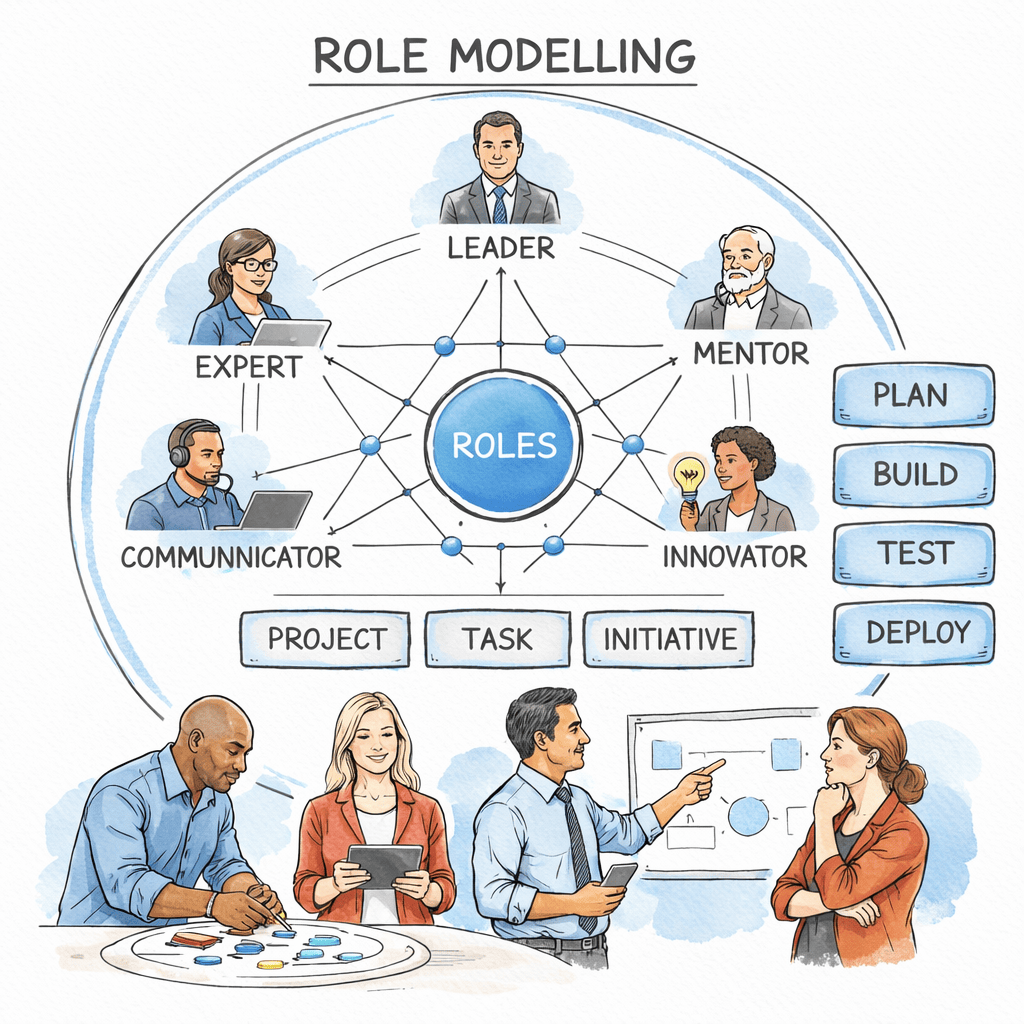
Definition and Scope
This subsection defines Role Modelling and its enterprise scope. It outlines core concepts and components across organisational and technological contexts. Role Modelling specifies roles—their purpose, outcomes, decision rights, competencies, and interfaces. It governs accountability and handoffs across processes.
- In Scope: role catalogues, responsibilities, authorities, controls, permissions.
- Out of Scope: job grading, performance appraisal, headcount planning, personal profiles.
- Primary Components: role catalogue, RACI/decision matrices, competency profiles, access models, and interfaces.
They integrate with process maps, service management, HR, and identity platforms. In agile, product, or operations, roles anchor squads and services, ensuring traceable authority and compliant execution.
Effective Role Modelling aligns people, process, and technology, eliminating ambiguity and rework. It provides a durable basis for scaling, auditability, and change.
Why Role Modelling Matters
Role Modelling underpins execution by clarifying who decides, delivers, and controls work. It translates strategy into accountable roles that scale across functions and channels.
Strategically, it links objectives to measurable outcomes and decision rights, enabling portfolio prioritisation, risk control, and regulatory compliance. Clear ownership reduces cycle time, handoff errors, and audit gaps.
As markets and technology shift, Role Modelling provides a stable backbone for change: teams can reconfigure without losing accountability; new digital workflows, AI, and automation inherit unambiguous permissions and controls.
Stakeholders value it differently:
- Executives: Portfolio choices and risk exposure become visible through decision-rights maps.
- Managers: Staffing, onboarding, and handoffs are streamlined via role catalogues and RACI.
- End Users: Fewer escalations, clearer interfaces, and permissions embedded in tools.
The result is higher productivity, better collaboration, and healthier workload balance across on-site, hybrid, and remote teams. Robust role designs enable innovation while maintaining control and compliance.
Business Case and Strategic Justification
Role Modelling creates accountable roles and interfaces that turn strategy into execution. This business case explains strategic fit, risk reduction, and measurable returns.
It aligns objectives, value streams, and decision rights across functions, products, and geographies. It tackles siloes, fuzzy ownership, compliance exposure, and sluggish scaling, while enabling AI, shared services, and platform operating models.
Returns stem from fewer handoffs and rework, faster onboarding, right-first-time decisions, and cleaner audits. Benefits are tracked via cycle time, throughput, rework %, onboarding time, service levels, and control effectiveness.
Typical benefits include:
- Faster Execution: Clear owners and decisions shorten cycle time.
- Lean Operations: Defined handoffs cut rework and waste.
- Risk Control: Embedded authority reduces audit findings.
- Scalable Change: Stable roles enable reorgs and growth.
- Digital Enablement: Permissions drive automation and AI.
Role Modelling is a low-cost, high-leverage capability with compounding value. Establish scope, baseline metrics, pilot a value stream, and scale through governance.
DON’T REINVENT THE WHEEL!
Get access to our Enterprise Standards to Drive Performance, Minimise Cost and Maximise Value.
How is Role Modelling Used?
Role Modelling is applied through a pragmatic framework that turns intent into accountable execution. It combines structured design with operational discipline to embed clarity, control, and adaptability.
The framework is built on three perspectives:
- Process stages define how to discover, design, validate, implement, and govern roles across value streams and platforms.
- Common pitfalls to avoid expose ambiguity, overlapping authority, and tool-only fixes that ignore operating reality.
- Exemplar practices demonstrate what good looks like, using peer benchmarks and standards to set bar-raising expectations.
The subsections that follow preview this journey:
- Key Phases and Process Steps describes the end-to-end approach.
- Identifying Pitfalls and Challenges highlights frequent failure modes.
- Learning from Outperformers illustrates proven patterns.
Together, these perspectives align stakeholders, reduce rework, and accelerate adoption. They provide a repeatable path to resilient role designs that scale with change and underpin digital ways of working.
Key Phases and Process Steps
Role Modelling follows a disciplined, end-to-end sequence that moves from intent to embedded practice. The ten phases below provide a repeatable path to design, adopt, and sustain accountable roles.
1. Scope & Objectives
Define outcomes, boundaries, dependencies, and success metrics.
2. Stakeholder Alignment
Confirm sponsorship, decision forums, and engagement cadence.
3. Process & Value Mapping
Trace value streams to identify role touchpoints.
4. Role Discovery
Gather activities, pain points, and controls from practitioners.
5. Role Design
Specify purpose, outcomes, interfaces, and measurable service expectations.
6. Decision Rights (RACI)
Allocate authority and accountability across key decisions.
7. Capabilities & Access
Map competencies, permissions, and segregation-of-duties.
8. Validation & Simulation
Test handoffs, workload balance, and risk controls.
9. Implementation & Enablement
Embed roles in tools, workflows, and onboarding.
10. Governance & Improvement
Monitor performance, audit compliance, and iterate.
This sequence reduces ambiguity, accelerates adoption, and safeguards control. It links strategic intent to operational execution and scales effectively across functions, platforms, and geographies.
Identifying Pitfalls and Challenges: Antipatterns and Worst Practices
Role Modelling often fails for predictable reasons. Naming them early prevents rework and risk.
5 Antipattern Examples:
5 Worst Practice Examples:
Avoid these traps to keep roles clear, workable, and auditable. Govern, iterate, and align tools.
Learning from Outperformers: Best Practices and Leading Practices
Outperformers treat Role Modelling as a management system, not a document. They align roles, decisions, and access with value creation and risk control.
5 Best Practice Examples:
5 Leading Practice Examples:
Adopt the basics firmly, then scale with advanced practices. This combination reduces friction, accelerates change, and safeguards compliance for evolving enterprises.
Who is Typically Involved with Role Modelling?
Understanding who participates in Role Modelling is essential to secure mandate, speed decisions, and embed change. Clear responsibilities streamline collaboration across business, technology, and control functions. The roles below form a pragmatic, cross-functional core.
- Executive Sponsor: Sets mandate, funds the work, removes obstacles, and arbitrates scope.
- Role Modelling Lead: Orchestrates methodology, cadence, and governance; aligns stakeholders and resolves design issues.
- Process Owner(s): Defines outcomes, handoffs, and controls; validates decision rights in value streams.
- HR/People & Change Lead: Curates competencies, onboarding, and change adoption; aligns roles with job architecture.
- IT/IAM & Workflow Architect: Implements permissions and workflows; maps roles to systems and automation.
Stakeholder impact and benefits:
- Executives: Portfolio choices and risk exposure become transparent; faster strategic trade-offs.
- Middle Management: Staffing, handoffs, and KPIs stabilise; less rework and escalation.
- Technical Teams & End Users: Clear interfaces and permissions reduce friction; smoother digital workflows.
Well-defined participants accelerate agreement and accountability. This structure enables auditable, scalable role designs that perform in daily operations and during change.
Where is Role Modelling Applied?
Role Modelling applies across enterprise functions and operating contexts. It clarifies decision rights, interfaces, and permissions wherever work crosses teams and systems.
Primary domains of application:
- Finance: Structures accountability for close-to-report, forecasting, controls, and segregation of duties.
- IT & Digital: Defines product/platform ownership, DevOps and SRE responsibilities, and change/access governance.
- Operations & Supply Chain: Clarifies planning, make/ship, quality, and incident roles across plants and partners.
- Customer Service & Sales: Aligns case ownership, SLAs, and handoffs between CX, sales, and field service.
- Risk, Legal & Compliance: Maps three lines of defence, approvals, and evidence responsibilities for audits.
Illustrative scenarios:
- ERP Transformation: Role catalogues and SoD models drive safer workflows and faster user onboarding.
- Hybrid Field Service: Dispatch, technician, and parts roles coordinate digitally to improve first-time-fix rates.
Role Modelling is versatile, fitting corporate, operational, and platform settings. It enables consistent execution, faster change, and embedded compliance across on-site, hybrid, and remote work. The same patterns scale from single processes to enterprise-wide operating models.
When Should You Embrace Role Modelling?
Choosing the right moment for Role Modelling determines speed of adoption and value realisation. Timing it to major business or technology shifts amplifies impact and reduces risk. Meeting a few prerequisites ensures the work is actionable, not theoretical.
Key scenarios and conditions:
- Rapid Growth or Scaling: Standardises roles to onboard faster and preserve quality.
- Operating Model Change: Anchors decision rights during reorganisation or service model shifts.
- Technology Refresh (ERP/Cloud): Aligns permissions, SoD, and workflows to new platforms.
- Regulatory Pressure: Clarifies ownership and controls to address audit findings.
- Performance Variability: Reduces rework, delays, and escalations by fixing handoffs.
Essential prerequisites:
- Executive Sponsorship: Mandate, funding, and escalation path.
- Stakeholder Alignment: Shared outcomes, scope, and decision forums.
- Process Baselines: Mapped value streams and KPIs.
- Access & Data Readiness: IAM, SoD policies, and system mapping.
- Change Capacity: Resources, training, and communications.
Selecting strong triggers and meeting basics de-risks adoption. The result is faster execution, cleaner controls, and scalable ways of working.
Most Common Role Modelling Artefacts
Effective Role Modelling relies on a small set of artefacts that turn intent into executable practice. They make responsibilities, interfaces, and permissions explicit across teams and systems. Used together, they accelerate onboarding, reduce rework, and enable compliant digital workflows.
Core artefacts and tools:
- Role Catalogue: Canonical inventory defining purpose, scope, outcomes, interfaces, and ownership of each role.
- Decision-Rights/RACI Matrix: Allocates accountability and approvals for key decisions; clarifies escalation paths and forums.
- Role–Process & Handoff Map: Swimlanes and SLAs linking tasks to roles; standardises inputs, outputs, and controls.
- Competency & Performance Profile: Skills, certifications, KPIs, and workload guidelines informing staffing, training, and evaluation.
- Access & SoD Model: Entitlements and segregation-of-duties mapped to IAM and workflows; enforces compliant permissions.
Together, these artefacts create a living operating backbone. They connect people, process, and technology, provide audit-ready evidence, and scale across on-site, hybrid, and remote work. Maintained through governance, they keep role designs aligned with change.
The Artefacts Table
This page summarises the core artefacts that translate Role Modelling from intent into day-to-day practice. Each entry names the artefact, defines its purpose in one sentence, and outlines how it is applied in real scenarios. Use it as a quick reference when designing, implementing, or auditing roles.
| Artefact | Description | Practical use |
|---|---|---|
| Role Catalogue | A canonical inventory of roles defining purpose, scope, outcomes, interfaces, and ownership. | Standardises roles across functions and geographies; accelerates onboarding during ERP or operating model changes. |
| Decision Rights Matrix (RACI) | A structured map of who decides, approves, is consulted, and informed for key decisions. | Clarifies approvals for pricing, change control, and exceptions; reduces escalations and cycle time. |
| Role–Process Handoff Map | A visual link between process steps and role owners with defined inputs, outputs, and SLAs. | Eliminates gaps in incident, order-to-cash, or claim workflows; improves first-time-right execution. |
| Competency Profile | A concise specification of required skills, certifications, and performance measures for each role. | Guides staffing and training plans; aligns career paths with platform, product, or service needs. |
| Access & SoD Model | A permissions blueprint enforcing least-privilege and segregation-of-duties across systems. | Implements compliant access in IAM and workflow tools; reduces audit findings during cloud or ERP migrations. |
Together, these artefacts create a consistent backbone linking people, process, and technology. They make accountability auditable, interfaces workable, and permissions enforceable, enabling reliable performance at scale. Maintain them through governance to keep role designs aligned with change.