
Enterprise Management
Revenue Model
Reference Content ID: #LEAD-ES20007BC
Introduction to Revenue Model
Revenue Model defines how an organisation creates, captures, and grows income. This section outlines its principles, components, and relevance across contexts. It aligns value propositions, pricing logic, and monetisation mechanisms with strategic aims. Clarity on segments, channels, and cost-to-serve ensures viable, scalable earnings.
Key components include design, pricing and packaging, revenue mechanics (recurring, usage, one-off), and governance. Supporting capabilities span data, compliance, partnerships, and controls.
Applicable to start-ups, mid-market, and global enterprises across products and services. It enhances productivity, fosters collaboration, supports well-being, and enables digital workflows for on-site, hybrid, and remote teams via clear incentives and automation.
A robust Revenue Model turns strategy into predictable revenues and resilience. Regular review keeps it market-responsive, customer-centric, and execution-ready.
Definition and Scope
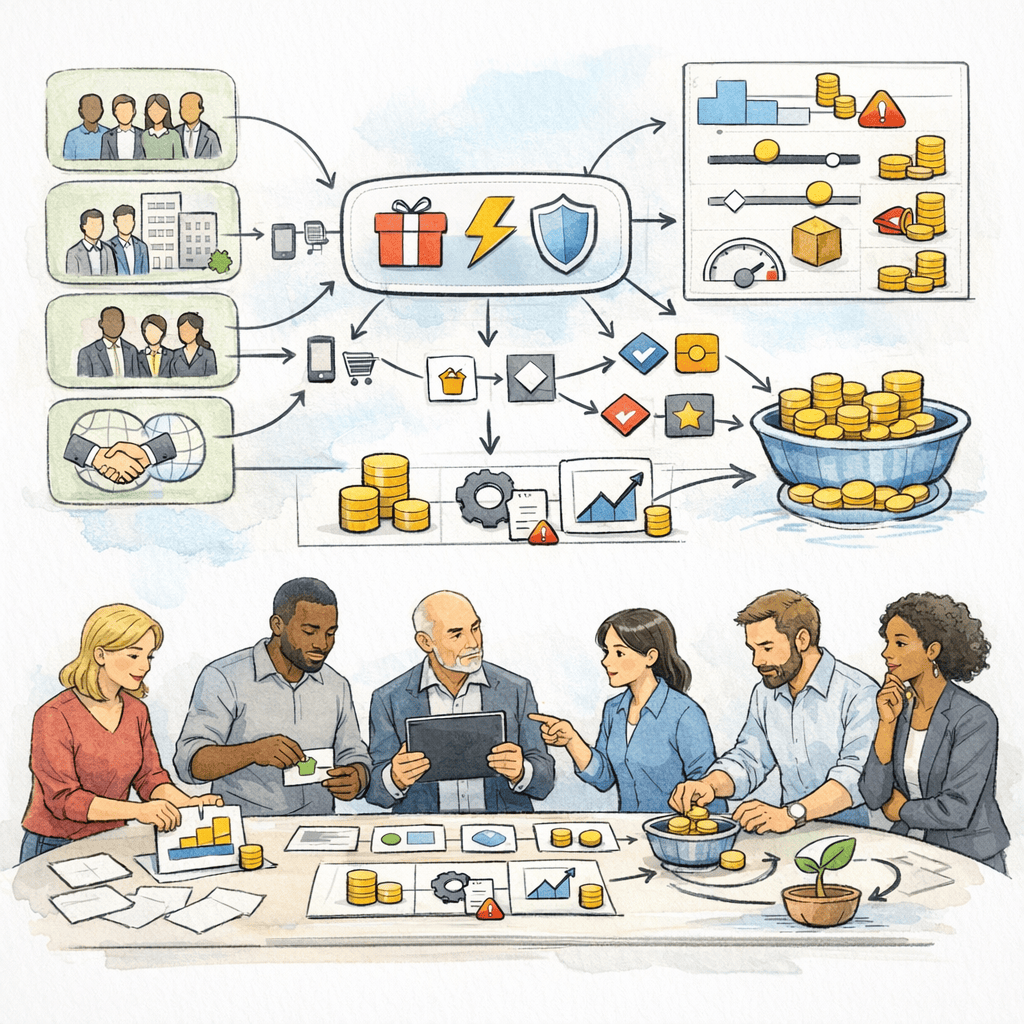
Revenue Model defines how an organisation converts customer value into income. This subsection clarifies core constructs and boundaries for consistent application.
It covers value monetisation, target segments, pricing and packaging, commercial channels, and revenue recognition. In scope are mechanisms that set price, terms, and billing. Out of scope are cost structures, P&L reporting, and sales playbooks, though these inform design.
Primary domains include monetisation strategy, pricing architecture, packaging, discount policy, contract terms, billing and collections, and performance analytics. They interact through shared data and governance across product, finance, legal, and IT, adapting to subscription, usage, marketplace, and one-off models.
A well-bounded Revenue Model links customer value to predictable cash flows and compliance. Clear interfaces across pricing, contracting, and systems reduce leakage and friction, enabling scale and faster change.
Why Revenue Model Matters
Revenue Model links strategy to cash. It defines how value is priced, packaged, transacted, and recognised enterprise-wide.
It enables strategic goals by aligning monetisation with growth targets, portfolio positioning, unit economics, and capital allocation.
It adapts to market and technology shifts—subscription, usage-based, marketplace, or AI-enabled offers—without destabilising operations or compliance.
It tackles inconsistent discounting, revenue leakage, weak forecasts, and fragmented tooling through shared data, governance, and clear process ownership.
- Executives: Transparent metrics (ARR, NRR, churn) inform investments and M&A timing.
- Managers: Guardrails and approvals cut discount variance and deal cycle time.
- Sales & Service Teams: Guided pricing and quote-to-cash automation free capacity for customers.
A disciplined Revenue Model improves decisions, speeds execution, and lowers risk. Managed as a capability, it compounds growth and resilience.
Business Case and Strategic Justification
Investing in the Revenue Model turns strategy into bankable outcomes. It establishes governance, data, and operating discipline to price, package, and recognise revenue consistently.
It aligns with growth, profitability, and customer strategies by linking value propositions to monetisation paths across products and services. It solves discount drift, revenue leakage, and slow approvals; enables new models (subscription, usage, marketplace); and maintains audit readiness without disrupting sales.
Return on investment comes from higher yield, lower leakage, and faster cash. Indicative outcomes include 2–5% uplift in price realisation, 10–20% shorter quote-to-cash, 20–40% fewer write-offs/credits, stronger ARR/NRR, and faster CAC payback—tracked via ASP, win rate, DSO, churn, and gross margin.
Typical benefits include:
- Revenue Lift: Improved price realisation and mix.
- Efficiency: Shorter deal cycles and fewer touches.
- Forecast Accuracy: Reliable ARR/NRR and pipeline signals.
- Risk & Compliance: Consistent terms and audit-ready recognition.
- Scalability: Reusable pricing, packaging, and policies across markets.
A funded Revenue Model delivers predictable, compliant growth and leaner operations. Next steps: baseline metrics, set targets, and sequence quick wins in quote-to-cash.
DON’T REINVENT THE WHEEL!
Get access to our Enterprise Standards to Drive Performance, Minimise Cost and Maximise Value.
How is Revenue Model Used?
Applying Revenue Model benefits from a simple, repeatable framework. It combines three perspectives—process stages, pitfalls to avoid, and exemplar practices—to translate strategy into compliant cash flow.
Process stages define the concept-to-cash lifecycle: market insight, pricing strategy, packaging, policy, quoting, contracting, billing, revenue recognition, analytics, and iteration. Each stage specifies owners, inputs, outputs, and controls to ensure consistency. The pitfalls perspective surfaces failure modes—discount sprawl, bespoke terms, metric misalignment, and tooling gaps—then links them to root causes and corrective actions. The exemplar practices perspective distils what outperformers do differently: value-based pricing, controlled discounting, experimentation, usage telemetry, and continuous improvement.
Key Phases and Process Steps explains the lifecycle and governance. Identifying Pitfalls and Challenges equips teams to spot and prevent waste. Learning from Outperformers provides actionable patterns. Together, these lenses align execution, reduce risk, and accelerate revenue realisation.
Key Phases and Process Steps
This ten-step approach turns strategy into predictable, compliant cash flow. It defines clear hand-offs, owners, and controls from idea to reporting.
1. Market Insight & Segmentation
Quantify demand, segment customers, prioritise addressable value.
2. Monetisation Strategy
Select model (subscription, usage, transactional) aligned to value.
3. Pricing Architecture
Define metrics, tiers, fences, and indexation rules.
4. Packaging & Bundling
Assemble offers, add-ons, and entitlements to optimise mix.
5. Policy & Discount Governance
Set guardrails, approvals, and floors to curb erosion.
6. Deal Design & Quoting (CPQ)
Configure offers and prices consistently with guided selling.
7. Contracting & Terms
Standardise clauses, obligations, and approvals to reduce friction.
8. Billing & Collections
Automate rating, invoicing, dunning, and cash application.
9. Revenue Recognition & Compliance
Apply standards, deferrals, and controls for audit readiness.
10. Performance Analytics & Optimisation
Track ARR/NRR, DSO, churn; test and iterate.
Sequenced and governed, these steps cut leakage, accelerate cycles, and improve predictability. Treat them as a loop—insights refresh pricing, policies, and systems for continuous improvement.
Identifying Pitfalls and Challenges: Antipatterns and Worst Practices
Avoiding pitfalls in the Revenue Model prevents leakage, delays, and compliance risk. The items below flag patterns that quietly erode value and momentum.
5 Antipattern Examples:
5 Worst Practice Examples:
Addressing these issues restores pricing power, speeds cycles, and reduces rework. Codify guardrails, simplify offers, and embed data and governance end-to-end.
Learning from Outperformers: Best Practices and Leading Practices
Outperformers treat monetisation as a managed capability. They combine data, governance, and iterative change to capture value predictably.
5 Best Practice Examples:
5 Leading Practice Examples:
Together, they lift yield, speed cycles, and reduce risk. Start with basics, then add advanced levers as data matures.
Who is Typically Involved with Revenue Model?
Clear role definition is vital to design, operate, and evolve the Revenue Model. It clarifies ownership, speeds decisions, and aligns commercial, financial, and technology outcomes.
Primary roles include:
- Executive Sponsor: Sets ambition, approves policies, arbitrates trade-offs across growth and risk.
- Monetisation Lead: Orchestrates design and change; aligns product, sales, finance, and legal.
- Pricing Architect: Builds pricing metrics, tiers, and guardrails; runs experiments and reviews.
- Revenue Operations Manager: Industrialises quote-to-cash; ensures data quality, SLAs, and hand-offs.
- Finance & Compliance Owner: Ensures recognition, controls, and audit readiness; tracks ARR/NRR and DSO.
Stakeholder impacts include:
- Executives: Portfolio and capital allocation improve via transparent yield, churn, and payback.
- Middle Management: Guardrails and playbooks reduce discount variance and cycle time.
- End Users (Sales/Service): Guided selling and automated billing remove admin and errors.
Clear ownership and collaboration turn pricing intent into predictable, compliant cash flows. With defined roles and forums, issues surface early, learnings compound, and scale becomes repeatable.
Where is Revenue Model Applied?
Revenue Model is applied wherever value is priced, transacted, and recognised. Its reach spans products, services, and data-driven offers, shaping how teams package, sell, deliver, and account for value.
Primary domains and functions:
- Product Management: Translates customer value into pricing metrics, tiers, and bundles.
- Commercial Operations: Enforces guardrails in CPQ, approvals, and discounting to protect yield.
- Finance & Accounting: Ensures recognition, forecasting, and controls for audit-ready revenue.
- Customer Success & Service: Links entitlements to adoption, expansion, and renewal playbooks.
- IT, Data, & RevOps: Integrates CRM, CPQ, billing, ERP, and telemetry to automate workflows.
Illustrative scenarios:
- SaaS Usage Shift: A platform moves from seat-based to metered pricing, lifting NRR and reducing churn.
- Servitised Manufacturing: An equipment maker adopts subscription and outcome SLAs, creating recurring revenue.
Because it touches design, delivery, and finance, Revenue Model fits start-ups and global enterprises alike. Executed well, it aligns incentives, tightens controls, and converts strategy into predictable cash flows.
When Should You Embrace a Revenue Model?
Timing is decisive for monetisation success. Adopt a Revenue Model when signals indicate scale, complexity, or change; ensure prerequisites are in place to avoid leakage, rework, and compliance risk.
- Scale-Up Inflection: Rapid growth overwhelms ad-hoc pricing; standardise to protect yield.
- Portfolio Shift: New offers or markets require coherent metrics, tiers, and terms.
- Business-Model Change: Moving to subscription/usage demands new controls and tooling.
- Margin Pressure: Erosion triggers guardrails, packaging simplification, and price realisation.
- Systems Transformation: CRM/CPQ/billing refresh is the moment to embed governance.
Prerequisites include:
- Executive Mandate: Sponsor, decision rights, and funding.
- Cross-Functional Team: Product, finance, sales, legal, RevOps.
- Baseline Data: Clean CRM, billing, and usage telemetry.
- Policy Framework: Discount floors, approvals, and standard terms.
- Systems Readiness: Integrated CRM/CPQ/billing/ERP.
These signals reduce implementation risk and raise impact. Acting at the right moment, with foundations ready, accelerates adoption, improves predictability, and converts strategy into durable, compliant cash flows.
Most Common Revenue Model Artefacts
The right artefacts turn monetisation intent into repeatable execution. They create shared language, enforce guardrails, and accelerate decisions across product, commercial, finance, and IT. The core set includes:
- Pricing Model & Rate Card: Defines metrics, tiers, fences, indexation, and approved price points by segment.
- Packaging & Entitlement Catalogue: Lists offers, bundles, add-ons, feature rights, and usage limits with clear rules.
- Discount & Approvals Matrix: Sets floors, step-up approvals, and exception pathways to control margin erosion.
- Contract Terms Library & Clause Playbook: Standardises positions on SLAs, renewals, uplifts, and liabilities to reduce cycle time.
- Quote-to-Cash Configuration (CPQ/Billing): Encodes rules in systems; ensures consistent quoting, rating, invoicing, and data capture.
Together these artefacts deliver clarity, speed, and control from design to recognition. They reduce leakage, strengthen compliance, and enable clean metrics for ARR, NRR, churn, and DSO. Maintained as living assets, they provide a stable baseline for experimentation and rapid iteration as markets and offerings evolve.
The Artefacts Table
| Artefact | Description | Practical use |
|---|---|---|
| Pricing Model & Rate Card | A structured set of pricing metrics, tiers, fences, indexation rules, and approved price points by segment. | Guides CPQ and negotiations, supports scenario pricing and quarterly reviews, and underpins price realisation tracking. |
| Packaging & Entitlement Catalogue | A definitive list of products, bundles, add-ons, feature rights, and usage limits with eligibility rules. | Assembles offers consistently, aligns billing and support on what customers receive, and simplifies migrations and renewals. |
| Discount & Approvals Matrix | A policy map of discount floors, approval tiers, exception paths, and rationale capture requirements. | Reduces margin erosion, speeds approvals, and creates audit trails for deals that deviate from standard. |
| Contract Terms Library & Clause Playbook | Standard templates and fallback clauses covering SLAs, renewals, uplifts, liabilities, and data terms. | Shortens legal review, enforces consistent positions across regions, and lowers contractual risk. |
| Quote-to-Cash Configuration (CPQ/Billing) | Encoded rules in CRM/CPQ/billing that enforce pricing, packaging, rating, invoicing, and data capture. | Automates quoting and billing, prevents errors and leakage, and produces clean data for recognition and analytics. |