
Enterprise Management
Process Flow
Reference Content ID: #LEAD-ES20006PF
Introduction to Process Flow
Process Flow maps how work moves from demand to delivery. It aligns people, data, and systems to remove friction. It rests on clarity of purpose, standardised handoffs, visible accountability, risk-aware controls, and continuous improvement driven by measurement and feedback. Core components span inputs and triggers, activities and roles, decision points, artefacts and controls, enabling platforms, and outcome-based metrics.
Across finance, HR, IT, operations, and customer service, it scales from local tasks to enterprise value streams in regulated and agile settings. Structured flow lifts productivity, cuts rework, and shortens cycle time. Shared visibility and workload design enhance collaboration and well-being, while automation and orchestration enable digital workflows for on-site, hybrid, and remote teams.
Definition and Scope
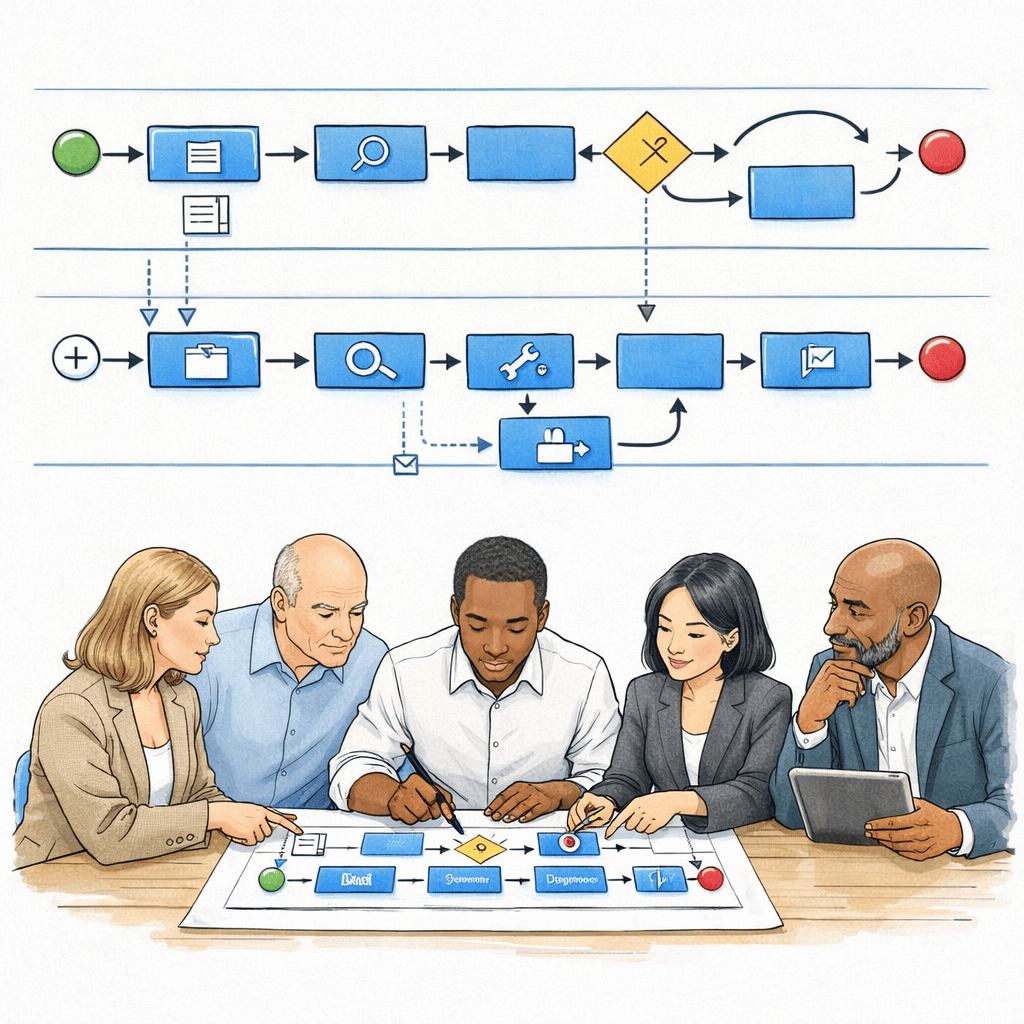
Process Flow maps how work moves from demand to delivery. It aligns people, data, and systems to remove friction. It rests on clarity of purpose, standardised handoffs, visible accountability, risk-aware controls, and continuous improvement driven by measurement and feedback.
Core components span inputs and triggers, activities and roles, decision points, artefacts and controls, enabling platforms, and outcome-based metrics.Across finance, HR, IT, operations, and customer service, it scales from local tasks to enterprise value streams in regulated and agile settings.
Structured flow lifts productivity, cuts rework, and shortens cycle time. Shared visibility and workload design enhance collaboration and well-being, while automation and orchestration enable digital workflows for on-site, hybrid, and remote teams.
Why Process Flow Matters
Process Flow translates strategy into executable, repeatable work. It provides the operating rhythm that links customer demand with compliant, measurable outcomes. It aligns investments, policies, and controls with daily execution. Clear sequences, SLAs, and metrics drive accountability, predictability, and value realisation.
As markets and technologies shift, codified flows let organisations pivot without chaos. Automation and data capture compress cycle times and surface insights for faster decisions. Process Flow tackles fragmentation, rework, and opaque ownership by clarifying roles and handoffs. Executives, managers, and end users each gain visibility, control, and a better work experience.
- Executive Steering: Portfolio dashboards tie outcomes to spend and risk tolerance.
- Manager Efficiency: Standard work and WIP limits improve throughput and capacity planning.
- User Experience: Guided workflows reduce errors, cognitive load, and handover friction.
Process Flow is essential to turning intent into outcome at scale. It sustains performance while enabling rapid adaptation across functions, channels, and customer journeys.
Business Case and Strategic Justification
Investing in Process Flow creates a scalable operating system for execution. It links strategy, risk appetite, and customer promise to day-to-day work. It is critical because it aligns objectives (growth, cost, quality, compliance) with transparent sequences, ownership, and controls. Process Flow addresses fragmentation, rework, and slow time-to-market while creating a foundation for cross-functional change and platform modernisation.
The business case centres on measurable ROI: fewer handoffs, less rework, and higher first-time-right reduce cost-to-serve; standard work enables automation and redeploys capacity to value tasks. Typical outcomes include 20–40% cycle-time reduction, 15–30% productivity uplift, lower incident rates, and improved NPS/CSAT.
Typical benefits include:
- Throughput Acceleration: Shorter lead times and faster releases.
- Cost Efficiency: Reduced rework, waste, and cost-to-serve.
- Risk Control: Embedded controls improve auditability and resilience.
- Experience Uplift: Smoother journeys for customers and employees.
- Data Advantage: Better metrics fuel decisions and innovation.
A structured Process Flow is a strategic lever, not an admin task. It justifies investment by delivering durable performance gains and creating the conditions for automation, AI, and continuous improvement.
DON’T REINVENT THE WHEEL!
Get access to our Enterprise Standards to Drive Performance, Minimise Cost and Maximise Value.
How is Process Flow Used?
Process Flow is applied through a pragmatic framework that balances structure with learning. Three complementary perspectives—stages, pitfalls, and exemplar practices—guide design, operation, and continual improvement.
Process stages define how work is discovered, designed, implemented, operated, and improved, specifying outcomes, roles, controls, platforms, and metrics. Pitfalls highlight failure modes such as fragmented ownership, unmanaged variance, manual handoffs, and tool-first automation, with guardrails to prevent rework and risk. Exemplar practices translate what top performers do—value-stream thinking, standard work, WIP limits, automation and orchestration, visual management, and outcome metrics—into actionable patterns.
Key Phases and Process Steps sets the lifecycle, deliverables, and accountabilities. Identifying Pitfalls and Challenges exposes anti-patterns with diagnostics and mitigations. Learning from Outperformers distils proven tactics and measurable results. Together, these lenses align intent, execution, and learning, enabling reliable performance at scale.
Key Phases and Process Steps
This ten-step approach structures work from demand to value. Each phase has a clear objective, handoffs, and metrics to ensure continuity and control.
1. Demand Intake
Capture requests, classify, and route to owners.
2. Triage & Prioritisation
Assess value, risk, capacity; select.
3. Discovery & Mapping
Document current state, pain points, data.
4. Requirements & Controls
Define outcomes, policies, SLAs, risks.
5. Design & Standard Work
Create target flow, roles, artefacts.
6. Enablement & Integration
Configure workflow, APIs, data, permissions.
7. Pilot & Validation
Test with users; measure readiness gaps.
8. Rollout & Change
Deploy at scale; train, communicate, transition.
9. Operate & Monitor
Run the process; track KPIs and compliance.
10. Improve & Scale
Remove waste; automate, replicate, and govern.
The sequence reduces rework and anchoring bias by enforcing evidence-led decisions at each gate. It creates a repeatable path to stable operations and continuous improvement.
Identifying Pitfalls and Challenges: Antipatterns and Worst Practices
Even well-intended initiatives stall when poor patterns take hold. Recognising and eliminating them protects value, speed, and compliance.
5 Antipattern Examples:
5 Worst Practice Examples:
Avoiding these traps keeps flows lean, observable, and adaptable. Strengthening governance, standard work, and incremental delivery restores throughput, quality, and confidence.
Learning from Outperformers: Best Practices and Leading Practices
Outperformers treat Process Flow as a management system and learning engine. They combine disciplined fundamentals with modern, data-driven enablement.
5 Best Practice Examples:
5 Leading Practice Examples:
Together, these practices lift throughput, quality, and experience while reducing risk and cost. They establish a robust platform for continuous improvement and automation.
Who is Typically Involved with Process Flow?
Clear roles turn Process Flow from diagrams into dependable execution. Mapping responsibilities reduces handoff risk, accelerates decisions, and embeds accountability across business, risk, and technology.
Primary roles:
- Executive Sponsor: Sets intent, funding, and risk appetite; unblocks and aligns leaders.
- Process Owner: Owns outcomes and controls; defines policies, SLAs, KPIs, and changes.
- Process Architect/Lead: Designs flow, roles, artefacts; facilitates alignment across business and technology.
- Operations Manager: Runs daily execution; manages capacity, WIP, incidents; drives improvements.
- Platform & Data Engineer: Builds workflow, integrations, and data; assures reliability and observability.
- Executives: Gain outcome visibility and risk control; prioritise investments by value signals.
- Middle Management: Plan capacity and demand; coach standard work; benefit from clearer SLAs.
- Technical Teams & End Users: Use guided workflows; see fewer manual steps; supply telemetry for improvement.
Defined ownership and shared metrics prevent ambiguity and delays. Disciplined collaboration makes Process Flow self-improving—raising throughput, quality, and experience enterprise-wide.
Where is Process Flow Applied?
Process Flow is applied across core functions, programmes, and shared services. It translates policy into execution with consistent handoffs, controls, and metrics that improve speed and quality.
Primary domains:
- Finance: Order-to-cash, procure-to-pay, record-to-report with embedded controls and SLA-driven handoffs.
- IT & Digital: Demand intake, change, release, incident/problem; orchestrates DevOps, ITSM, and security controls.
- Operations & Supply Chain: Plan-make-deliver cycles, standard work, quality gates, and partner integrations.
- Customer Service & Sales: Case management, entitlement, guided resolution, and lead-to-close orchestration.
- HR & Workforce: Hire-to-retire, onboarding, mobility, and compliance with auditable approvals.
Illustrative scenarios:
- Global Product Launch: Synchronises content, pricing, channel enablement, and supply readiness to hit market dates.
- Cyber Incident to Recovery: Coordinates detection, containment, stakeholder communications, root cause, and controlled change.
These applications show Process Flow’s versatility from back office to growth engines. A shared model reduces risk while enabling automation, analytics, and continuous improvement across contexts.
When Should You Embrace Process Flow?
Choosing the right moment to adopt Process Flow multiplies impact and reduces change risk. Timing should reflect strategic shifts and operational readiness, while prerequisites ensure speed and durability.
Key scenarios for adoption:
- Rapid Growth: Scaling demand overwhelms existing ways of working.
- Market Disruption: New competitors, regulation, or channels require faster response.
- Quality & Rework Pain: Escalating defects, backlogs, and customer complaints.
- Technology Refresh: ERP/cloud/platform rollouts need standardised flows to succeed.
- M&A or Model Change: Integrations or restructures demand harmonised processes and controls.
Essential prerequisites:
- Executive Sponsorship: Clear intent, funding, and decision rights.
- Process Ownership: Named owners, roles, and governance cadence.
- Baseline Metrics: Current SLAs, volume, quality, and risk data.
- Capacity & Skills: Time, change management, and automation capability.
- Platform Readiness: Workflow, integration, and data foundations.
These signals help prioritise where Process Flow delivers immediate value. Enter with sponsorship, metrics, and platform readiness to accelerate adoption and sustain results. Start small, prove outcomes, then scale.
Most Common Process Flow Artefacts
Disciplined artefacts translate Process Flow from intent to reliable execution. They create shared understanding, enable automation, and provide the evidence base for governance and improvement.
The most common artefacts are:
- Process Map / Value Stream: Visualises end-to-end steps, handoffs, decisions, and pain points to align stakeholders.
- Ownership Model (RACI): Clarifies accountability and collaboration across roles, avoiding shadow ownership and delays.
- Standard Work Package (SOPs and templates): Defines task-level steps, inputs/outputs, and acceptance criteria for consistency and training.
- Risk & Control Matrix: Links risks to preventive/detective controls, embedding compliance into the flow and audits.
- KPI/SLA Dashboard: Tracks throughput, cycle time, quality, and backlog with alerts to trigger action and learning.
Together these artefacts provide a single source of truth for design, operation, and change. They support onboarding, automation, and scaling while maintaining compliance. Maintained as living documents, they keep Process Flow observable, adaptable, and tied to measurable outcomes.
The Artefacts Table
The table below summarises the core artefacts that translate Process Flow from intent into reliable execution. Each entry states its purpose and how it is applied in real scenarios. Use it as a quick reference during design, rollout, and ongoing operations.
| Artefact | Description | Practical use |
|---|---|---|
| Process Map | A visual model of end‑to‑end steps, handoffs, decisions, and value‑stream flow. | Used in workshops to align stakeholders, expose bottlenecks, and scope automation and controls. |
| RACI Ownership Model | A responsibility matrix clarifying who is responsible, accountable, consulted, and informed. | Removes ambiguity at handoffs, speeds approvals, and anchors governance and escalation paths. |
| Standard Work Package | A set of SOPs and templates defining task steps, inputs/outputs, and acceptance criteria. | Enables consistent execution, onboarding, and quality checks across teams and locations. |
| Risk & Control Matrix | A linkage of process risks to preventive and detective controls with evidence requirements. | Builds compliance into workflows, supports audits, and prioritises remediation and resilience. |
| KPI/SLA Dashboard | A performance view of throughput, cycle time, backlog, quality, and service levels. | Drives daily management, triggers interventions, and informs continuous improvement and investment cases. |
Together these artefacts create a single source of truth for design, execution, and governance. They improve alignment, traceability, and auditability while enabling automation and data‑driven decisions. Maintained as living assets, they keep Process Flow observable, adaptable, and tied to measurable outcomes.