
Enterprise Modelling
Performance Model
Reference Content ID: #LEAD-ES20011BCPG
Introduction to Performance Model
Performance Model links strategy, processes, people, and technology to measurable outcomes. It sets a common language for goals and value across customer, operations, finance, people, and technology domains.
Core principles: outcome orientation, evidence-based decisions, end-to-end accountability, and continuous improvement. It embeds risk, compliance, and ethics to sustain performance.
Components cover objectives and KPIs, process and role clarity, data and analytics, incentives, skills, enabling tooling and automation.
It raises productivity with standardised workflows, strengthens collaboration with shared metrics, supports well-being through realistic capacity planning, and enables digital workflows—on-site, hybrid, remote—across industries and functions.
Applied at enterprise, function, programme, or team level, the model adapts to context while keeping measures consistent. Used well, it turns strategy into repeatable results and transparent accountability.
Definition and Scope
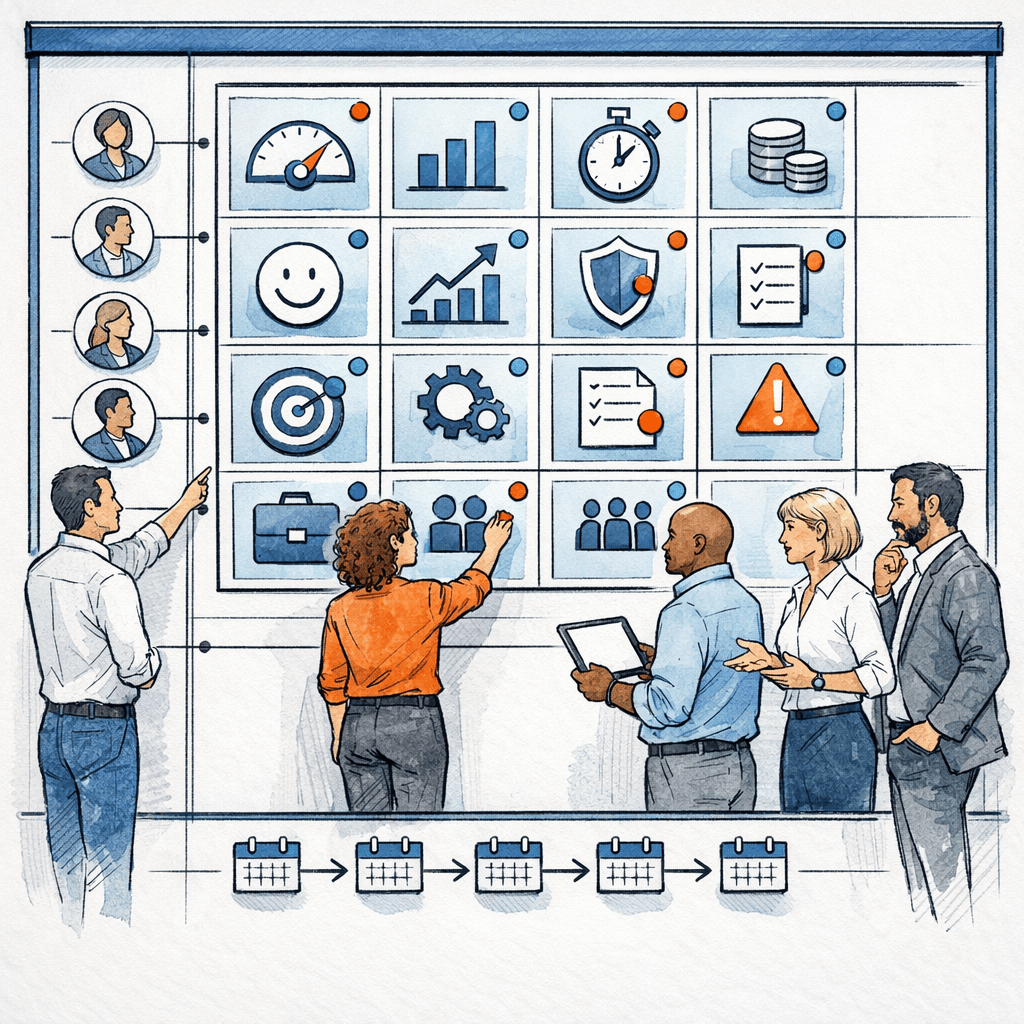
Performance Model translates strategy into observable, measurable outcomes. It defines success, how it is tracked, and who is accountable across the enterprise.
Scope covers alignment from policy to execution, target setting, metric design, monitoring, and continuous improvement. It connects objectives, processes, roles, data, and technology with explicit guardrails. Outside scope: detailed accounting, HR policy authorship, and tool-specific configuration.
Domains comprise outcomes and KPIs; operating processes and roles; data and analytics; incentives and capability; platforms, automation, and controls. They interact in a closed loop: set targets, execute, capture data, analyse variance, act. The model fits portfolios, programmes, products, and service operations.
It governs end-to-end performance without replacing specialist disciplines. Applied consistently, it aligns stakeholders and drives accountable, faster improvement.
Why Performance Model Matters
Performance Model matters because it turns strategy into measurable results and orchestrates execution. It establishes a backbone for decisions, investment, and improvement.
It cascades objectives to portfolios, products, and operations, aligning funding, capacity, and accountabilities to outcomes with transparent KPIs and governance.
By instrumenting processes and digital work, it exposes real-time performance, enabling rapid prioritisation, experimentation, and scaling as markets, regulations, or technologies change.
It reduces siloed metrics, unclear ownership, and initiative sprawl through standardised measures, closed-loop reviews, and explicit decision rights.
- Executive Clarity: Comparable outcome dashboards focus capital, shape bets, and retire underperforming work.
- Team Efficiency: Shared measures and automation cut handoffs, rework, and wait time across locations.
- Innovation Cadence: Hypothesis-led metrics accelerate pilots, proving value before scaling investment.
Stakeholders gain a common language for value and speed of execution. Used consistently, Performance Model strengthens resilience, accountability, and portfolio returns.
Business Case and Strategic Justification
A well-structured Performance Model provides a disciplined path from strategy to results. It underpins governance, investment choices, and continuous improvement.
Strategically, it aligns corporate objectives with portfolios, products, and operations, clarifying ownership and decision rights. It addresses fragmented metrics, initiative sprawl, and slow course correction, while enabling regulatory compliance and risk-aware growth.
The investment case combines productivity gains, reduced rework, cycle-time compression, and improved asset utilisation. Typical ROI evidence includes cost-to-serve reduction, on-time delivery uplift, and revenue acceleration from faster experimentation; tracked via OKRs, leading indicators, and unit economics.
Typical benefits include:
- Outcome Alignment: Portfolio funding targets measurable customer, financial, and risk outcomes.
- Throughput Efficiency: Standardised workflows and automation cut handoffs and wait time.
- Decision Velocity: Real-time dashboards and variance reviews accelerate prioritisation.
- Quality & Compliance: Embedded controls reduce defects and audit findings.
- Talent Engagement: Clear goals and capacity planning improve well-being and retention.
By linking strategy, operations, and data in one model, the organisation gains transparency and control. Adopt a staged rollout with baselines, quarterly targets, and governance to secure benefits and sustain value.
DON’T REINVENT THE WHEEL!
Get access to our Enterprise Standards to Drive Performance, Minimise Cost and Maximise Value.
How is Performance Model Used?
Performance Model is applied through a practical, repeatable framework that links intent to impact. It provides common lenses to diagnose, design, and improve performance across functions and work modes.
Three perspectives guide use:
- Process stages define the end-to-end steps from setting outcomes to learning.
- Pitfalls reveal failure modes to be mitigated early.
- Exemplar practices show patterns that consistently deliver value.
Upcoming subsections deepen each lens:
- Key Phases and Process Steps describes the lifecycle, artefacts, and decision points.
- Identifying Pitfalls and Challenges surfaces antipatterns, constraints, and risk controls.
- Learning from Outperformers distils leading practices, templates, and capability enablers for rapid adoption.
Viewed as a system, these perspectives create a closed feedback loop: plan, execute, measure, adapt. Applying them consistently accelerates benefits realisation, reduces waste, and raises accountability.
Key Phases and Process Steps
Performance Model follows a disciplined, end-to-end sequence from intent to impact. The ten phases below provide a repeatable path to design, execute, and optimise performance.
1. Strategic Intent & Outcomes
Translate vision into measurable outcome themes.
2. Value Hypotheses & Metrics
Define KPIs, leading indicators, guardrails.
3. Portfolio Prioritisation & Funding
Allocate capacity to highest-value bets.
4. Process & Role Design
Clarify workflows, handoffs, ownership, decision rights.
5. Data & Instrumentation
Specify events, baselines, sources, telemetry.
6. Target Setting
Establish baselines, stretch goals, thresholds, tolerances.
7. Enablement & Execution
Equip teams with tooling, skills, automation.
8. Monitoring & Variance Analysis
Visualise performance; detect signal vs. noise.
9. Improvement & Scaling
Run experiments; fix constraints; scale proven patterns.
10. Governance & Learning
Review quarterly; codify lessons; update standards.
This flow creates a closed loop that links planning, doing, and learning. Applied consistently, it accelerates benefits, reduces waste, and strengthens accountability.
Identifying Pitfalls and Challenges: Antipatterns and Worst Practices
Performance Model falters when organisations chase metrics without meaning, misalign incentives, or treat it as a tooling project. The patterns below signal risk and erode value.
5 Antipattern Examples:
5 Worst Practice Examples:
Avoiding these traps keeps attention on outcomes, learning, and accountability. Start small, test value, and scale with clear ownership and simple, decision-ready measures.
Learning from Outperformers: Best Practices and Leading Practices
Outperformers treat the Performance Model as a management system, not a dashboard. They combine disciplined measurement with adaptive governance and capability building.
5 Best Practice Examples:
5 Leading Practice Examples:
Together these practices sharpen decisions, accelerate learning, and reduce waste. Sequenced adoption compounds benefits and sustains performance.
Who is Typically Involved with Performance Model?
Clear roles make Performance Model actionable and credible. Understanding who plans, executes, and governs the model prevents gaps in ownership and accelerates decisions.
Roles include:
- Executive Sponsor: Sets direction, secures funding, removes barriers, and chairs governance.
- Performance Lead: Designs the model, owns the metrics taxonomy, and orchestrates alignment and rollout.
- Process Owner: Holds end-to-end accountability, defines standards, and resolves cross-team issues.
- Data & Analytics Manager: Ensures data quality, instrumentation, dashboards, and insight generation.
- Change & Enablement Lead: Drives training, communications, adoption tracking, and feedback loops.
Stakeholder influence and benefits:
- Executives: Prioritise investments via outcome dashboards and rebalance portfolios confidently.
- Middle Management: Run variance reviews to allocate capacity and address constraints quickly.
- Technical Teams & End Users: Gain clear definitions, reduced rework, and automation; supply telemetry and improvement ideas.
Defined responsibilities, decision rights, and review cadences create transparency and speed. With aligned stakeholders, the organisation moves from reporting to improvement, turning strategy into measurable results.
Where is Performance Model Applied?
Performance Model applies wherever outcomes must be defined, measured, and improved. It provides a consistent management system connecting objectives, work, and data across functions and delivery models. Its versatility supports regulated and high-growth contexts alike.
- Operations: Optimises end-to-end flow, cycle time, capacity, and quality across value streams.
- Customer Service: Lifts service levels, first-contact resolution, and experience metrics across channels.
- IT & Digital: Improves reliability, delivery throughput, platform cost, and automation efficacy.
- Finance: Sharpens cost-to-serve, unit economics, portfolio ROI, and risk guardrails.
- HR & Talent: Builds capability pipelines, tracks engagement, and balances productivity with well-being.
- Hybrid Contact Centre: Define SLAs, baseline response/handling, deploy dashboards and playbooks to cut abandonment and raise CSAT.
- Agile Delivery Portfolio: Use hypothesis metrics, WIP limits, and telemetry to accelerate cadence and reduce defects.
By standardising goals, metrics, and review rhythms, the model aligns diverse teams while respecting local context. It enables targeted interventions that scale. The same framework fits projects, products, and shared services.
When Should You Embrace Performance Model?
Choosing the right moment to adopt a Performance Model maximises return and reduces change friction. Use the signals below to decide when to act, and the prerequisites to ensure readiness.
Signals list:
- Rapid Scaling: New markets or teams need consistent outcomes, ownership, and decision rights.
- Market/Regulatory Shift: Changing rules or rivals demand faster learning and course correction.
- Digital Transformation: Platform refresh enables instrumentation, automation, and standardised workflows.
- Performance Volatility: Missed targets or variation require baselines, controls, and focused fixes.
- Portfolio Congestion: Too many initiatives require evidence-based prioritisation and funding shifts.
Prerequisites list:
- Executive Sponsorship: Clear mandate, budget, and barrier removal.
- Aligned Outcomes: Agreed KPIs, definitions, and guardrails across functions.
- Data Readiness: Trusted sources, telemetry plan, and privacy controls.
- Governance & Ownership: Review cadences, decision forums, and single-point accountability.
- Capacity & Enablement: Time, skills, training, and communications for adoption.
Act when urgency and sponsorship coincide, with a minimal viable data and governance backbone. Start with targeted pilots, prove value quickly, and scale deliberately.
Most Common Performance Model Artefacts
Effective Performance Model practice relies on a small set of artefacts that convert intent into measurable outcomes. These tools standardise definitions, enable transparent reviews, and speed corrective action across teams and work modes.
Core artefacts used in Performance Model:
- Outcome Map & Strategy Cascade: Visualises value themes, objectives, and ownership from enterprise to team level.
- KPI Taxonomy & Metric Dictionary: Defines each measure, formula, source, thresholds, and guardrails for consistent reporting.
- Data Instrumentation Plan & Telemetry Schema: Specifies events, fields, baselines, and integrations to capture reliable, privacy-safe data.
- Performance Dashboard & Scorecard: Presents leading/lagging indicators, variance, and trends tailored to executive and operational audiences.
- Variance Review Pack & Action Log: Structures root-cause analysis, decisions, owners, due dates, and follow-up status.
Together these artefacts create a closed loop—plan, measure, learn, act. Using standardised templates improves comparability, accelerates onboarding, and strengthens governance. Maintained regularly, they ensure decisions are evidence-based and improvements are repeatable.
The Artefacts Table
This page summarises the essential artefacts that make a Performance Model operational. Each entry offers a short definition and a real-world application so teams can select, implement, and govern the right tools for their context. Use it as a quick reference during design and performance reviews.
| Artefact | Description | Practical use |
|---|---|---|
| Outcome Map | A structured cascade linking enterprise goals to team-level objectives and owners. | Aligns strategy with OKRs across functions so funding and capacity follow measurable outcomes. |
| KPI Dictionary | A canonical list of metrics with definitions, formulas, data sources, thresholds, and guardrails. | Standardises reporting across departments, enabling comparable dashboards and audit-ready metrics. |
| Telemetry Plan | A schema and implementation plan for events, fields, and integrations to capture reliable data. | Instruments CRM, ERP, and digital apps to establish baselines and feed real-time performance views. |
| Performance Dashboard | A role-tailored view of leading and lagging indicators, variance, and trends. | Supports executive and operational reviews, triggering interventions when thresholds are breached. |
| Variance Review Pack | A structured template for root-cause analysis, decisions, owners, due dates, and follow-up. | Drives weekly action tracking after KPI breaches to remove constraints and verify improvements. |