
Enterprise Modelling
Measurement
Reference Content ID: #LEAD-ES20016PG
Introduction to Measurement
Measurement provides the fact base that turns strategy into execution. It defines what good looks like, tracks progress, and informs enterprise decisions.
Its principles are relevance, reliability, repeatability: choose goal-aligned metrics, collect trustworthy data, and apply consistent methods. Governance and transparency safeguard integrity.
Core components: metric definitions; trusted data sources; baselines and targets; dashboards and alerts; review cadences. Together they link outcomes to activities and spend.
Across functions—operations, finance, HR, IT—measurement improves productivity, clarifies accountability, and enables digital workflows. Shared KPIs and feedback loops help on-site, hybrid, and remote teams coordinate work, protect well-being, and collaborate.
Done well, measurement creates a single source of truth that speeds learning and course correction. It makes performance visible, comparable, and actionable for stakeholders.
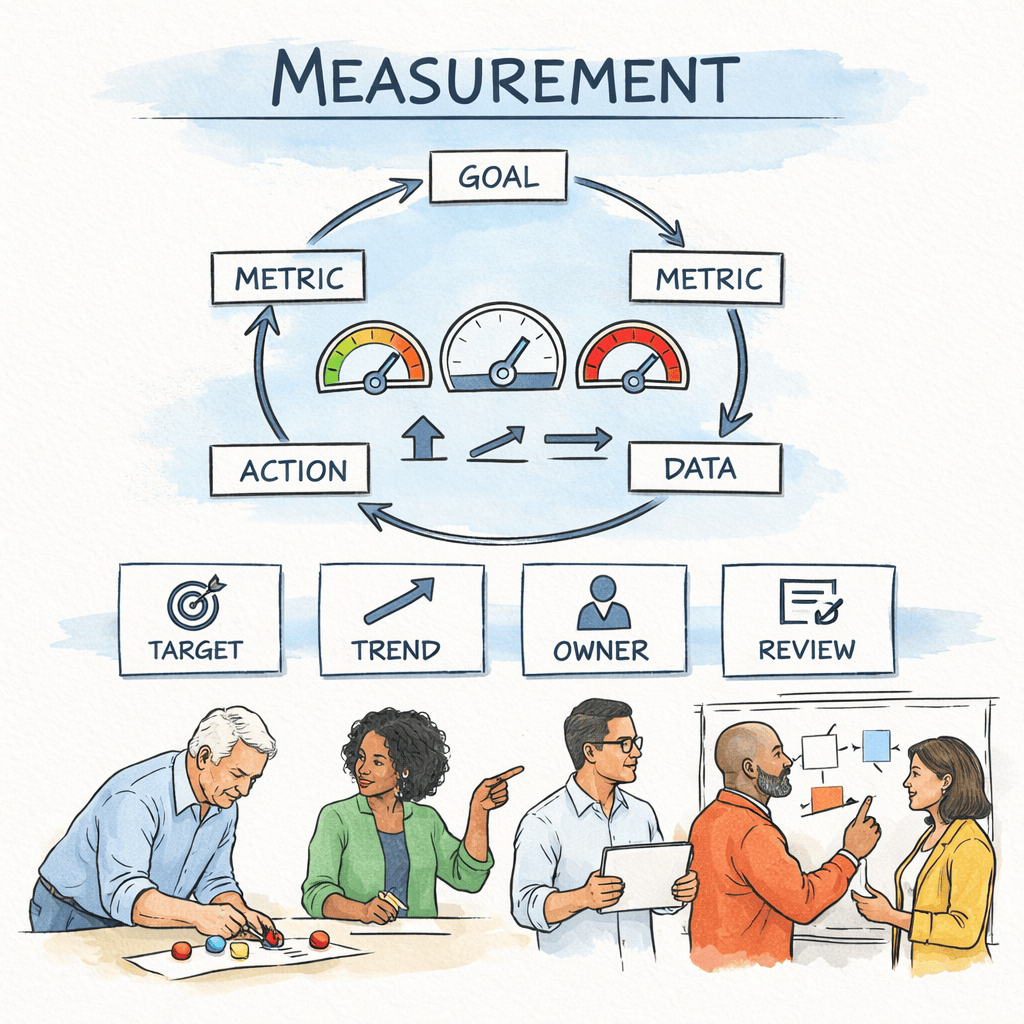
Definition and Scope
This subsection defines Measurement and its boundaries. It offers a shared language for designing metrics and using them responsibly.
Measurement is the disciplined specification, collection, and use of quantitative and qualitative indicators to steer performance and risk. In scope are outcomes, efficiency, compliance, and sustainability, captured through clear definitions, baselines, and targets. Out of scope are ungoverned tracking, individual surveillance, and vanity metrics untethered to objectives.
Primary domains: metric taxonomy, data acquisition, data quality, analytics, and governance. They connect via pipelines, data stores, dashboards, and decision cadences. Digital contexts rely on instrumentation; manual settings use sampling and audits.
The scope is purpose-led and evidence-based, not measurement for its own sake. When these domains work as a system, organizations gain timely, ethical, and actionable insight.
Why Measurement Matters
Measurement matters because it converts ambition into evidence and orchestrates improvement. It ensures strategy is executed, value is protected, and risk is managed.
It translates objectives into targets, links spend to outcomes, and prioritises initiatives by impact versus effort. Clear KPIs enable resource allocation and benefits tracking.
In volatile markets and rapid technology cycles, measurement provides early signals on adoption, performance, and resilience. Teams test, learn, and scale based on objective feedback.
It reduces ambiguity, breaks functional silos, and creates accountability. Shared metrics align cross-functional teams and shorten decision cycles.
- Executives: Portfolio choices guided by ROI, risk, and capacity constraints.
- Managers: Throughput, quality, and cycle-time metrics expose bottlenecks and direct daily improvement.
- End Users: Experience and well-being measures surface friction and inform design changes that stick.
Measurement is a leadership system, not a reporting chore. When embedded into rhythms and tools, it accelerates decisions, de-risks change, and sustains innovation.
Business Case and Strategic Justification
A disciplined measurement capability underpins strategy execution and value creation. This case explains why to invest and expected returns.
Measurement aligns corporate objectives with operational reality—translating goals into KPIs, exposing trade-offs, and de-risking change. It addresses opacity, siloed decisions, compliance duties, and rapid technology shifts through timely, comparable evidence.
ROI comes from fewer failed initiatives, shorter cycle times, and better customer/employee outcomes.
- Costs: tooling, data pipelines, and governance.
- Benefits: efficiency, quality, revenue, and risk reduction, proven via baseline-to-target deltas and payback within planning cycles.
The most typical benefits are:
- Strategic Alignment: KPIs tie initiatives to goals.
- Cost Efficiency: Surface waste; optimise spend and capacity.
- Revenue Growth: Monitor funnel and usage to scale.
- Risk Control: Early warnings on compliance and resilience.
- Experience Uplift: Reduce friction across customer and employee journeys.
Investment pays when metrics are governed and drive decisions. Next: define scope, owners, and a benefits ledger tied to portfolio governance.
DON’T REINVENT THE WHEEL!
Get access to our Enterprise Standards to Drive Performance, Minimise Cost and Maximise Value.
How is Measurement Used?
This overview explains how Measurement is applied to steer performance and change. It offers a pragmatic lens for designing, operating, and improving a measurement system.
The framework combines three perspectives:
- Key Phases and Process Steps set the lifecycle—from scoping metrics and instrumenting data to reporting, review, and course correction.
- Identifying Pitfalls and Challenges surfaces failure modes—weak definitions, poor data quality, misaligned incentives—and practical mitigations.
- Learning from Outperformers distils practices such as customer-centric KPIs, automated data pipelines, and governance rhythms.
Together these perspectives translate strategy into measurable results while reducing risk. They guide teams to select the right metrics, trust the data, and embed decisions in daily workflows. Treat them as a checklist and playbook for consistent, value-focused implementation.
Key Phases and Process Steps
This ten-step approach shows how to design, operate, and evolve Measurement end to end. Each phase has a distinct objective and clear hand-offs to the next.
1. Strategy Alignment
Translate enterprise goals into measurable outcomes and priorities.
2. Stakeholder Governance
Assign owners, roles, and decision rights for metrics and data.
3. Metric Design
Define taxonomy, formulas, scopes, and leading/lagging indicators.
4. Source Mapping
Identify systems, logs, and surveys; confirm accessibility and constraints.
5. Instrumentation
Configure events, fields, and integrations to capture required signals.
6. Data Quality
Validate completeness, accuracy, timeliness, and lineage with controls.
7. Baselines & Targets
Establish current performance and set time-bound, realistic goals.
8. Insights & Reporting
Build dashboards, alerts, and narratives tailored to audiences.
9. Review Cadence
Run operational and strategic reviews; trigger decisions and actions.
10. Continuous Improvement
Retire weak metrics, add new ones, and automate.
Follow the sequence to maintain traceability from objectives to actions and results. Iteration keeps the system relevant as priorities and technologies change. The outcome is a reliable, decision-ready capability that sustains performance.
Identifying Pitfalls and Challenges: Antipatterns and Worst Practices
Avoiding common traps protects integrity and value. The patterns below flag where measurement derails execution, trust, and adoption.
5 Antipattern Examples:
5 Worst Practice Examples:
Prevent these by aligning to goals, governing definitions, and instrumenting quality data. Pair concise dashboards with review cadences and ethics-by-design.
Learning from Outperformers: Best Practices and Leading Practices
Outperformers treat measurement as an operating system for decisions. They standardise essentials and push the frontier where it matters.
5 Best Practice Examples:
5 Leading Practice Examples:
These practices raise trust, speed, and impact. Start by standardising and governing core metrics; then automate, productise, and embed ethics to scale value.
Who is Typically Involved with Measurement?
Understanding who does what is critical to trustworthy, decision-ready measurement. Clear ownership accelerates delivery, reduces rework, and safeguards ethics and compliance.
The core roles typically involved are:
- Executive Sponsor: Sets ambition, funds capability, clears roadblocks; aligns measurement to strategy and risk.
- Measurement Lead (PMO): Orchestrates roadmap, governance, and RACI; ensures definitions, cadence, and benefits tracking.
- Data & Analytics Lead: Owns models, quality, and lineage; translates questions into metrics and insights.
- Platform & Integration Owner: Delivers instrumentation, pipelines, and dashboards; ensures scalability, security, and interoperability.
- Domain/Process Owner: Provides context, accepts targets, and acts on insights; embeds metrics into workflows.
Stakeholder influence and benefits include:
- Executives: Portfolio, investment, and compliance decisions guided by ROI, risk, and trend signals.
- Middle Management: Uses throughput, quality, and cycle-time metrics to remove bottlenecks and manage capacity.
- Technical Teams & End Users: Engineers instrument and automate; employees give feedback and gain simpler journeys.
Explicit accountabilities and decision rights create a reliable chain from data to action. With shared cadences and governed definitions, teams collaborate faster and deliver measurable outcomes.
Where is Measurement Applied?
Measurement spans enterprise functions, programmes, and teams, providing a common language for performance, risk, and value. It is applied wherever objectives must be translated into targets, monitored, and improved.
The primary domains are:
- Finance: Tracks ROI, cost-to-serve, liquidity, and regulatory metrics to steer capital and efficiency.
- Operations: Monitors throughput, cycle time, quality, and asset uptime to optimise flow and reliability.
- IT & Digital: Uses SLA/SLO, DORA, security, and adoption metrics to improve resilience and delivery.
- Sales & Marketing: Measures pipeline health, conversion, CAC/LTV, and churn to focus growth.
- HR & Workplace: Follows engagement, well-being, attrition, time-to-hire, and learning to enable talent.
Illustrative scenarios include:
- Product Launch Stabilisation: Adoption, defect rate, and NPS dashboards trigger cross-functional fixes.
- Compliance Transformation: Readiness indices, control effectiveness, and gap burndown guide remediation.
Measurement’s versatility supports diverse contexts, from plants to cloud platforms. With governed definitions and review cadences, it aligns decisions and accelerates outcomes.
When Should You Embrace Measurement?
Timing determines impact. Adopt Measurement when it will shape decisions, not just document them. The right moment combines strategic need with operational readiness.
The key scenarios include:
- Rapid Scaling: Growth in customers or headcount demands capacity, quality, and cost visibility.
- Market or Regulatory Shifts: New rules or competitors require early-warning signals and compliance clarity.
- Digital Refresh: Platform modernisation benefits from instrumentation to track adoption and reliability.
- Performance Stall or Cost Pressure: Evidence-led targeting identifies waste and unlocks throughput.
- M&A or Portfolio Reprioritisation: Comparable KPIs enable integration choices and funding shifts.
Prerequisites:
- Stakeholder Alignment: Shared objectives, decision rights, and success criteria.
- Clear Questions: Hypotheses and targets linked to strategy.
- Data Foundations: Accessible sources, defined metrics, and quality controls.
- Governance: Accountable owners, cadence, and ethics safeguards.
- Capacity & Tools: Skills, platforms, and change management support.
Act when need and readiness intersect. With these signals and prerequisites, Measurement accelerates improvement, reduces risk, and ensures resources flow to what works.
Most Common Measurement Artefacts
Effective measurement relies on a small set of artefacts that standardise definitions, protect data integrity, and turn signals into decisions. The items below create traceability from strategy to action and enable repeatability across teams. They are technology-agnostic and scale from spreadsheets to enterprise platforms.
The core artefacts and tools are:
- KPI Taxonomy & Definitions: Structured catalogue of metrics with formulas, scopes, and owners to ensure shared meaning and comparability.
- Tracking Plan: Specification of events, fields, sources, and retention rules so instrumentation aligns to KPIs, privacy, and security constraints.
- Data Lineage & Catalogue: End-to-end mapping of data flows, transformations, and permissions to support auditability and impact analysis.
- Quality Scorecard: Automated checks for completeness, accuracy, and timeliness with thresholds, exceptions, and remediation SLAs.
- Dashboards & Alerts: Role-based views and notifications with narrative context and drill-through to drive timely decisions and actions.
Together, these artefacts form a governed, transparent measurement system. They shorten the path from observation to action, improve productivity, and reduce compliance and operational risk. Maintain them as living assets with clear ownership and scheduled reviews.
The Artefacts Table
| Artefact | Description | Practical use |
|---|---|---|
| KPI Taxonomy | A governed list of metrics with clear formulas, scopes, and owners to ensure consistency and comparability. | Aligns programme KPIs to corporate objectives so portfolio reviews use like-for-like measures to allocate funding. |
| Tracking Plan | A specification of events, fields, sources, and retention rules that ties instrumentation to defined KPIs and policies. | Guides product teams on which events to capture during a release, enabling adoption and funnel analysis post-launch. |
| Data Catalogue & Lineage | A registry of data assets and end-to-end flow mapping that documents provenance, transformations, and access. | Supports audit and impact assessment when a source changes, reducing breakages and accelerating compliance checks. |
| Quality Scorecard | An automated set of checks for completeness, accuracy, and timeliness with thresholds and remediation actions. | Flags delayed or erroneous feeds before executive reporting, preventing misinformed decisions and rework. |
| Dashboards & Alerts | Role-based visualisations and notifications that translate signals into decisions and actions. | Provides daily operations with throughput and defect views, triggering alerts when thresholds are breached. |