
Enterprise Modelling
Extended Sequence Flow
Reference Content ID: #LEAD-ES20023ALL
Introduction to Extended Sequence Flow
Extended Sequence Flow orchestrates tasks, events, and decisions across people, systems, and channels. It extends basic process flow to cover exceptions, parallel paths, and data-driven triggers.
Principles: end-to-end visibility, controlled handoffs, and event awareness. Rules and data states drive paths, with human checkpoints for quality and compliance.
Components include control flow, event and timer triggers, gateways, service/API calls, and work queues. Governance adds ownership, SLAs, and metrics.
Applicable across operations, finance, customer service, HR, supply chain, and IT—for casework and fulfilment. It scales from team workflows to enterprise streams.
Standardised paths and automation lift productivity and cut rework. Shared models clarify handoffs and foster collaboration; queues reduce context switching and support well-being. API-driven orchestration keeps on-site, hybrid, remote teams aligned.
Definition and Scope
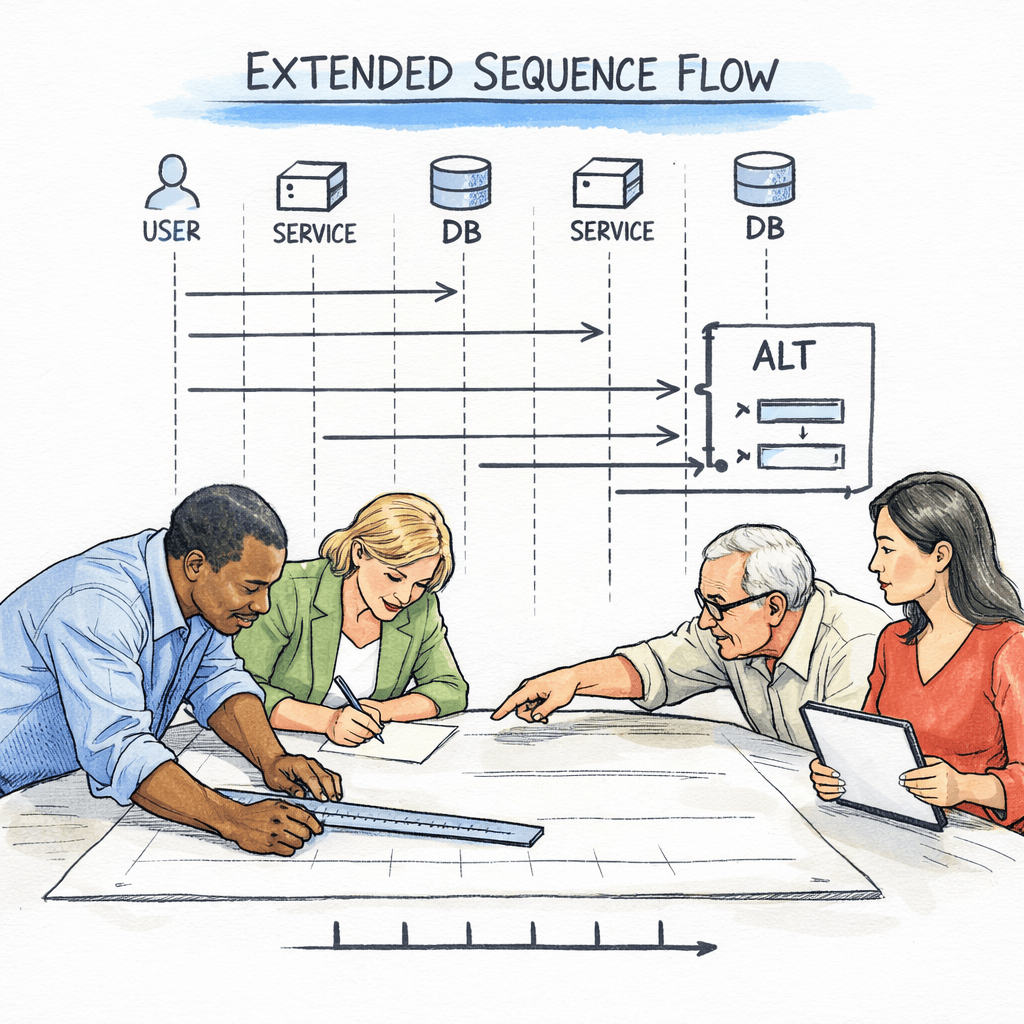
Extended Sequence Flow defines how work moves across tasks and events in complex processes. It augments basic sequencing with parallelism, exceptions, and long-running, event-driven steps. Its reach spans people, systems, and channels.
It covers orchestration of human and system tasks, data-based routing, and hand-offs.
- In scope: runtime flow logic, event correlation, escalations, compensation, audit.
- Outside scope: policy setting, data modelling, UI design, programme
Primary domains are control flow, events and timers, data and rules, human work management, API integration, and monitoring. Events open gateways, data selects paths, APIs call services, and queues coordinate approvals. It fits ERP, CRM, ITSM, on-premises or cloud.
Clear boundaries keep flows adaptable and predictable. Used well, it delivers accountable, auditable progress from intent to outcome.
Why Extended Sequence Flow Matters
Extended Sequence Flow connects strategy to execution by orchestrating work across people, systems, and channels. It enables resilient, audit-ready processes that adapt to change.
Strategically, it converts operating models into measurable flows, aligning KPIs to end-to-end pathways and spotlighting bottlenecks for investment. Operationally, it absorbs volatility—new rules, suppliers, or journeys—via event-driven routing and modular integrations without destabilising core platforms.
It closes gaps in handoffs, shadow processes, and compliance; standardised paths and escalations cut rework, cycle time, and risk.
- Faster Decisions: real-time path metrics guide prioritisation.
- Manager Control: SLAs, queues, and load balancing match capacity to demand.
- User Experience: clear next steps, fewer context switches, consistent outcomes.
Stakeholders gain clearer accountability, predictable delivery, and frictionless work. The net effect is agility at scale with traceable, customer-centric results.
Business Case and Strategic Justification
Extended Sequence Flow is a strategic capability that connects operating models to daily execution. Investing in it strengthens control, resilience, and measurable value delivery across functions.
It is critical because it orchestrates cross-functional work, eliminates blind spots in handoffs, and adapts rapidly to regulatory, market, and technology change. This alignment improves customer journeys, operational stability, and accountability.
The return stems from fewer manual touches, reduced rework, and smarter routing that lifts throughput and first-time-right rates. Typical benchmarks include double-digit cycle-time reductions, lower cost-to-serve, improved SLA adherence, and higher NPS and employee engagement.
Typical benefits include:
- Cycle Time Reduction: Parallelism and automation compress end-to-end duration.
- Cost Optimisation: Fewer handoffs and errors reduce operating expense.
- Compliance Assurance: Auditable paths and rules enforce policy by design.
- Employee Well-Being: Clear queues and load balancing cut context switching.
- Revenue Uplift: Faster fulfilment and consistent outcomes increase conversion.
The business case is strong: lower risk, higher productivity, and better customer value. Next steps focus on a targeted pilot, KPI baselines, and a phased rollout.
DON’T REINVENT THE WHEEL!
Get access to our Enterprise Standards to Drive Performance, Minimise Cost and Maximise Value.
How is Extended Sequence Flow Used?
Extended Sequence Flow is applied through a pragmatic framework that links strategy, design, and execution. It combines three complementary perspectives to ensure flows are effective, resilient, and measurable.
The framework comprises process stages, pitfalls to avoid, and exemplar practices.
- Process stages translate goals into executable paths, governance, automations, and metrics.
- Pitfalls surface the common failure modes—poor handoffs, brittle rules, hidden work—and how to detect and prevent them.
- Exemplar practices capture patterns, templates, and KPIs proven by top performers.
Upcoming subsections preview the method:
- Key Phases and Process Steps explains the end-to-end lifecycle from discovery to continuous improvement;
- Identifying Pitfalls and Challenges shows what derails flows and how to mitigate;
- Learning from Outperformers distils repeatable patterns and scorecards.
Together, these perspectives align stakeholders, de-risk delivery, and accelerate time to value. They provide a shared language to iteratively improve outcomes at scale.
Key Phases and Process Steps
This ten-step approach structures Extended Sequence Flow from intent to measurable delivery. Each phase produces clear artefacts and decisions for predictable progress. Apply end-to-end or iteratively.
1. Set Objectives
Define outcomes, KPIs, scope, and constraints.
2. Discover Flows
Map current steps, events, actors, and data.
3. Prioritise
Rank candidates by value, risk, and effort.
4. Design Target
Model control flow, events, rules, and SLAs.
5. Integrate
Specify APIs, services, data contracts, and event schemas.
6. Establish Controls
Assign roles, approvals, and compliance checkpoints.
7. Build
Configure orchestration, automate tasks, and unit-test paths.
8. Pilot
Run limited rollout and compare to baselines.
9. Scale
Deploy broadly, train teams, and embed change.
10. Optimise
Monitor, alert, A/B test, and iterate improvements.
The sequence minimises risk while accelerating value. Each step feeds the next through metrics and feedback, forming a learning loop. Following it ensures traceable progress from strategy to outcome.
Identifying Pitfalls and Challenges: Antipatterns and Worst Practices
Poorly handled Extended Sequence Flow fails for predictable reasons. Recognising these pitfalls helps protect throughput, quality, and compliance.
5 Antipattern Examples:
5 Worst Practice Examples:
Avoiding these patterns preserves stability and value realisation. Use them as a pre-flight checklist during design, testing, and scaling.
Learning from Outperformers: Best Practices and Leading Practices
Outperformers treat Extended Sequence Flow as a disciplined, data-driven capability. They codify repeatable patterns and refine them with evidence.
5 Best Practice Examples:
5 Leading Practice Examples:
Together, these practices compress cycle time, lift quality, and reduce risk. Institutionalising them turns flows into a scalable operating advantage.
Who is Typically Involved with Extended Sequence Flow?
Clear role alignment is essential to plan, execute, and govern Extended Sequence Flow. Defined responsibilities reduce handoff risk, accelerate decisions, and ensure accountability across business and IT.
Primary roles:
- Executive Sponsor: Sets strategic objectives, secures funding, removes escalations; partners with the flow owner and finance.
- Flow Owner: Owns end-to-end outcomes, KPIs, and backlog; coordinates architects, operations, and product.
- Process Architect: Designs control flow, events, and rules; co-designs with SMEs and engineers to ensure compliance fit.
- Integration Lead: Orchestrates APIs, data contracts, and environments; aligns with security, data, and vendors.
- Operations Manager: Runs daily execution, capacity, SLAs, and improvements; works with change management and support.
Stakeholder influence and benefits:
- Executives: Gain KPI visibility to steer portfolios and risk with evidence.
- Managers & Engineers: Balance demand and capacity, standardise handoffs, and accelerate safe change.
- End Users: Receive guided steps, fewer handoffs, and shorter cycle times.
Clear role definitions eliminate ambiguity and delays. Formal RACI and working cadences anchor collaboration and keep outcomes on track.
Where is Extended Sequence Flow Applied?
Extended Sequence Flow applies wherever work crosses teams, systems, and channels. It scales from discrete workflows to enterprise-wide streams, improving visibility, control, and speed. The following domains show typical high-impact use:
- Finance: Orchestrates order-to-cash and procure-to-pay, enforces controls, and accelerates close.
- IT/ITSM: Coordinates incidents, changes, releases, and approvals; integrates monitoring and CI/CD.
- Operations & Supply Chain: Aligns planning, sourcing, fulfillment, and returns across partners and warehouses.
- Customer Service: Routes cases, escalations, and field service; synchronises CRM, knowledge, and parts logistics.
- HR & Compliance: Standardises hiring, onboarding, access, and policy attestations with audit-ready trails.
- KYC Onboarding: Multi-step identity checks, risk scoring, and account provisioning across channels.
- Major Incident Response: Auto-triage, swarm mobilisation, change approvals, and communication until resolution.
These patterns suit on-site, hybrid, and remote teams, with APIs connecting legacy and cloud. The result is predictable outcomes, lower cost-to-serve, and faster time-to-value across diverse contexts.
When Should You Embrace Extended Sequence Flow?
Choosing the right moment is critical because Extended Sequence Flow reshapes how work traverses teams and systems. Introduce it when value is highest and disruption risk is manageable.
- Growth Inflection: Volumes and variants rise; orchestration preserves throughput and quality.
- Market/Regulatory Change: New rules or offerings demand rapid, auditable path updates.
- Technology Refresh: ERP/CRM/cloud migrations need decoupled flows to reduce cutover risk.
- Quality/Compliance Gaps: SLA misses and audit findings require enforceable controls and traceability.
- Cross-Channel Expansion: Omnichannel journeys need coordinated events, handoffs, and data.
Prerequisites:
- Executive Mandate: Clear outcomes, funding, and escalation path.
- Flow Ownership: Named owner, RACI, and governance cadence.
- Data Readiness: Stable reference data and event schemas.
- Platform & Integration: API access, environments, and security patterns.
- Measurement Baseline: KPIs, SLAs, and telemetry defined.
These signals indicate readiness to start with a focused pilot and scale iteratively. Meeting prerequisites reduces risk, aligns stakeholders, and accelerates time to value.
Most Common Extended Sequence Flow Artefacts
Effective Extended Sequence Flow depends on a small set of artefacts and tools that turn intent into governed execution. They provide shared language, design control, and operational visibility across business and IT.
The core artefacts and tools are:
- Flow Design Specification: End-to-end model of tasks, events, rules, SLAs, and ownership.
- Event Catalogue & Schemas: Standardised business/technical events with payloads, semantics, producers, and consumers.
- SLA & Control Matrix: Thresholds, approvals, segregation of duties, escalations, and audit checkpoints.
- Integration Contracts (APIs): Versioned interfaces, message topics, idempotency, retries, and security patterns.
- Operations Dashboard & Runbook: Live KPIs, queue health, error triage, fallback procedures, and on-call roles.
Together, these artefacts reduce ambiguity, speed delivery, and improve compliance and resilience. Maintained as living documents, they enable reuse and consistent change management. Adopting them early lowers risk and shortens time-to-value for every subsequent flow.
The Artefacts Table
This page presents the artefacts that operationalise Extended Sequence Flow. Each item has a clear purpose and a practical application, enabling consistent design, control, and continuous improvement across business and IT. Use it as a quick reference when scoping, designing, or operating flows.
Artefacts table
| Artefact | Description | Practical use |
|---|---|---|
| Flow Design Specification | A structured model of tasks, events, rules, SLAs, and ownership for an end-to-end flow. | Designs the target process, validates handoffs with stakeholders, and serves as the build blueprint. |
| Event Catalogue & Schemas | A governed list of business and technical events with standardised payloads and semantics. | Enables reliable event-driven routing, reuse across teams, and faster integration onboarding. |
| SLA & Control Matrix | A definition of thresholds, approvals, segregation of duties, escalations, and audit checkpoints. | Sets operating guardrails, powers dashboards and alerts, and evidences compliance. |
| Integration Contracts (APIs) | Versioned interface definitions covering endpoints, topics, idempotency, retries, and security. | Stabilises system interactions, reduces coupling, and streamlines change across platforms. |
| Operations Dashboard & Runbook | Live performance views and procedural guides for triage, failover, and recovery. | Monitors flow health, accelerates incident resolution, and drives continuous optimisation. |