
Enterprise Modelling
Event Model
Reference Content ID: #LEAD-ES20020ALL
Introduction to Event Model
The Event Model defines how an enterprise senses and responds to business-relevant signals across processes and channels. It provides shared definitions for triggers, context, and actions so teams act in real time.
Core principles include event-centric thinking, loose coupling, and governed, policy-driven orchestration.
Key components span schemas, streams and brokers, routing rules, services, and guardrails for SLAs and monitoring.
Applied across customer, operations, finance, supply chain, and HR, it lifts productivity and collaboration, reduces interruptions to support well-being, and enables digital Event Models via APIs, analytics, and automation for on-site, hybrid, and remote teams.
Adopting the Event Model aligns people, process, data, and technology around fast, auditable outcomes. Organisations gain resilience, insight, and scalable innovation.
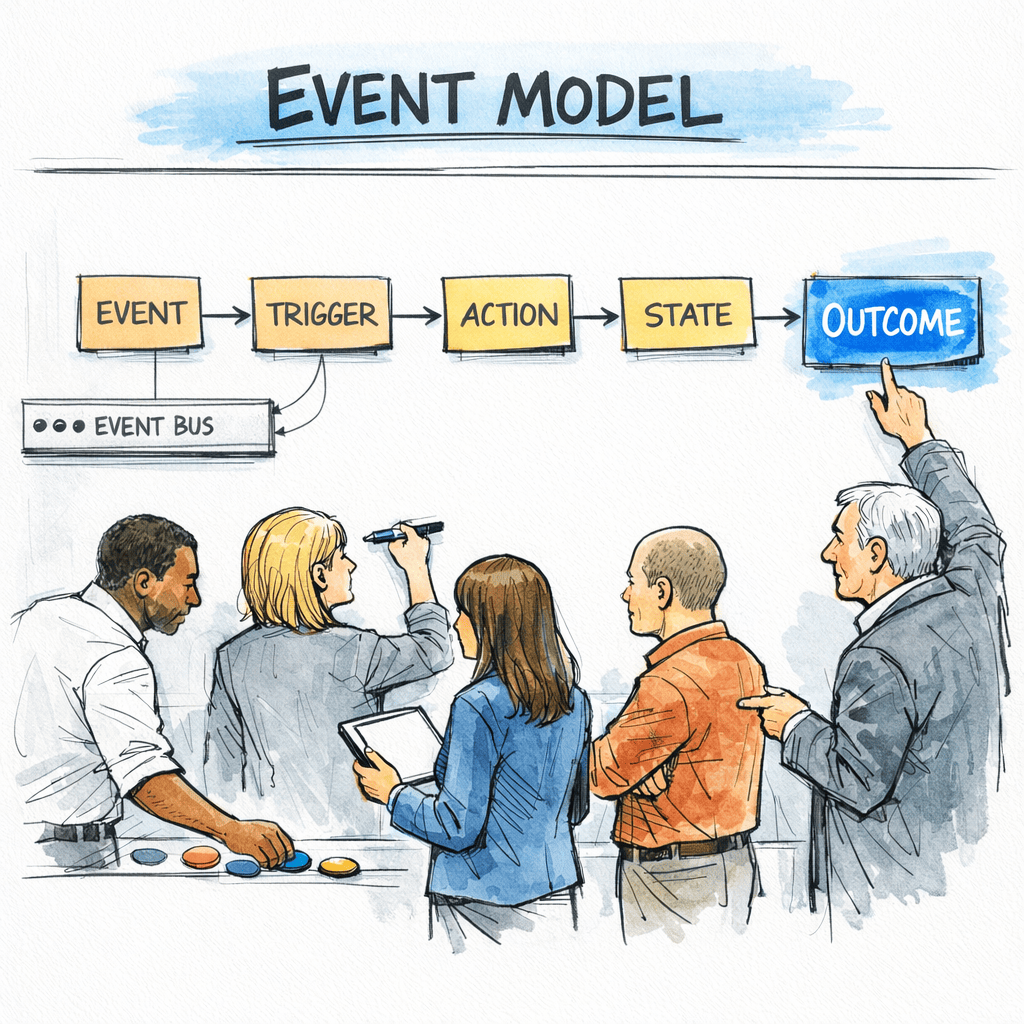
Definition and Scope
The Event Model defines how an organisation structures, governs, and executes responses to business events. It turns signals into decisions and actions across processes and platforms.
It covers event definitions, context, correlation, policies, routing, and measurable outcomes. In scope are triggers from systems, devices, and people; outside are ad-hoc actions lacking traceability or governance.
Core domains include schemas, capture/streaming, rules/orchestration, service interfaces, observability, and risk controls. They interact via APIs and contracts across customer, operations, finance, and supply chains, in on-prem and cloud environments.
A disciplined scope enables repeatable, auditable execution and reduces coupling between teams and systems. The model accelerates change while preserving compliance and reliability at enterprise scale.
Why Event Model Matters
Event Model matters because it converts business signals into timely, governed action. It links strategy to execution, ensuring priorities flow into day-to-day decisions.
It enables strategic goal attainment by aligning outcomes to events, making KPIs observable and auditable in real time. It increases organisational agility by decoupling producers and consumers, absorbing market or technology change without costly rewrites. It reduces common failure modes—hand-offs, delays, shadow processes—through clear policies, routing, and accountability.
Executives gain visibility and control; managers orchestrate dependable workflows; end users experience fewer interruptions and faster resolutions. The model also supports compliance, resilience, and secure data sharing across hybrid and cloud estates.
- Cycle-Time Reduction: Event-driven approvals cut wait times from days to minutes through automated routing.
- Proactive Risk Control: Early-warning events trigger mitigations before SLA breaches or safety incidents occur.
- Product Iteration Velocity: Telemetry events feed experiments, accelerating release quality and adoption.
Event Model becomes a durable operating mechanism for productivity, collaboration, well-being, and digital ways of working across on-site, hybrid, and remote teams. It is a catalyst for faster, safer, and more innovative execution.
Business Case and Strategic Justification
Event Model is a strategic capability that turns signals into governed action. It aligns execution to enterprise priorities at scale.
It underpins OKR delivery, compliance-by-design, and resilience by decoupling producers and consumers. Leaders absorb market shifts and regulatory change without rewrites, eliminating hand-offs, workarounds, and unclear accountability.
ROI stems from cycle-time compression, right-first-time quality, and automation of low-value tasks. Gains include faster throughput, fewer escalations, and higher conversion from next-best-action—lifting revenue and lowering cost-to-serve.
Typical benefits and advantages:
- Governed Agility: Policy-driven routing adapts safely to change.
- Productivity Gains: Automation removes queues and rework.
- Customer Outcomes: Real-time triggers personalise journeys.
- Risk & Compliance: Early warnings prevent breaches.
- Innovation Velocity: Telemetry accelerates iteration and rollout.
Event Model forms an auditable, adaptable operating spine. Begin with a pilot in a high-value journey, then scale using enterprise standards and metrics.
DON’T REINVENT THE WHEEL!
Get access to our Enterprise Standards to Drive Performance, Minimise Cost and Maximise Value.
How is Event Model Used?
Event Model is applied through a pragmatic framework linking design, governance, and delivery. It provides a shared language for orchestrating events from discovery to scale.
Three lenses guide use:
- Process stages, pitfalls to avoid, and exemplar practices.
- Stages create a repeatable path from opportunity framing to live operations.
- Pitfalls reveal anti-patterns that erode value; exemplars codify what works.
Key Phases and Process Steps maps the lifecycle—discover, model, implement, operate, evolve—clarifying roles, artefacts, and quality gates. Identifying Pitfalls and Challenges surfaces failure modes, trade-offs, and controls. Learning from Outperformers distils patterns and metrics that lift throughput, quality, and speed.
Together these perspectives align stakeholders, reduce risk, and accelerate time to value. They make Event Model actionable, measurable, and scalable across varied environments.
Key Phases and Process Steps
The Event Model lifecycle follows ten disciplined phases that turn signals into governed action. This approach ensures clarity of purpose, quality gates, and measurable outcomes from idea to scale.
1. Opportunity Framing
Prioritise use cases, define outcomes, and align on success metrics.
2. Event Inventory
Catalogue triggers, sources, consumers, and ownership boundaries.
3. Policy & Guardrails
Establish compliance, security, SLAs, and change controls.
4. Schema Design
Standardise event structures, context fields, and versioning conventions.
5. Architecture Blueprint
Select platforms, brokers, and integration patterns for scale.
6. Orchestration Design
Specify routing, rules, compensations, and exception paths.
7. Build & Configuration
Implement producers, consumers, interfaces, and policy-as-code.
8. Test & Simulation
Validate flows, load, resilience, and failure handling.
9. Release & Run
Deploy, operationalise runbooks, and enable support models.
10. Observe & Evolve
Monitor KPIs, tune rules, and iterate through controlled releases.
Together, these phases provide a repeatable, auditable path from concept to value. The sequence reduces risk, compresses cycle times, and enables continuous optimisation at enterprise scale.
Identifying Pitfalls and Challenges: Antipatterns and Worst Practices
Antipatterns and worst practices erode value, increase risk, and slow delivery. Tackling them early preserves clarity, resilience, and measurable outcomes.
5 Antipattern Examples:
5 Worst Practice Examples:
Name, monitor, and retire these behaviours with standards, automation, and ownership. Doing so stabilises flow, compresses cycle time, and scales Event Model safely.
Learning from Outperformers: Best Practices and Leading Practices
Outperformers treat Event Model as an operating discipline, not tooling. Below are repeatable patterns that deliver reliable value, and frontier practices that scale advantage.
5 Best Practice Examples:
5 Leading Practice Examples:
These practices lift reliability, speed, and compliance while curbing rework. Adopt the fundamentals first, then graduate to leading practices through targeted pilots with measurable guardrails.
Who is Typically Involved with Event Model?
Understanding who leads, designs, runs, and governs Event Model is vital to de-risk delivery and accelerate value. Clear accountability tightens alignment between strategy, technology, and day-to-day execution.
Primary roles:
- Executive Sponsor: Sets strategy and funding; resolves cross-functional issues with the programme lead.
- Programme Lead: Owns roadmap and outcomes; coordinates architects, engineers, and operations to milestones.
- Domain Architect: Designs schemas and contracts; co-creates policies with risk, security, and data leads.
- Platform Owner: Operates brokers and tooling; partners with engineers to scale, secure, and optimise costs.
- Operations & Controls: Runs SRE/service management; collaborates with product teams on SLAs, incidents, and change.
Stakeholder impact examples:
- Executives: Prioritise use cases and guardrails; gain outcome-linked KPI visibility.
- Middle Management: Sequence resources and work; benefit from predictable flow and fewer handoffs.
- Technical Teams & End Users: Build/operate contracts and provide feedback; enjoy faster releases and fewer interruptions.
Clear role definitions create a single operating spine across business and IT. With accountability and collaboration embedded, Event Model scales safely while improving speed, reliability, and experience.
Where is Event Model Applied?
Event Model applies wherever timely signals must drive governed action. It spans core functions and journeys, enabling consistent outcomes across on-site, hybrid, and remote teams. The following areas show where it creates the most value.
Primary domains and functions:
- Customer Service: Events trigger next-best actions, case routing, and proactive outreach.
- Operations & Supply Chain: IoT and logistics signals coordinate scheduling, inventory, and recovery.
- Finance & Risk: Transaction events enforce controls, detect anomalies, and automate approvals.
- IT & Digital Platforms: CI/CD and incident signals enable self-healing and cost optimisation.
- HR & Workplace: Employee lifecycle events orchestrate access, provisioning, and well-being interventions.
Illustrative scenarios:
- Order Recovery Loop: Stockout event auto-reroutes fulfilment, updates ETA, and informs the customer.
- Regulatory Breach Prevention: Threshold-crossing event triggers containment, notifications, and evidence capture.
These applications demonstrate versatility from front office to back office. By standardising schemas, policies, and orchestration, organisations compress cycle time and risk while improving experience. The same patterns scale across products, geographies, and technology estates.
When Should You Embrace Event Model?
Timing determines whether Event Model accelerates outcomes or adds complexity. The right moment is when strategic change requires governed, real-time responses and enabling foundations are in place.
- Rapid Growth or Scaling: Standardise events to decouple teams and prevent coordination drag.
- Market or Regulatory Shifts: Encode new rules once and propagate safely across channels.
- Legacy Modernisation: Wrap systems with event contracts to reduce risk and unlock iteration.
- Digital Product Launches: Instrument journeys to enable analytics, experiments, and automation.
- Resilience or Cost Mandates: Automate detection, remediation, and cost-aware routing.
- Executive Sponsorship: Clear outcomes, funding, and policy guardrails.
- Product & Platform Alignment: Defined ownership of domains, brokers, and contracts.
- Policy & Risk Framework: Privacy, security, and compliance-as-code ready.
- Data & Schema Governance: Versioned canonical definitions.
- Operational Readiness: SRE, observability, runbooks, and change management.
Use these signals to scope an initial high-value journey and prove ROI quickly. Establish standards and measures early, then scale safely across functions.
Most Common Event Model Artefacts
Effective Event Model practice relies on a small set of disciplined artefacts and tools. They create shared understanding, enforce governance, and enable safe change across products, platforms, and teams.
Core artefacts and tools:
- Canonical Event Schema: Standardises fields, semantics, and versioning to ensure interoperability and controlled evolution.
- Contract & Registry: Manages producer–consumer contracts, compatibility checks, discoverability, ownership, and lifecycle status.
- Policy & Routing Rules: Encodes eligibility, privacy, SLAs, compensation, and escalation as code to orchestrate reliable flows.
- Event Catalogue & Lineage: Inventories sources, consumers, and dependencies, enabling impact analysis, risk controls, and audit evidence.
- Observability & Runbooks: Dashboards, traces, SLOs, alerts, and operational playbooks for incident response and continual improvement.
Together, these artefacts provide clarity, control, and speed from design to operations. They reduce rework, compress cycle time, and increase reliability. Establish them early, keep them lightweight but governed, and evolve them with measurable feedback.
The Artefacts Table
This page provides a quick reference to the core Event Model artefacts and tools, clarifying what each is and how it is applied. Use it to align stakeholders, select supporting tooling, and standardise implementation across teams.
| Artefact | Description | Practical use |
|---|---|---|
| Canonical Event Schema | A standardised, versioned structure for event payloads that ensures semantic consistency across domains. | Design and validate events so multiple teams can produce and consume reliably without breaking changes. |
| Contract & Registry | A catalogue that records producer–consumer contracts, ownership, lifecycle status, and compatibility rules. | Discover available events, check contract compliance before deployment, and manage deprecation safely. |
| Policy & Routing Rules | Machine-readable rules that govern eligibility, privacy, SLAs, error handling, and orchestration paths. | Automate next-best actions, enforce controls, and adapt flows quickly when regulations or priorities change. |
| Event Catalogue & Lineage | An inventory that maps sources, consumers, dependencies, and data lineage for impact and risk analysis. | Trace the downstream effect of a change, support audits, and accelerate incident triage. |
| Observability & Runbooks | Dashboards, traces, SLOs, alerts, and operational playbooks that guide monitoring and recovery. | Detect anomalies early, execute standard responses, and drive continuous improvement from measured outcomes. |
Together these artefacts establish a shared language, governance, and repeatable execution for event-driven work. Adopt them early, keep them lightweight, and maintain their lifecycle to support safe change. Consistent use improves reliability, speeds delivery, and makes the Event Model auditable and scalable.