
Enterprise Modelling
Competency Modelling
Reference Content ID: #LEAD-ES20015BC
Introduction to Competency Modelling
Competency Modelling defines the skills, behaviours, and knowledge required for roles. It creates a common language linking strategy to work.
It is grounded in clear role expectations, observable behaviours, proficiency levels, and evidence-based assessment, with governance and continuous improvement.
Key components span a competency dictionary, role profiles, proficiency scales, assessments, learning pathways, and workforce-planning integration.
It applies across functions and sectors, scaling from SMEs to global enterprises. Standardised expectations and skills boost productivity, improve collaboration, support well-being, and enable digital workflows for on-site, hybrid, and remote teams.
Used well, it makes talent decisions transparent and measurable. It underpins role design, hiring, learning, and performance.
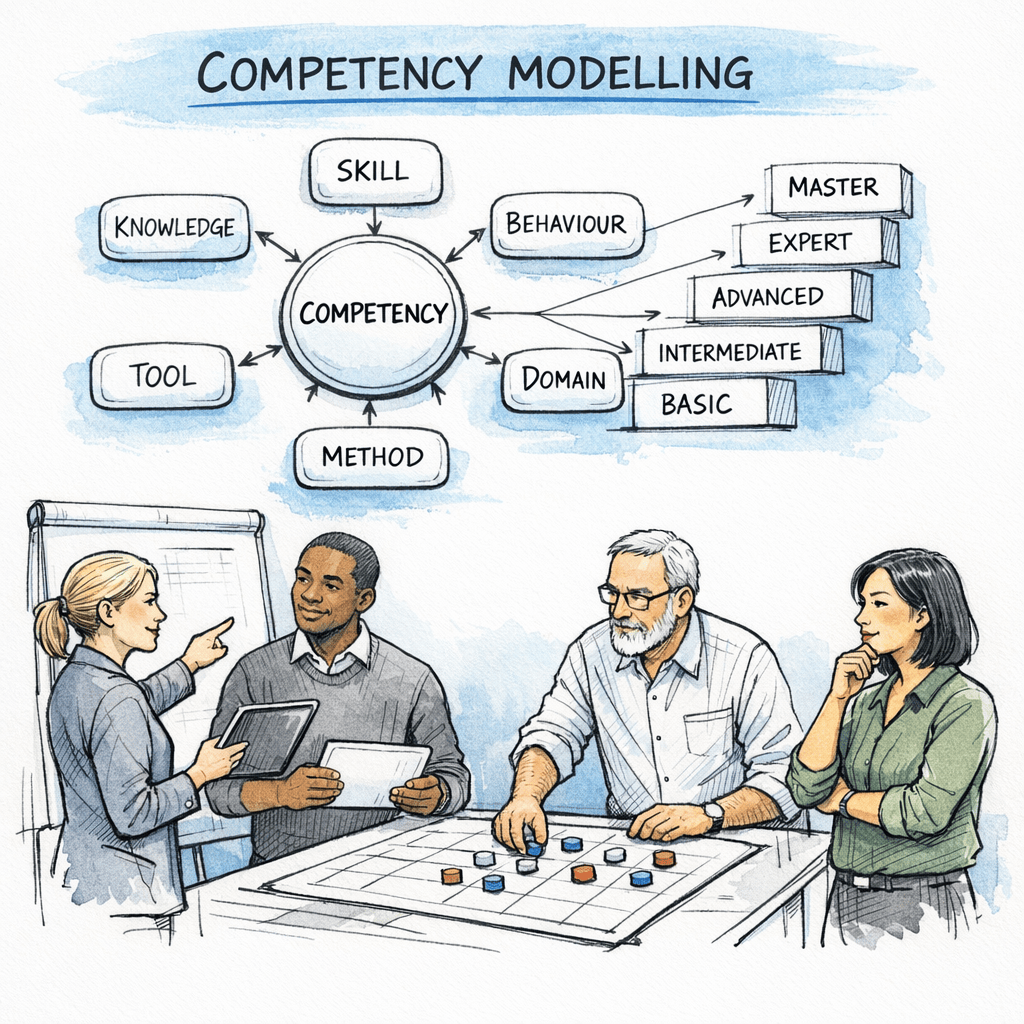
Definition and Scope
Competency Modelling defines the capabilities an organisation needs to execute work effectively. This subsection clarifies its meaning, boundaries, and core building blocks.
It structures skills, knowledge, behaviours, and mindsets into role-based expectations with proficiency levels and evidence indicators. Within scope are competency taxonomies, role profiles, assessments, and governance for updates. Outside scope are pay setting, job grading, and psychological diagnostics, unless explicitly linked to competencies.
Primary domains include a competency dictionary, proficiency scales, role maps, assessment methods, and learning pathways. They interact via HRIS, ATS, LMS, and workflow tools to embed expectations into hiring, onboarding, performance, and reskilling. In technical contexts, APIs and skills ontologies enable analytics and automation.
Effective modelling aligns strategy, roles, and development with measurable standards. Clear scope prevents misuse and ensures integration across business and digital platforms.
Why Competency Modelling Matters
Competency Modelling matters because it connects strategy to execution and reduces ambiguity in how work gets done. It provides a stable, data-driven baseline for workforce decisions.
It translates strategic priorities into the capabilities required by roles and teams, focusing investment on skills that drive outcomes. Clear standards streamline workforce planning, role design, and resource allocation.
As markets and technology shift, competencies provide an adaptable backbone for reskilling and automation. They enable faster redeployment, safer adoption of AI, and compliant operations across jurisdictions.
Executives gain governance and risk control, managers gain clarity for performance and development, and employees gain transparency and mobility across career paths.
- Decision Velocity: Shared definitions speed hiring, staffing, and promotion choices.
- Efficiency & Quality: Observable behaviours reduce rework and improve handovers.
- Innovation & Agility: Targeted upskilling accelerates product and process change.
Organisations that institutionalise Competency Modelling make better, faster, and fairer people decisions. It becomes the operating system for hiring, learning, and performance across on-site, hybrid, and remote work.
Business Case and Strategic Justification
Competency Modelling is a strategic asset for executing vision through people. It provides a transparent, measurable basis for talent, investment, and change.
It aligns corporate strategy with role expectations by codifying the capabilities that drive value. It addresses fragmentation, unclear accountability, compliance risk, and uneven performance across on-site, hybrid, and remote teams.
ROI comes from faster staffing, reduced time-to-competence, fewer handovers, and targeted learning spend. Benchmarks include lower vacancy days, higher first-time-right rates, increased internal mobility, and productivity gains per FTE enabled by digital workflows.
Typical benefits include:
- Decision Quality: Evidence-based standards improve hiring, promotion, and allocation.
- Speed-to-Productivity: Clear expectations shorten onboarding and reskilling.
- Workflow Orchestration: Shared language streamlines handovers and automation.
- Risk & Compliance: Defined behaviours support auditability and safety.
- Engagement Mobility: Transparent pathways boost retention and internal moves.
The case is compelling when competencies are embedded in HRIS, LMS, and workflow tools. Prioritise critical roles first, measure outcomes, and iterate with governance.
DON’T REINVENT THE WHEEL!
Get access to our Enterprise Standards to Drive Performance, Minimise Cost and Maximise Value.
How is Competency Modelling Used?
Competency Modelling is best applied through a practical framework that converts strategy into role-based capability. This overview clarifies how to execute, what to avoid, and what to emulate.
The framework unites three perspectives. Process stages provide a repeatable path—scoping, taxonomy design, role mapping, validation, deployment, and governance—so decisions are traceable and outcomes measurable.
Pitfalls highlight typical failure modes such as over-engineering, weak evidence, poor adoption, and tool misalignment. Exemplar practices distil what outperformers do—lightweight taxonomies, evidence-based proficiency levels, workflow embedding, and continuous improvement.
Upcoming subsections:
- Key Phases and Process Steps explains when and how to execute each stage.
- Identifying Pitfalls and Challenges surfaces risk signals and mitigations.
- Learning from Outperformers translates proven patterns into checklists.
Together, these perspectives supply direction, guardrails, and accelerators. They help teams deliver usable models, sustain adoption, and realise value across digital, hybrid, and on-site contexts.
Key Phases and Process Steps
A disciplined ten-step approach makes Competency Modelling repeatable and outcome-driven. It progresses from scoping to integration and continuous improvement, with each phase de-risking the next.
1. Scope & Objectives
Define purpose, success criteria, and priority roles.
2. Governance & Stakeholders
Establish sponsorship, decision rights, and working cadence.
3. Role Inventory
Catalogue roles, clusters, and critical workflows to target.
4. Competency Taxonomy
Create a concise, reusable dictionary aligned to strategy.
5. Proficiency Levels
Specify observable behaviours and evidence for each level.
6. Role Mapping
Assign competencies and target proficiencies per role and context.
7. Validation & Calibration
Test with pilots; refine for consistency and fairness.
8. System Integration
Embed in HRIS, ATS, LMS, and digital workflow tools.
9. Enablement & Rollout
Train managers and employees; provide guides and nudges.
10. Measurement & Improvement
Track adoption, productivity, quality, and mobility; iterate.
This flow produces usable models that guide hiring, learning, and performance. Start with high-impact roles, embed in daily tools, and evolve through metrics and feedback.
Identifying Pitfalls and Challenges: Antipatterns and Worst Practices
Competency Modelling fails when complexity outweighs usefulness and governance is weak. Avoid these recurring traps to protect adoption, fairness, and ROI. Address them early to sustain credibility.
5 Antipattern Examples:
5 Worst Practice Examples:
Design for usefulness, not volume. Pilot, embed in systems, and maintain governance so competencies guide hiring, learning, and performance across all work settings. Make adoption measurable with simple, observable standards.
Learning from Outperformers: Best Practices and Leading Practices
Outperformers treat Competency Modelling as a living system embedded in daily work. They prioritise clarity, adoption, and measurable impact over exhaustive catalogues.
5 Best Practice Examples:
5 Leading Practice Examples:
These practices convert strategy into repeatable, people-centred execution. Start small, integrate deeply, and iterate using evidence and governance.
Who is Typically Involved with Competency Modelling?
Understanding who participates ensures accountability, faster decisions, and sustained adoption. Clear roles reduce overlap, align stakeholders, and embed competencies into daily tools and routines.
Primary roles:
- Executive Sponsor: Sets direction and funding; resolves escalations; aligns with board and strategy.
- Program Lead: Orchestrates plan, resources, and cadence; coordinates HR, IT, and business units.
- HR COE Owner: Curates taxonomy, proficiency standards, and policy; partners with managers on adoption.
- People Analytics & IT Integrator: Connects HRIS/LMS/workflows; ensures data quality, reporting, and automation.
- Line Manager Community: Validates roles, applies assessments, and feeds improvements from operations.
Stakeholder influence and benefits:
- Executives: Use KPI dashboards for risk, compliance, and capital allocation decisions.
- Middle Management: Applies role clarity to staffing, coaching, and performance conversations.
- Technical Teams & End Users: Gain in-tool guidance, transparent expectations, and mobility pathways.
Well-defined responsibilities enable effective collaboration and measurable outcomes. With governance, analytics, and frontline feedback working in concert, Competency Modelling becomes a reliable engine for capability, productivity, and fairness.
Where is Competency Modelling Applied?
Competency Modelling spans business and technical functions, giving teams a shared language for capability, quality, and risk. It scales from local departments to global programmes, supporting on-site, hybrid, and remote work. Applied well, it anchors hiring, learning, and workflow automation.
Primary domains:
- Finance: Defines controls, analysis standards, and forecasting rigour to improve close cycles and decision support.
- IT & Digital: Clarifies engineering, security, and DevOps proficiencies to accelerate delivery and reduce incidents.
- Operations & Supply Chain: Specifies process, quality, and safety behaviours to stabilise throughput and reduce waste.
- Customer Service & Sales: Frames service, product, and negotiation skills to lift NPS, conversion, and retention.
- Risk & Compliance: Codifies regulatory, audit, and data-handling behaviours to assure consistent compliance.
Illustrative scenarios:
- Cloud Migration Squad: Maps target skills, sequences upskilling, and gates releases via proficiency checks.
- Contact Centre Transformation: Aligns coaching to behaviours, automates prompts in CRM, and raises first-contact resolution.
Its versatility lies in clear standards embedded in everyday systems. Organisations gain faster execution, better quality, and auditable outcomes across contexts.
When Should You Embrace Competency Modelling?
Choosing the right moment to adopt Competency Modelling maximises impact and reduces rework. Timing matters because competencies anchor hiring, learning, and automation across on-site, hybrid, and remote teams.
Scenarios that signal readiness:
- Scale-Up or Growth: New roles and locations require consistent standards.
- Regulatory or Market Shifts: New obligations and risks demand verifiable behaviours.
- Technology Refresh: Cloud or AI alters workflows; competencies guide reskilling and automation.
- Operating Model Change/M&A: Harmonises roles, reduces duplication, accelerates integration.
- Performance Variability or Skill Gaps: Targets development where outcomes lag.
Essential prerequisites:
- Executive Sponsor & Budget: Clear mandate and funding.
- Defined Scope & Governance: Decision rights and update cadence.
- Role Inventory & Baseline Data: Roles, skills, and performance signals.
- System Integration Capacity: HRIS/LMS/workflow connectors and data quality.
- Change & Enablement Plan: Toolkits, training, and communications.
Heed these signals to sequence work and de-risk delivery. Start with critical roles, pilot in one business unit, and expand based on measurable gains.
Most Common Competency Modelling Artefacts
Effective Competency Modelling relies on a small set of reusable artefacts that make expectations explicit and measurable. These tools connect strategy to roles and embed capability into hiring, learning, and performance.
- Competency Dictionary: Curated library of skills, knowledge, and behaviours with definitions, tags, and examples aligned to strategy.
- Proficiency Scale & Indicators: Levels rubric (e.g., Foundation to Expert) with observable behaviours and evidence thresholds per competency.
- Role–Competency Matrix: Mapping of roles to required competencies and target levels, with variants for risk, geography, or shift pattern.
- Assessment Toolkit: Structured self/manager/360 instruments, interview guides, work-sample rubrics, and calibration rules for consistent ratings.
- Development Pathways: Role-based learning journeys, on-the-job tasks, and coaching prompts linked to LMS and workflow tools for in-flow support.
Together, these artefacts standardise language, reduce ambiguity, and enable auditable, data-driven decisions. Embedded in HRIS, ATS, and LMS, they accelerate onboarding, reskilling, and internal mobility. Ongoing governance keeps them current and ensures sustained business impact.
The Artefacts Table
| Artefact | Description | Practical use |
|---|---|---|
| Competency Dictionary | A curated library of skill, knowledge, and behaviour definitions aligned to organisational strategy. | Standardises language across hiring, performance, and learning; tags support search and analytics. |
| Proficiency Scale & Indicators | Structured levels with observable behaviours and evidence thresholds for each competency. | Guides assessments, promotion criteria, and risk-based gating in regulated or safety-critical work. |
| Role–Competency Matrix | A mapping of each role to required competencies and target proficiency by business or risk context. | Drives job profiles, workforce planning, and automation rules in HRIS/ATS. |
| Assessment Toolkit | A set of calibrated instruments (self, manager, 360, work samples) with scoring rubrics. | Enables fair selection, targeted development plans, and audit-ready records. |
| Development Pathways | Role-based learning journeys with on-the-job tasks, coaching prompts, and LMS links. | Accelerates onboarding and reskilling; in-tool nudges surface at the moment of work. |