
Enterprise Modelling
Channel
Reference Content ID: #LEAD-ES20018ALL
Introduction to Channel
Channel is the process that designs, governs, and optimizes how information, services, and value move between people and platforms. It sets rules for selecting, integrating, and operating communication and delivery pathways.
Principles are clarity, accessibility, trust, and measurable outcomes, enforced by standardised, user-centric ways of working. Components include channel strategy, architecture and taxonomy, workflow orchestration, governance, enablement, and analytics aligned to deliver reliable, compliant interactions.
Across on-site, hybrid, and remote teams, Channel streamlines work, reduces noise, and speeds decisions. It boosts productivity, deepens collaboration, supports well-being via predictable norms, and enables scalable digital channels.
The result is fewer handoffs, faster cycle times, and higher-quality outcomes. Channel becomes a repeatable capability that adapts to organisational size, sector, and maturity.
Definition and Scope
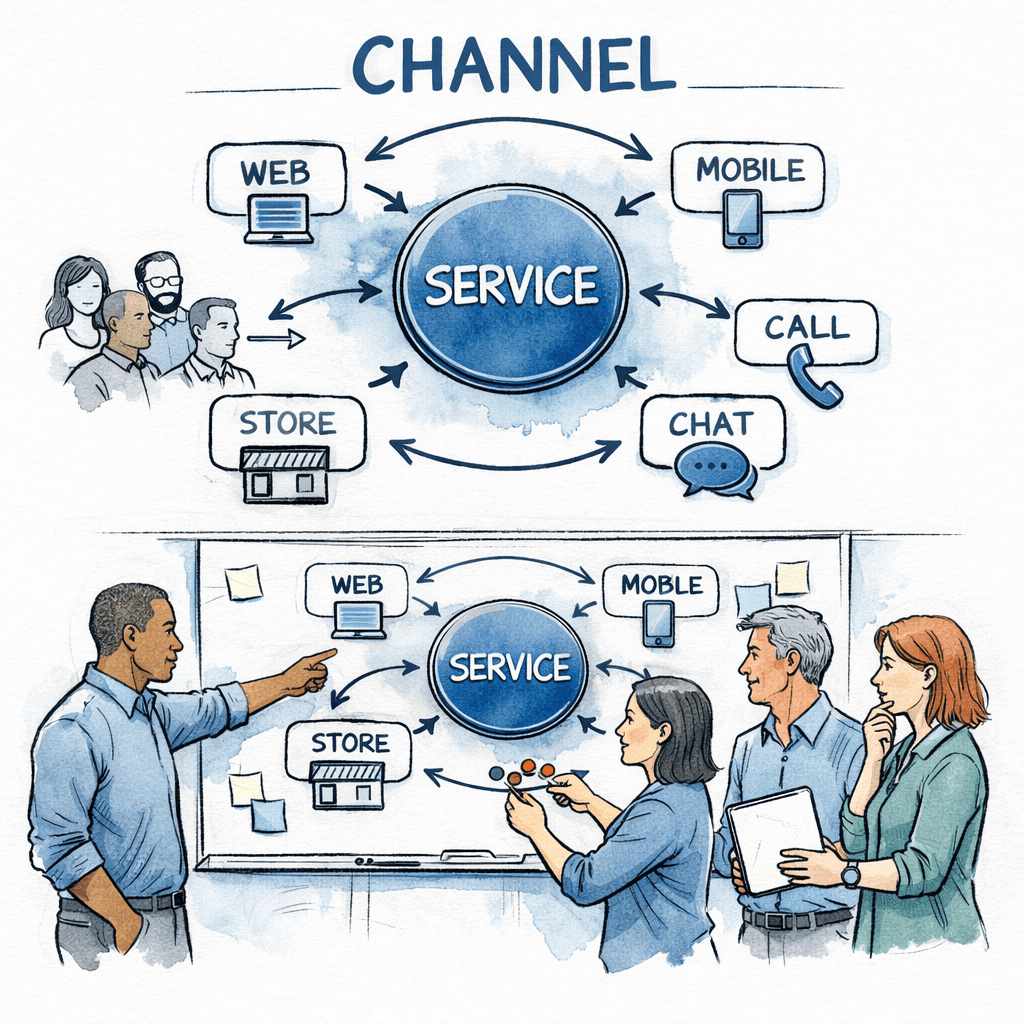
Channel is the enterprise process that designs and governs how interactions flow across touchpoints. This defines its concepts and scope.
Channel encompasses strategy, policies, architecture, and operations for communications and delivery—spanning human and digital pathways. It manages modalities, taxonomies, and routing. Outside scope: content creation, branding, product development, network infrastructure; Channel coordinates but does not own them.
Primary domains: strategy and governance; experience design; architecture and taxonomy; orchestration; enablement and adoption; measurement and compliance. Governance sets standards, architecture defines pathways, orchestration routes demand, analytics drives improvements. Across collaboration suites, contact centres, portals, and APIs, these domains interlock to ensure consistency.
Channel is the interaction layer linking people and platforms. Clear scope reduces overlap; modular domains adapt to organisational and technology contexts.
Why Channel Matters
Channel matters because it governs how work, information, and services flow. Done well, it turns strategy into reliable, scalable execution. It aligns priorities with customer and employee journeys, embedding clarity, ownership, and KPIs into interactions to drive growth, quality, and managed risk.
It helps organisations absorb change—AI assistants, new platforms, privacy rules—through standards and guardrails that enable rapid adoption without fragmenting experience or compliance. It tackles channel sprawl, tool redundancy, unclear ownership, and signal noise. Governance and orchestration reduce handoffs, errors, and cycle time across functions.
Stakeholders benefit differently:
- Executives: portfolio-level transparency and control linking investments to outcomes and risk.
- Managers: consistent workflows and routing that improve utilisation, throughput, and service levels.
- End Users: clear norms and tools that lower cognitive load and enable frictionless collaboration.
By clarifying who uses what, when, and why, Channel elevates everyday work. It becomes a capability that sustains productivity, well-being, and innovation at scale.
Business Case and Strategic Justification
Channel converts strategy into consistent execution by governing how interactions flow. Investment provides a managed way to scale collaboration, service delivery, and customer experience.
It aligns corporate objectives—growth, efficiency, risk, experience—by standardising pathways, ownership, and KPIs across human and digital touchpoints. It addresses tool sprawl, fragmented journeys, compliance gaps, and slow decisions, creating a single operating logic.
Return stems from reduced licence and operating waste, faster cycle times, higher first-contact resolution, and better utilisation. Typical targets: 10–20% productivity uplift, 15–30% fewer handoffs, 20–40% lower rework, and improved NPS/ESAT.
Typical benefits include:
- Productivity: fewer handoffs, clearer routing, faster throughput.
- Experience: consistent journeys across channels and devices.
- Risk & Compliance: auditable rules, privacy-by-design controls.
- Cost Optimisation: rationalised tools and licences; automation.
- Innovation: safe adoption of AI and new platforms.
Channel is a strategic, measurable lever for operational excellence and growth. Prioritise a staged rollout with governance, tooling, and change enablement to realise value quickly and compound it over time.
DON’T REINVENT THE WHEEL!
Get access to our Enterprise Standards to Drive Performance, Minimise Cost and Maximise Value.
How is Channel Used?
Channel is applied through a pragmatic framework that translates strategy into repeatable routines. It blends process discipline, governance, and enablement to deliver reliable interactions across human and digital pathways.
Three perspectives guide effective use:
- Process stages define the lifecycle from discovery and design through run and optimise.
- Pitfalls highlight failure patterns and risks to avoid.
- Exemplar practices provide proven patterns, standards, and accelerators.
Together they create guardrails and momentum for value realisation.
Key Phases and Process Steps sets roles, decision gates, and artefacts across the lifecycle. Identifying Pitfalls and Challenges exposes anti-patterns, root causes, and mitigations. Learning from Outperformers surfaces benchmarks, metrics, and playbooks to raise performance.
Applied in concert, these lenses enable structured rollout, reduced risk, and faster adoption. Teams gain clarity, measurable outcomes, and adaptability as technology and business needs evolve.
Key Phases and Process Steps
The Channel framework is executed through ten critical phases that move from understanding demand to continuous optimisation. The sequence creates clarity, control, and measurable outcomes across human and digital pathways.
1. Discovery & Baseline
Inventory channels, volumes, pain points, risks, and compliance.
2. Demand & Journey Mapping
Capture intents, moments of truth, SLAs, and success measures.
3. Vision & Principles
Define north star, guardrails, roles, and non-negotiables.
4. Strategy & Policy
Decide purpose, eligibility, ownership, and decision rights per channel.
5. Architecture & Taxonomy
Design pathways, routing logic, naming, and metadata standards.
6. Business Case & Prioritisation
Quantify value, costs, sequencing, and target OKRs.
7. Design & Orchestration
Specify workflows, handoffs, automations, and escalation rules.
8. Tooling & Integration
Select platforms, integrate data, security, and identity controls.
9. Pilot & Scale
Prove MVP, harden operations, and expand by cohort.
10. Run, Monitor & Optimise
Operate, measure, govern, and iterate the lifecycle.
This flow enforces decision gates while keeping ownership and metrics visible. Applied iteratively, it reduces risk, accelerates value, and institutionalises better ways of working.
Identifying Pitfalls and Challenges: Antipatterns and Worst Practices
Avoiding Channel failure starts with recognising patterns that degrade flow, experience, and control. These recurring pitfalls and worst practices delay value, inflate costs, and elevate risk.
5 Antipattern Examples:
5 Worst Practice Examples:
Mitigate them by enforcing ownership, staged rollout, integrated metrics, and role-based enablement. Strong governance and design-led orchestration keep channels coherent, compliant, and continuously improving.
Learning from Outperformers: Best Practices and Leading Practices
Outperformers treat Channel as a managed system of decisions, standards, and learning. They favour clarity, evidence, and small, fast iterations.
5 Best Practice Examples:
5 Leading Practice Examples:
Together these practices drive reliable scale and safe innovation. Adopt them progressively, measure relentlessly, and retire what does not deliver.
Who is Typically Involved with Channel?
Clear role definition is essential to turn Channel strategy into reliable execution. Channel spans business and technology, so coordination, accountability, and decision rights must be explicit. The following roles and stakeholder expectations enable speed, safety, and measurable outcomes:
- Executive Sponsor: secures funding, removes blockers, and links Channel outcomes to corporate goals; chairs the steering cadence with peers.
- Channel Product Owner: owns roadmap, policies, and KPIs; aligns journeys and SLAs; prioritises backlog with stakeholders.
- Architecture & Taxonomy Lead: designs pathways, routing, metadata, and integration patterns; ensures interoperability and standards.
- Orchestration & Operations Manager: runs day-to-day workflows, capacity, and incident response; drives continuous improvement.
- Analytics, Risk & Compliance Manager: defines metrics, monitors adherence, and automates controls for privacy, security, and retention.
Stakeholder influence and benefits:
- Executives: steer investment to outcome metrics; gain risk visibility and portfolio-level performance.
- Middle Management & Technical Teams: optimise staffing, SLAs, and integrations; reduce incidents and rework.
- End Users: receive clear norms and tools; experience faster decisions with lower cognitive load.
Clear ownership, joint governance, and shared metrics keep the Channel cohesive, compliant, and adaptable. These roles create a durable operating model that scales value across teams and platforms.
Where is Channel Applied?
Channel applies wherever interactions, requests, and decisions must move reliably across people and platforms. Its reach spans internal collaboration and external service delivery, creating consistent pathways, controls, and metrics. Adoption scales from single teams to enterprise-wide programmes.
Primary domains and functions:
- Customer Service: orchestration of omnichannel intake, routing, SLAs, and knowledge reuse.
- IT & Digital Workplace: service desk, incident, change, and collaboration governance.
- Finance & Procurement: approvals, spend controls, supplier interactions, and audit-ready trails.
- HR & People Operations: hiring, onboarding, helpdesk, policy access, and case management.
- Operations & Supply Chain: work dispatch, exceptions, partner coordination, and performance visibility.
Illustrative scenarios:
- Hybrid Programme Hub: project channels standardise decisions, automate status, and reduce meeting load.
- Critical Incident Bridge: cross-functional war room with templated roles, handoffs, and post-incident learning.
Channel’s versatility supports regulated, customer-facing, and back-office contexts alike. By aligning journeys, policies, and tooling, it reduces friction, improves compliance, and accelerates outcomes across diverse organisational settings.
When Should You Embrace Channel?
Timing determines whether Channel accelerates value or adds noise. Organisations should recognise readiness signals and ensure core enablers are in place. Acting too early risks rework; too late cements fragmented habits.
Right moments to implement:
- Rapid Growth or Scale-Up: standardise pathways before volumes spike.
- Market or Regulatory Change: embed controls and transparency quickly.
- Platform Refresh or Consolidation: unify taxonomies and routing during migration.
- Service Quality Gaps: address handoffs, SLA misses, and rework.
- AI & Automation Rollout: govern triage, privacy, and explainability.
Prerequisites:
- Executive Sponsorship: funding, decision rights, and cross-function mandate.
- Single Owner & Governance: accountable roadmap, policies, and standards.
- Defined Journeys & SLAs: intents, measures, and compliance requirements.
- Data & Integration Readiness: identity, telemetry, and APIs in scope.
- Change Enablement Capacity: training, comms, and adoption support.
Use these triggers and prerequisites to time adoption deliberately. Start small, prove value, and expand by cohort. With clear ownership and measured outcomes, Channel becomes a compounding capability.
Most Common Channel Artefacts
Effective Channel execution relies on a small set of artefacts that translate strategy into day-to-day routines. These assets codify decisions, align stakeholders, and provide evidence for governance and improvement. They are lightweight, version-controlled, and reusable across teams.
Primary artefacts and tools:
- Channel Strategy & Policy: purpose, eligibility, decision rights, controls, and guardrails per channel.
- Channel Architecture & Taxonomy: canonical pathways, intents, naming, and metadata standards to ensure consistency and findability.
- Orchestration Playbooks & Runbooks: routing logic, SLAs, escalation paths, and automation steps for predictable execution.
- Operating Model & RACI: ownership, roles, cadences, and forums that drive accountability and synchronisation.
- Metrics & SLA Dashboard: throughput, cycle time, first-contact resolution, quality, risk, and experience measures with alerts.
Together these artefacts provide a coherent operating system for Channel—clear rules, consistent pathways, and measurable outcomes. They accelerate onboarding, de-risk change, and enable continuous optimisation. Keep them current, integrated with toolchains, and auditable.
The Artefacts Table
This page provides a quick reference to the core Channel artefacts used to turn strategy into repeatable execution. Each entry states what the artefact is and how it is applied in practice to improve flow, compliance, and outcomes. Teams can lift and adapt these items to fit their context. Catalogue of primary Channel artefacts with purpose and practical application.
| Artefact | Description | Practical use |
|---|---|---|
| Channel Strategy & Policy | A single source of truth defining purpose, eligibility, decision rights, and guardrails for each channel. | Used to approve new channels, set usage rules, and ensure changes meet risk, privacy, and brand requirements. |
| Channel Architecture & Taxonomy | A canonical map of pathways, intents, naming, and metadata standards to ensure consistency and findability. | Applied to design routing, de-duplicate tools, and align integrations across collaboration suites and customer touchpoints. |
| Orchestration Playbooks & Runbooks | Operational guides detailing workflows, SLAs, escalation routes, and automation steps for predictable execution. | Used by teams to triage requests, trigger automations, handle incidents, and maintain service quality under load. |
| Operating Model & RACI | A governance blueprint defining roles, cadences, forums, and accountabilities across the Channel lifecycle. | Applied to set ownership, run steering and design reviews, and coordinate change, adoption, and budget decisions. |
| Metrics & SLA Dashboard | A consolidated view of throughput, cycle time, quality, risk, and experience measures with alerts and thresholds. | Used to monitor performance, prioritise improvements, and demonstrate value to sponsors and audit stakeholders. |