
Enterprise Modelling
Case Management
Reference Content ID: #LEAD-ES20019ALL
Introduction to Case Management
Case Management coordinates complex, variable work that depends on human judgement and coordinated actions. It offers a structured, adaptable path from intake to resolution.
Fundamentals blend governance, data integrity, and traceability with flexible workflows that adjust as facts change. Rules ensure consistency; discretion enables tailored outcomes.
Key components cover intake and triage, planning, assignment, collaboration, knowledge, analytics, and closure. Platforms unify these with identity, privacy, and compliance controls.
Across on-site, hybrid, and remote teams, Case Management raises productivity through clear ownership, prioritisation, and automation. It strengthens collaboration with shared context, supports well-being through balanced workloads, and enables digital self-service and real-time status.
Organisations gain reliable resolution of high-stakes matters. Outcomes are shorter cycle times, better experiences, and controlled risk at scale.
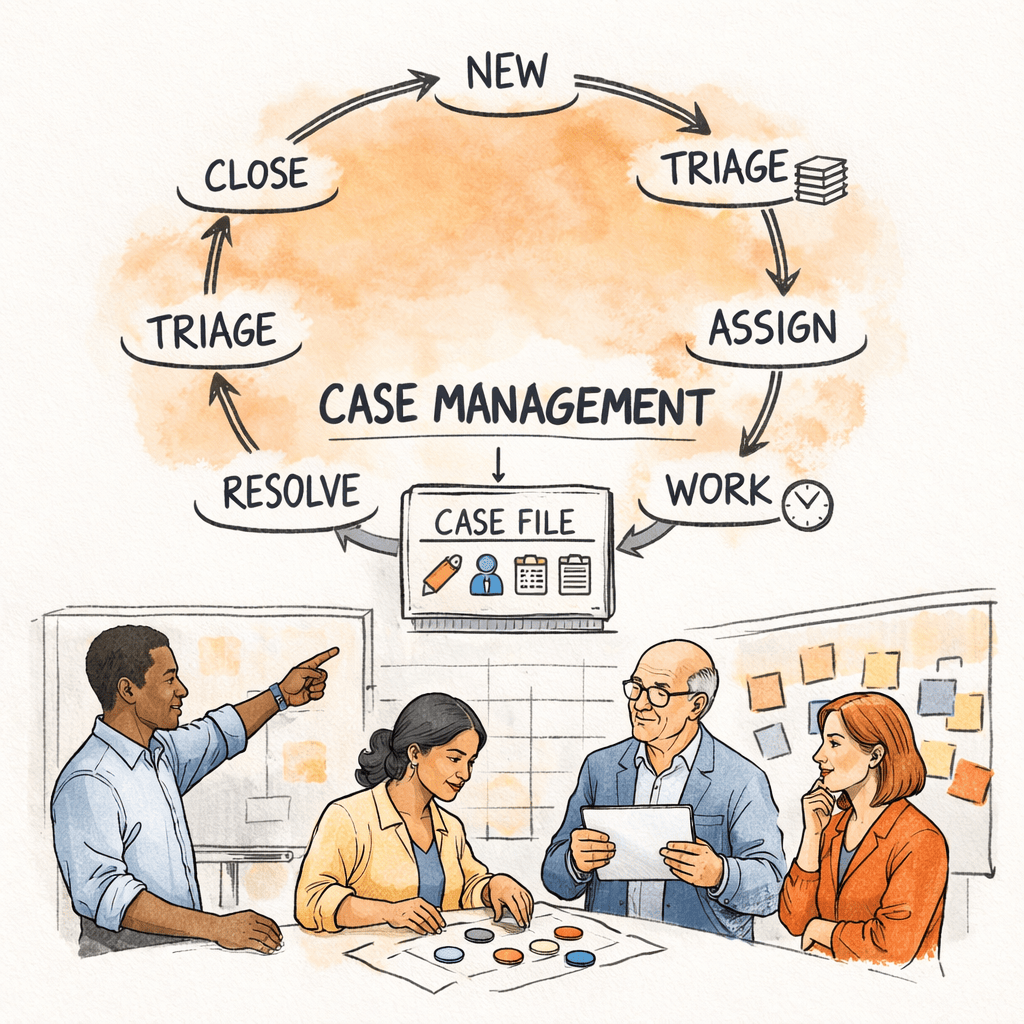
Definition and Scope
Case Management coordinates the lifecycle of cases—discrete, outcome-oriented work items—through governed yet adaptable workflows. It balances rules with discretion to manage variability, risk, and stakeholder expectations.
Defined as the orchestration of intake, investigation, decision, and resolution, it treats each case as a container for data, tasks, documents, and communications. In scope are human-centric, non-linear processes with dependencies and SLAs; out of scope are straight-through, high-volume transactions best handled by rigid workflow or RPA.
Primary domains include intake and triage; planning and assignment; collaboration and knowledge; compliance and audit; analytics and reporting; closure and learning. These interact via a case record, shared context, and rules engines, integrating with CRM, ERP, identity, and content services across on-premise, cloud, or hybrid landscapes.
Effective Case Management clarifies ownership, preserves traceability, and adapts to change without losing control. The scope is bounded by human judgement and complexity—where flexibility, assurance, and outcomes matter most.
Why Case Management Matters
Case Management matters because it converts fragmented, variable work into governed, outcome-driven operations. It creates transparency, accelerates resolution, and protects compliance in environments where rules and discretion must coexist.
Strategically, it links enterprise goals to day-to-day execution by making ownership, priorities, and service levels explicit. This enables reliable delivery, measurable value, and controlled risk across business units and jurisdictions.
Operationally, it absorbs market, regulatory, and technology change without re-engineering entire processes. Standardised case records, configurable rules, and automation reduce delays, rework, and handoffs—common sources of cost and customer dissatisfaction.
Stakeholders benefit in distinct ways:
- Executives: Portfolio risk visibility and auditability; improved compliance and customer outcomes.
- Managers: Balanced workloads and SLA adherence; seamless cross-team coordination.
- Caseworkers: Unified workspace and guidance; fewer handoffs and faster decisions.
Case Management strengthens decision quality, productivity, and innovation by combining structure with flexibility. Organisations gain resilience and scalability while safeguarding well-being and trust.
Business Case and Strategic Justification
A well-structured business case for Case Management links strategic ambition to measurable operational gains. It targets risk-heavy, variable work where governance, agility, and customer outcomes must improve together.
Case Management advances strategy by aligning policies, service levels, and ownership across functions. It addresses fragmented workflows, opaque decisions, regulatory exposure, and inconsistent customer experiences while enabling growth, scaling, and cross-border operations.
Return on investment is driven by fewer handoffs, faster cycle times, and right-first-time decisions. Benefits accrue from automation, workload balancing, embedded controls, and analytics. Typical metrics include reduced time to resolution, higher SLA attainment, lower rework, improved compliance adherence, and better NPS/CSAT.
Typical benefits include:
- Faster Resolution: 20–40% cycle-time reduction via triage and automation.
- Higher Compliance: Embedded controls, audit trails, and policy enforcement.
- Productivity Uplift: 15–30% throughput gains from balanced workloads.
- Better Experience: Clear status, fewer handoffs, and self-service.
- Actionable Insight: Analytics that expose bottlenecks and guide improvement.
The investment strengthens resilience and growth capacity while protecting trust. Next steps are to baseline metrics, prioritise use cases, and phase delivery for quick wins.
DON’T REINVENT THE WHEEL!
Get access to our Enterprise Standards to Drive Performance, Minimise Cost and Maximise Value.
How is Case Management Used?
Case Management is applied through a pragmatic framework that balances structure with flexibility. It combines a clear sequence of activities with guidance on what to avoid and what to emulate.
- The first perspective, process stages, defines how cases move from intake and triage through investigation, decision, fulfilment, and closure, ensuring traceability and service-level control.
- The second, common pitfalls to avoid, prepares teams to recognise failure modes—unclear ownership, excessive handoffs, weak controls—before they erode performance.
- The third, exemplar practices, distils techniques used by outperformers to accelerate throughput and improve outcomes.
Upcoming subsections—Key Phases and Process Steps; Identifying Pitfalls and Challenges; Learning from Outperformers—provide actionable detail for design and execution. Together, these perspectives create a repeatable path to consistent, compliant, and scalable Case Management.
Key Phases and Process Steps
Case Management progresses through a disciplined, end-to-end sequence that remains adaptable to complexity. The ten phases below define ownership, controls, and outcomes while allowing professional judgement.
1. Intake
Receive the request, validate legitimacy, capture context and initial data.
2. Registration & Classification
Create the case record; categorise, tag, and set SLAs.
3. Triage & Prioritisation
Assess urgency, risk, impact, and route to the right queue.
4. Planning & Assignment
Define objectives, approach, skills needed; assign owner and collaborators.
5. Information Gathering
Collect evidence, documents, and interactions; ensure data quality and traceability.
6. Analysis & Evaluation
Interpret facts, apply rules, model options, and quantify implications.
7. Decision & Authorisation
Record decisions, obtain approvals, document rationale, and update stakeholders.
8. Execution & Fulfillment
Implement actions, coordinate tasks, automate steps, and monitor progress.
9. Assurance & Controls
Enforce policies, manage risks, handle exceptions, and capture audit trails.
10. Closure & Learning
Verify outcomes, communicate resolution, archive records, and feed improvements.
Together these phases provide clear ownership, predictable throughput, and controlled compliance. The flow is linear when possible, adaptive when necessary, and always traceable.
Identifying Pitfalls and Challenges: Antipatterns and Worst Practices
Avoiding known pitfalls is essential to realise Case Management’s value. The lists below flag patterns that erode control, speed, and experience.
5 Antipattern Examples:
5 Worst Practice Examples:
Replace these with clear ownership, risk-based designs, integrated data, and embedded controls. Doing so increases throughput, consistency, and stakeholder trust. Continuous monitoring and rapid remediation keep performance and compliance on track.
Learning from Outperformers: Best Practices and Leading Practices
Outperformers pair disciplined execution with intelligent adaptability. Their practices reduce waste, accelerate resolution, and strengthen compliance.
5 Best Practice Examples:
5 Leading Practice Examples:
Adopt foundational practices first, then layer advanced patterns where risk, volume, and variability warrant. Measure relentlessly to sustain gains and compound value.
Who is Typically Involved with Case Management?
Clear role definition is the backbone of effective Case Management. It aligns decision rights, accelerates handoffs, and embeds accountability across business and technology teams.
Primary roles include:
- Executive Sponsor: Sets ambition, secures funding, removes blockers; aligns outcomes with strategy.
- Process Owner: Defines policies, SLAs, and controls; steers design and resolves cross-functional issues.
- Operations Manager: Balances workloads, manages capacity, and drives day-to-day performance and quality.
- Case Owner/Lead: Holds end-to-end accountability, coordinates collaborators, and communicates status to stakeholders.
- Platform/IT Product Owner: Evolves the case platform, integrations, and analytics in partnership with the business.
Stakeholder influence and benefits:
- Executives & Middle Management: Use portfolio insights to steer priorities, manage risk, and prove value through KPI dashboards.
- Technical Teams: Deliver reliable platforms, automate low-value tasks, and enable secure data exchange.
- End Users (Caseworkers/Customers): Gain clear guidance, self-service options, and shorter time-to-resolution.
Defined responsibilities and collaboration paths reduce friction and rework. With the right roles in place, organisations deliver consistent outcomes, scale with confidence, and sustain improvement.
Where is Case Management Applied?
Case Management spans functions where work is variable, high-stakes, and multi-party. It standardises how requests become decisions and outcomes while preserving discretion and auditability.
Primary domains:
- Customer Service: Manage complaints, escalations, and service recovery with SLAs and root-cause capture.
- Operations: Coordinate incident handling, quality deviations, and supplier issues across sites and shifts.
- Finance & Risk: Orchestrate credit reviews, disputes, fraud investigations, and controls testing.
- HR: Handle grievances, investigations, accommodations, and complex onboarding/offboarding.
- IT & Security: Govern incidents, changes, access requests, and cyber investigations with clear ownership.
Illustrative scenarios:
- Product Recall: Cross-functional case swarms trace lots, notify customers, and close corrective actions.
- Third-Party Breach: Security, legal, and procurement coordinate containment, disclosure, and remediation.
These use cases share the need for traceability, collaboration, and risk-aware decision-making. Case Management provides the platform and practices to deliver consistent outcomes across industries and operating models.
When Should You Embrace Case Management?
Choosing the right moment to introduce Case Management determines how quickly value is realised and how well change endures. Organisations should watch for clear signals and confirm a few essentials first.
Scenarios signalling readiness:
- Rapid Scaling: Demand and complexity outpace informal coordination; governance and SLAs are needed.
- Regulatory Shifts: New rules or audits require embedded controls, evidence, and traceability.
- Backlog Creep: Ageing queues and missed SLAs call for triage and workload balancing.
- Cross-Functional Incidents: Recalls or breaches need orchestrated, multi-team resolution with clear ownership.
- Technology Refresh: Consolidating legacy tools benefits from a standardised case model and workflows.
Prerequisites:
- Executive Mandate: Visible sponsor, funding, and urgency.
- Clear Use Cases: Prioritised scope and measurable success metrics.
- Process Baseline: Defined policies, SLAs, and ownership.
- Data Readiness: Known sources, integrations, identity, and content services.
- Change Capacity: Product owner, SMEs, training, and support.
Act when signals converge and prerequisites are met. This timing accelerates adoption, reduces risk, and sustains performance improvements across functions and channels.
Most Common Case Management Artefacts
Well-defined artefacts make Case Management repeatable, auditable, and scalable. They codify how information is captured, decisions are made, and work is monitored across teams and channels. The items below are the building blocks most organisations rely on.
The core artefacts and tools are:
- Case Type & Record Template: Standardises metadata, status model, confidentiality, and required fields across case variants.
- Intake & Triage Form: Structures request capture, validates completeness, classifies risk/priority, and routes to the right queue.
- Workflow & Decision Model: Maps stages, tasks, approvals, and decision logic (e.g., rules catalogues) to ensure consistent outcomes.
- SLA & Escalation Matrix: Defines response/resolution targets, thresholds, alerts, and escalation paths to protect service levels.
- Operational Dashboard & Audit Trail: Provides real-time WIP, ageing, and bottlenecks while preserving evidence, rationale, and timestamps.
Together these artefacts align policy with execution, reduce rework, and enable continuous improvement. They support governance, analytics, and automation, ensuring cases move quickly without sacrificing control or customer experience.
The Artefacts Table
This page summarises the artefacts that make Case Management consistent, auditable, and scalable. It clarifies each artefact’s purpose and how it is applied in day-to-day operations to drive control and speed.
| Artefact | Description | Practical use |
|---|---|---|
| Case Type & Record Template | A standard structure for case metadata, status model, confidentiality, and required fields. | Creates consistent cases across departments (e.g., complaints, incidents) and enforces mandatory data at creation. |
| Intake & Triage Form | A structured capture form that validates completeness, classifies priority and risk, and routes requests. | Used in portals and contact centres to reduce rework and direct high-risk cases to specialist queues. |
| Workflow & Decision Model | A mapped set of stages, tasks, approvals, and rules that govern progression and decisions. | Automates approvals, coordinates handoffs, and ensures policy adherence during investigations. |
| SLA & Escalation Matrix | Defined response and resolution targets with thresholds, alerts, and escalation paths. | Triggers alerts as deadlines approach and auto-escalates critical cases to senior reviewers. |
| Operational Dashboard & Audit Trail | Real-time visibility of work-in-progress, ageing, and bottlenecks with immutable evidence and timestamps. | Enables managers and auditors to monitor throughput, prove compliance, and conduct post-incident reviews. |