
Enterprise Management
Production Management
Reference Content ID: #LEAD-ES10010BC
Introduction to Production Management
Production Management provides the structured discipline required to plan, coordinate, and control the processes that transform inputs into finished products or services. It establishes the operational backbone that organisations rely on to deliver consistent quality, manage resources efficiently, and align day-to-day execution with strategic objectives.
Its core principles centre on workflow optimisation, capacity planning, performance monitoring, quality assurance, and continuous improvement. These components work together to reduce variability, eliminate waste, and strengthen operational reliability across all production environments—whether in manufacturing, service delivery, or digital operations. Production Management applies equally in large enterprises, mid-sized organisations, and public institutions.
By orchestrating clear processes, shared standards, and integrated digital tools, Production Management enhances productivity, supports cross-functional collaboration, and simplifies work for teams on-site, hybrid, or remote. It creates a stable operating environment that reduces friction, improves well-being, and enables smoother, technology-supported workflows. This section outlines the foundational concepts and practical relevance of Production Management across diverse organisational contexts.
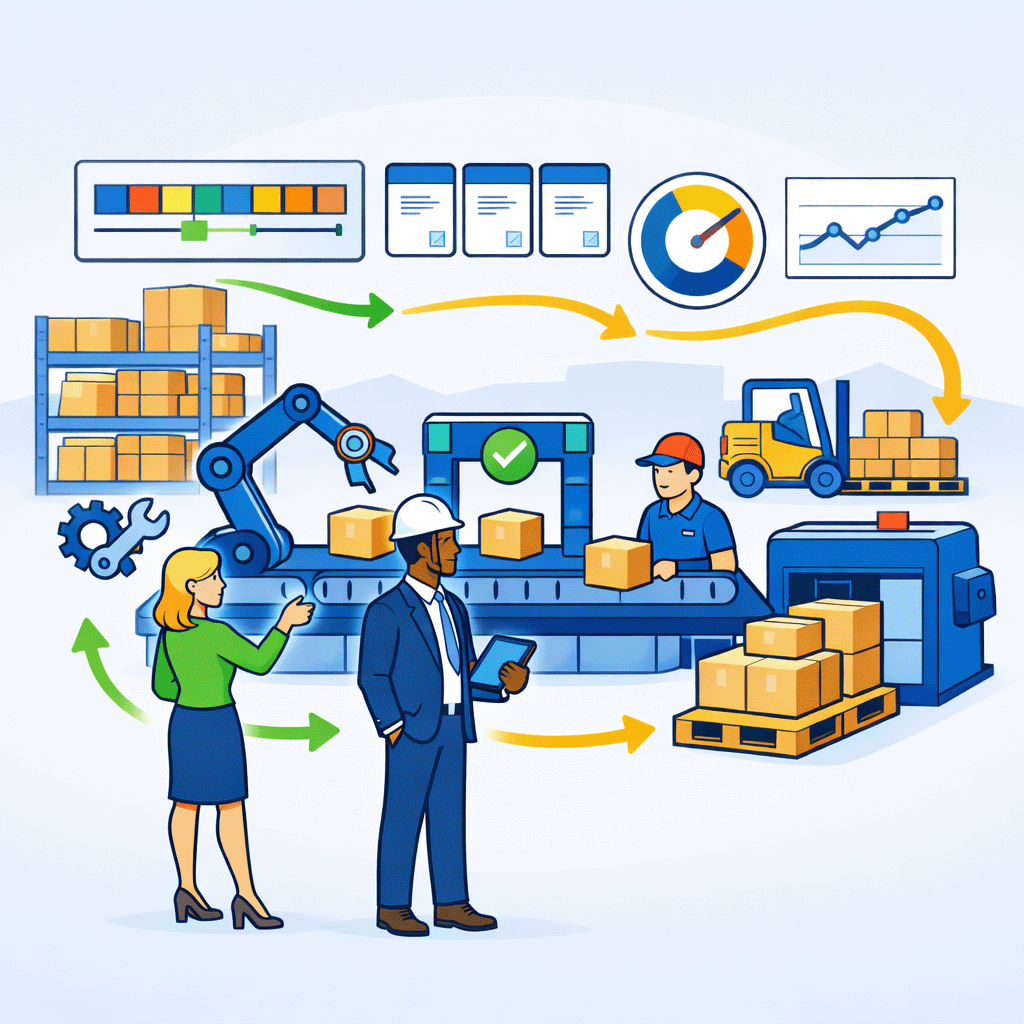
Definition and Scope
Production Management provides the structured discipline for planning, organising, directing, and controlling the activities required to produce goods or services. It establishes the methods and principles that ensure resources, processes, and technologies operate in a coordinated and efficient manner. This subsection clarifies the essential concepts of Production Management and the boundaries that define its application.
Its core domains include demand planning, workflow design, scheduling, resource allocation, quality control, and performance monitoring. These components govern how inputs are transformed into outputs across physical, digital, and service-based environments. While closely connected to areas such as product development and commercial planning, Production Management does not extend into strategic decision-making or sales execution.
Together, these elements function as an integrated system that adapts to organisational structures and technology platforms. They shape the operational environment in which Production Management delivers consistent performance and measurable value.
Why Production Management Matters
Production Management is essential for ensuring that organisations can meet evolving customer expectations, operate efficiently, and remain competitive in dynamic markets. It creates the operational discipline needed to translate strategic objectives into reliable execution and supports organisations as they adapt to technological change and shifting demand.
It enables consistent performance by reducing process variability, improving resource utilisation, and ensuring that teams work within clear workflows and standards. Executives rely on it to gain visibility into operational performance, managers use it to coordinate teams effectively, and end users benefit from simplified processes that minimise friction in daily work.
- Operational Transparency: Improves decision-making by giving leaders real-time insight into performance and capacity.
- Process Efficiency: Streamlines workflows, reducing delays and rework across production environments.
- Innovation Enablement: Creates stable foundations that allow organisations to introduce new tools and technologies with lower risk.
Production Management strengthens organisational resilience and enhances both productivity and quality. It enables teams at all levels to operate confidently and consistently while supporting strategic progress.
Business Case and Strategic Justification
A strong business case for Production Management rests on its ability to connect daily operations with strategic goals while ensuring consistent, high-quality output. Organisations adopt Production Management to address inefficiencies, reduce operational risk, and create a scalable foundation that supports growth. It responds to increasing pressure for faster delivery, higher customer expectations, and the need for better coordination across functions.
Production Management aligns directly with corporate objectives such as cost optimisation, quality improvement, and digital transformation. Its return on investment is realised through reduced waste, improved utilisation of resources, higher throughput, and fewer operational disruptions. Organisations benefit from measurable gains in productivity, cycle-time reductions, and more predictable performance outcomes.
The most typical benefits of Production Management include:
- Efficiency Gains: Reduces process waste and shortens cycle times.
- Cost Reduction: Lowers operating expenses through better resource utilisation.
- Quality Improvement: Enhances consistency and reduces defects.
- Risk Mitigation: Minimises operational disruptions and compliance issues.
- Scalability: Supports business growth through structured and repeatable processes.
Production Management provides a clear return through improved stability and performance. It strengthens operational capability and creates the conditions for sustainable value creation, making it an essential investment for organisations committed to long-term success.
DON’T REINVENT THE WHEEL!
Get access to our Enterprise Standards to Drive Performance, Minimise Cost and Maximise Value.
How is Production Management Used?
Production Management is applied through a structured framework that helps organisations organise work, avoid common pitfalls, and adopt proven practices. It offers a clear lens for understanding how production activities should be planned, executed, monitored, and improved. This framework supports consistent performance and ensures alignment between operational tasks and strategic objectives.
- The first perspective, Key Phases & Process Steps, outlines the end-to-end workflow from planning to delivery.
- The second, Identifying Pitfalls & Challenges, highlights the obstacles and failure patterns that can disrupt production.
- The third, Learning from Outperformers, presents leading practices that strengthen collaboration, quality, and efficiency.
Together, these perspectives guide organisations in designing robust production systems and improving daily operations. They provide a balanced foundation for effective implementation and ongoing optimisation of Production Management.
Key Phases and Process Steps
Production Management follows a structured set of phases that guide work from initial planning through execution, monitoring, and continuous improvement. These ten steps provide a clear, repeatable framework that supports consistent quality, efficient resource use, and reliable delivery. Each phase builds on the previous one to create an integrated production lifecycle.
1. Demand Analysis
Defines customer or internal requirements to determine production needs.
2. Capacity Planning
Assesses resource availability to ensure feasible production levels.
3. Workflow Design
3. Workflow Design: Maps activities, roles, and handovers for streamlined execution.
4. Scheduling
Establishes timelines, sequencing, and task prioritisation.
5. Resource Allocation
Assigns people, tools, and materials based on demand and capacity.
6. Execution Management
Oversees day-to-day production activities and resolves issues.
7. Quality Control
Verifies output accuracy and adherence to agreed standards.
8. Performance Monitoring
Tracks progress using KPIs and operational metrics.
9. Issue Resolution
Identifies deviations, applies corrective actions, and prevents recurrence.
10. Continuous Improvement
Optimises processes based on insights and performance feedback.
These phases ensure a stable, transparent, and controlled production environment. The structured flow enables organisations to coordinate effectively, reduce inefficiencies, and drive ongoing operational excellence.
Identifying Pitfalls and Challenges: Antipatterns and Worst Practices
Effective Production Management requires awareness of behaviours and patterns that undermine performance. Organisations often struggle not because of missing processes, but due to recurring antipatterns and poor practices that create delays, reduce quality, and weaken collaboration. Recognising these challenges early helps prevent operational instability and inefficiency.
5 Antipattern Examples:
5 Worst Practice Examples:
Avoiding these pitfalls strengthens operational discipline and enhances production reliability. Addressing them proactively enables smoother workflows, more resilient processes, and better overall performance.
Learning from Outperformers: Best Practices and Leading Practices
Organisations that excel in Production Management combine disciplined execution with forward-looking methods that enhance reliability, efficiency, and adaptability. Their success provides valuable guidance for others seeking to strengthen operational performance. These practices demonstrate how structured processes and continuous innovation work together to create resilient production environments.
5 Best Practice Examples:
5 Leading Practice Examples:
Adopting these practices helps organisations elevate their operational maturity and position Production Management as a strategic capability. They enable stronger outcomes, higher resilience, and sustained competitive advantage.
Who is Typically Involved with Production Management?
Clear role definitions are essential for effective Production Management, as they ensure accountability, smooth coordination, and consistent decision-making. Each participant contributes specific expertise that supports planning, execution, and continuous improvement. Understanding these roles helps organisations build strong operational governance and avoid gaps in ownership.
The primary roles involved in Production Management include:
- Executive Sponsor: Provides strategic direction and secures organisational commitment.
- Production Manager: Oversees end-to-end production activities and ensures workflow continuity.
- Operations Lead: Coordinates daily operations, resolves issues, and supports team performance.
- Quality Specialist: Ensures outputs meet defined standards and manages quality controls.
- Technical Support Team: Maintains systems, tools, and technologies that enable production.
Different stakeholder groups contribute and benefit in distinct ways:
- Executive Leadership: Uses production insights to guide strategic investments and risk decisions.
- Middle Management: Improves team coordination and resource utilisation through structured processes.
- End Users & Technical Staff: Gain clarity, reduced friction, and better support for daily tasks.
Clear ownership across these roles strengthens collaboration, improves workflow transparency, and enhances production reliability. It enables organisations to operate with greater confidence and consistency.
Where is Production Management Applied?
Production Management is used across a wide range of organisational functions to improve efficiency, reliability, and coordination. It supports both operational and knowledge-based activities, ensuring structured workflows and predictable outcomes. Its breadth of application makes it a valuable discipline for organisations seeking consistency and high performance.
The primary organisational domains include:
- Operations: Manages production workflows, resource usage, and daily execution.
- IT & Digital Services: Coordinates service delivery, system changes, and support activities.
- Customer Service: Structures case handling, response processes, and quality monitoring.
- Finance: Streamlines recurring activities such as reporting, reconciliation, and approvals.
- Supply Chain: Oversees inventory flow, procurement cycles, and logistics processes.
Illustrative scenarios include:
- Cross-Functional Projects: Teams use structured workflows to reduce delays and align deliverables.
- Service Teams: Support functions apply Production Management to manage workload peaks and improve response times.
Production Management proves valuable across diverse organisational contexts by providing clarity, structure, and operational stability. Its adaptability enables teams to address challenges effectively and improve overall performance.
When Should You Embrace Production Management?
The timing of adopting Production Management has a direct impact on its effectiveness and long-term value. Organisations benefit most when they introduce it at moments of change, increased complexity, or rising performance expectations. Understanding the right conditions and prerequisites helps ensure a smooth and successful implementation.
Key scenarios that indicate the right moment include:
- Rapid Growth: Increased volume requires structured processes to maintain consistency.
- Operational Complexity: Expanding product lines or services demand clearer coordination.
- Market Pressure: Competitive or regulatory shifts require greater efficiency and control.
- Technology Modernisation: New digital tools need integrated workflows to deliver value.
- Performance Gaps: Persistent delays, defects, or bottlenecks highlight the need for discipline.
Before adopting Production Management, organisations should ensure stakeholder alignment, available resources for change, clarity of responsibilities, and a baseline maturity in related processes such as planning and reporting.
Recognising these signals enables organisations to introduce Production Management at the right moment for maximum impact. With proper readiness, teams can achieve faster adoption, stronger performance gains, and more sustainable operational improvements.
Most Common Production Management Artefacts
Production Management relies on a set of practical artefacts that bring structure, visibility, and control to daily operations. These tools support consistent execution, enable better decision-making, and help teams coordinate effectively across functions. Understanding their purpose allows organisations to apply them with clarity and impact.
The primary artefacts include:
- Production Plan: Outlines expected demand, required resources, and planned output for a defined period.
- Workflow Map: Visualises process steps, handovers, and responsibilities to ensure structured execution.
- Scheduling Board: Organises tasks, timelines, and dependencies to manage work sequencing.
- Quality Checklist: Defines criteria and control points to verify accuracy and compliance during production.
- Performance Dashboard: Tracks key metrics such as throughput, cycle time, and defect rates for monitoring and improvement.
These artefacts provide the operational backbone that enables teams to work consistently and transparently. They support clearer communication, reduce uncertainty, and strengthen the overall effectiveness of Production Management.
The Artefacts Table
The following table summarises the core artefacts used in Production Management, providing a quick reference to what each artefact is and how it is applied in practice. It is intended to support consistent use of terminology and improve alignment across teams working with production processes.
| Artefact | Description | Practical use |
|---|---|---|
| Production Plan | A structured overview of expected demand, resources, and planned output over a defined period. | Used by managers to align capacity with demand, set realistic targets, and coordinate production activities across teams. |
| Workflow Map | A visual representation of process steps, handovers, and responsibilities within the production flow. | Applied in process design and improvement workshops to identify bottlenecks, clarify roles, and streamline execution. |
| Scheduling Board | A planning tool that organises tasks, timelines, and dependencies into a coherent schedule. | Used in daily or weekly planning sessions to prioritise work, manage sequencing, and adjust to changing conditions. |
| Quality Checklist | A predefined list of quality criteria and control points to verify output against standards. | Applied during production and inspection activities to ensure compliance, reduce defects, and support audits. |
| Performance Dashboard | A consolidated view of key performance indicators related to throughput, cycle time, and defects. | Used by leaders and teams to monitor performance trends, detect issues early, and drive continuous improvement initiatives. |
Together, these artefacts provide structure, transparency, and control across the production lifecycle. They help organisations translate strategic objectives into operational reality, support informed decisions, and enable teams to manage performance in a consistent and disciplined way.