
Enterprise Management
Planning Management
Reference Content ID: #LEAD-ES10007BC
Introduction to Planning Management
Effective planning is a cornerstone of organisational performance. Planning Management provides the structure and methodology to align resources, objectives, and timelines in support of strategic and operational success.
At its core, Planning Management centres around synchronising business priorities with structured foresight and coordination. It encompasses components such as objective setting, resource allocation, milestone tracking, and progress evaluation. These foundational elements enable teams to manage time, talent, and technology with clarity and control.
Applicable across industries and functions, Planning Management creates value by enhancing productivity, improving communication, and fostering collaboration. Whether in on-site teams, hybrid models, or remote environments, it facilitates coordinated digital workflows and strengthens employee well-being by reducing ambiguity and stress.
Planning Management equips organisations with the clarity, agility, and structure needed to manage complexity and deliver consistent outcomes. It is a foundational capability for driving execution across evolving enterprise landscapes.
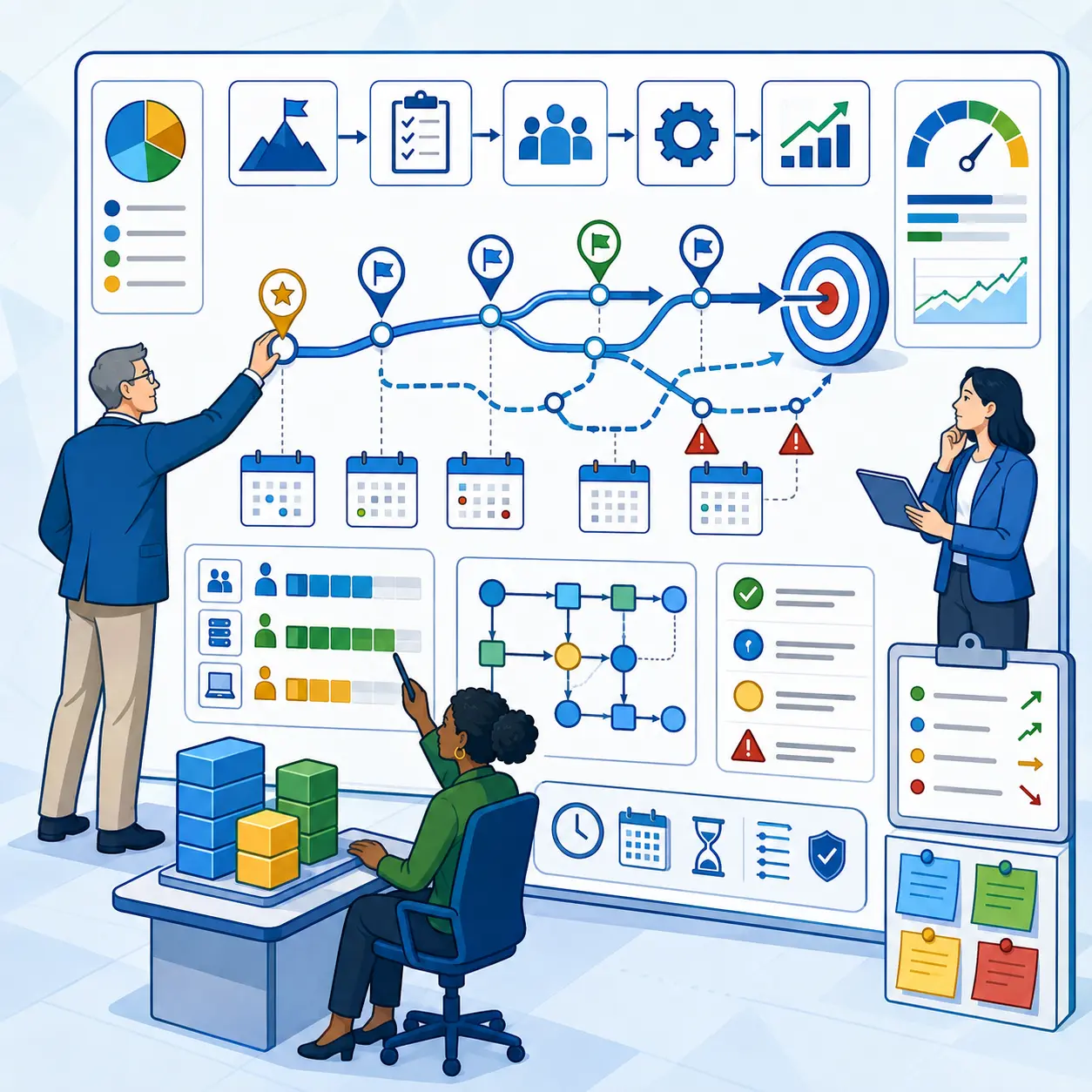
Definition and Scope
Planning Management provides the structure for aligning strategic intent with operational execution. It defines how goals are translated into actionable plans, allocating resources and sequencing tasks to drive measurable progress.
At its core, Planning Management involves setting objectives, defining priorities, developing timelines, and managing dependencies. It includes domains such as strategic planning, operational planning, capacity planning, and project planning. These components work together to ensure decisions are time-bound, resource-aware, and outcome-focused across business units, functions, or technology platforms.
While Planning Management covers forward-looking coordination and execution readiness, it does not include ad hoc decision-making or reactive crisis management. It supports proactive management by instilling consistency and accountability.
In any environment—digital, physical, or hybrid—Planning Management connects intent with impact. Its structured, disciplined approach ensures organisations stay aligned, agile, and outcome-driven.
Why Planning Management Matters
Planning Management plays a vital role in aligning long-term strategy with day-to-day execution. It enables organisations to navigate complexity, optimise performance, and adapt to changing market conditions with confidence and clarity.
Effective planning ensures that resources are prioritised and deployed where they create the greatest value. It strengthens the organisation’s ability to anticipate disruption, respond to emerging technologies, and manage interdependencies across functions. By creating a shared roadmap, it helps resolve misalignment, reduce duplication, and clarify accountability.
Different stakeholder groups rely on Planning Management to inform their actions and decisions:
- Executives: Gain visibility into strategic progress and ensure alignment across portfolios.
- Managers: Coordinate tasks, balance workloads, and monitor progress across teams.
- End Users: Experience greater transparency, clearer priorities, and improved access to support and resources.
Planning Management creates a foundation for organisational agility and resilience. It empowers all levels of the enterprise to act decisively, collaboratively, and with purpose.
Business Case and Strategic Justification
Planning Management supports the strategic foundation of any organisation by ensuring that initiatives are properly aligned, resourced, and executed with discipline. It translates corporate objectives into structured plans, allowing leadership to manage priorities, risks, and outcomes proactively.
The investment in Planning Management delivers measurable returns through improved resource efficiency, faster decision-making, and better utilisation of capital and talent. It helps organisations mitigate uncertainty, reduce operational waste, and improve forecasting accuracy—all of which directly contribute to cost reduction and increased value delivery.
The most common benefits of Planning Management include:
- Strategic Alignment: Ensures all initiatives support business goals and deliver value across functions.
- Resource Optimisation: Matches available capacity with actual demand to minimise waste and bottlenecks.
- Improved Forecasting: Enhances accuracy in demand, cost, and delivery projections.
- Faster Execution: Reduces delays by identifying dependencies and proactively managing timelines.
- Risk Mitigation: Identifies planning gaps and prevents project failures through early intervention.
Planning Management strengthens operational discipline while enabling agility. It supports a consistent planning rhythm and offers a clear pathway to improved enterprise performance.
DON’T REINVENT THE WHEEL!
Get access to our Enterprise Standards to Drive Performance, Minimise Cost and Maximise Value.
How is Planning Management Used?
Planning Management is applied through structured frameworks that balance discipline with adaptability. It enables organisations to coordinate activities, align resources, and execute strategic initiatives efficiently.
The practical use of Planning Management can be viewed through three core perspectives:
- Defined process stages that guide end-to-end planning.
- Common pitfalls that highlight what to avoid.
- Exemplar practices that showcase how high-performing organisations succeed.
Together, these perspectives provide a complete view of how to plan effectively and sustainably.
The subsection on Key Phases and Process Steps outlines the sequential flow of planning activities. Identifying Pitfalls and Challenges explores recurring mistakes that reduce impact. Learning from Outperformers presents proven practices and lessons from leaders in planning excellence.
By understanding and integrating these three perspectives, organisations can apply Planning Management in a way that is structured, resilient, and results-driven. This framework supports informed decisions and consistent value delivery.
Key Phases and Process Steps
Planning Management follows a structured, repeatable sequence of steps that enables organisations to move from strategic intent to operational execution. Each phase builds upon the previous, ensuring clarity, alignment, and adaptability across teams and functions.
1. Vision & Goal Setting
Establishes the overarching direction and measurable objectives.
2. Needs & Demand Assessment
Identifies resource requirements, constraints, and anticipated demand.
3. Prioritisation & Alignment
Ranks initiatives and aligns them with organisational strategy.
4. Capacity & Resource Planning
Matches available capabilities and resources to planned activities.
5. Scenario Planning
Models alternative paths and prepares for uncertainties or disruptions.
6. Timeline & Milestone Definition
Sets clear schedules, deadlines, and key checkpoints.
7. Dependency & Risk Analysis
Evaluates critical interdependencies and potential risks.
8. Plan Consolidation & Validation
Finalises integrated plans and secures stakeholder approval.
9. Execution & Coordination
Implements plans with active tracking and team coordination.
10. Review & Continuous Improvement
Assesses outcomes, captures lessons, and refines future plans.
This ten-step approach enables structured, end-to-end planning while allowing flexibility for change. It ensures that plans are actionable, sustainable, and closely tied to organisational goals.
Identifying Pitfalls and Challenges: Antipatterns and Worst Practices
While Planning Management offers a structured path to execution, it is often undermined by recurring pitfalls. These include both behavioural antipatterns and procedural worst practices that weaken planning effectiveness and reduce value delivery.
5 Antipattern Examples:
5 Worst Practice Examples:
Avoiding these pitfalls helps establish realistic, adaptable, and inclusive planning processes. Recognising and correcting them early leads to more resilient and impactful Planning Management.
Learning from Outperformers: Best Practices and Leading Practices
Organisations that excel in Planning Management apply a blend of proven best practices and forward-looking leading practices. These approaches help them operate with precision, agility, and long-term alignment.
5 Best Practice Examples:
5 Leading Practice Examples:
By learning from outperformers, organisations can evolve from static planning to a dynamic, insight-driven capability. These practices drive alignment, efficiency, and strategic resilience.
Who is Typically Involved with Planning Management?
Successful Planning Management depends on clear roles and collaboration across levels of the organisation. Understanding who is responsible, accountable, and informed ensures consistency, ownership, and alignment throughout the planning lifecycle.
The five key roles commonly involved include:
- Executive Sponsor: Sets strategic direction, provides resources, and ensures alignment with corporate goals.
- Planning Manager: Leads the planning process, coordinates stakeholders, and ensures methodological consistency.
- Project or Program Lead: Translates plans into actionable workstreams and tracks progress toward milestones.
- Operations Manager: Aligns plans with operational capacity and ensures feasibility of execution.
- Finance or Portfolio Analyst: Supports decision-making with cost modelling, forecasts, and performance metrics.
Stakeholder involvement and benefits include:
- Executives: Use planning insights to drive investments and prioritisation.
- Middle Management: Coordinate across teams and ensure plans are actionable.
- Technical Teams: Use plans to synchronise development and resource needs.
Clear role definitions create accountability and improve planning accuracy. Effective Planning Management relies on collaboration and shared ownership across all levels.
Where is Planning Management Applied?
Planning Management is widely applicable across industries and functions, serving as a foundational discipline for structuring initiatives, allocating resources, and achieving organisational objectives. Its principles are tailored to suit the needs of specific domains while ensuring enterprise-wide consistency and coordination.
The five key domains where Planning Management is commonly applied include:
- Finance: Supports budgeting, forecasting, and capital allocation aligned with financial strategy.
- IT: Manages technology roadmaps, system upgrades, and resource planning across projects.
- Operations: Coordinates production schedules, supply chain needs, and capacity planning.
- Human Resources: Plans workforce needs, hiring timelines, and talent development strategies.
- Customer Service: Aligns staffing, service levels, and process improvement initiatives with customer expectations.
Illustrative scenarios include:
- A global IT team uses Planning Management to synchronise multiple software rollouts while mitigating resource conflicts.
- An operations department leverages Planning Management to balance seasonal production demands with supplier capacity.
Planning Management enables scalable planning across diverse functions, from tactical execution to strategic delivery. Its adaptability makes it an essential discipline for both core business functions and cross-functional initiatives.
When Should You Embrace Planning Management?
Timing is critical when adopting Planning Management. Implementing it too early may lead to inefficiencies, while adopting it too late risks disorganisation and misalignment. Recognising the right conditions ensures the discipline adds immediate and lasting value.
Five common scenarios indicating readiness include:
- Organisational Growth: Rapid scaling requires structured planning to manage complexity.
- Market or Regulatory Shifts: New conditions demand strategic re-alignment and responsive planning.
- Technology Implementations: Large system upgrades or transformations need structured coordination.
- Resource Constraints: Limited capacity requires better prioritisation and utilisation.
- Cross-Functional Initiatives: Collaborative efforts benefit from integrated, transparent planning.
Essential prerequisites for success include:
- Stakeholder Alignment & Executive Sponsorship
- Defined Strategic Objectives & Success Criteria
- Available Planning & Analytical Resources
- Clear Roles & Governance Structures
- Established Data & Reporting Processes
Recognising the right signals ensures that Planning Management delivers structure, clarity, and impact. Well-timed adoption sets the foundation for disciplined growth and sustainable execution.
Most Common Planning Management Artefacts
Artefacts play a central role in structuring, documenting, and communicating Planning Management activities. These tools provide clarity, consistency, and traceability across teams and planning cycles, enabling better execution and decision-making.
Five of the most widely used artefacts in Planning Management include:
- Strategic Planning Framework: Outlines long-term objectives, guiding principles, and priorities that shape planning efforts.
- Capacity & Resource Plan: Details available resources, capabilities, and constraints to inform feasible planning decisions.
- Integrated Project Timeline: Visualises key milestones, dependencies, and delivery windows across initiatives.
- Scenario Planning Matrix: Presents alternative planning options and their potential impacts to support informed decisions.
- Planning Review Dashboard: Aggregates performance data, progress indicators, and risk insights for ongoing plan monitoring.
These artefacts help structure thinking, ensure alignment, and support iterative improvement. When consistently applied, they make Planning Management more transparent, measurable, and results-oriented.
The Artefacts Table
The following table summarises five core artefacts commonly used in Planning Management. Each artefact plays a distinct role in supporting structure, coordination, and informed decision-making throughout the planning lifecycle.
| Artefact | Description | Practical Use |
|---|---|---|
| Strategic Planning Framework | Defines overarching goals, principles, and strategic priorities. | Used to align all planning activities with the organisation’s long-term direction. |
| Capacity & Resource Plan | Maps resource availability and capability across functions. | Supports realistic planning by matching workload to available capacity. |
| Integrated Project Timeline | Provides a visual overview of milestones, deadlines, and dependencies. | Helps teams coordinate delivery schedules and manage time-critical activities. |
| Scenario Planning Matrix | Explores multiple planning options and their likely outcomes. | Used to prepare for uncertainty and guide strategic decision-making. |
| Planning Review Dashboard | Consolidates KPIs, risks, and progress data into a single view. | Enables real-time tracking and supports course corrections when needed. |
These artefacts form the backbone of a disciplined Planning Management approach. When used consistently, they enhance visibility, improve coordination, and drive timely, data-informed decisions.