
Enterprise Management
Enterprise DNA
Reference Content ID: #LEAD-ES10029ALL
Introduction to Enterprise DNA
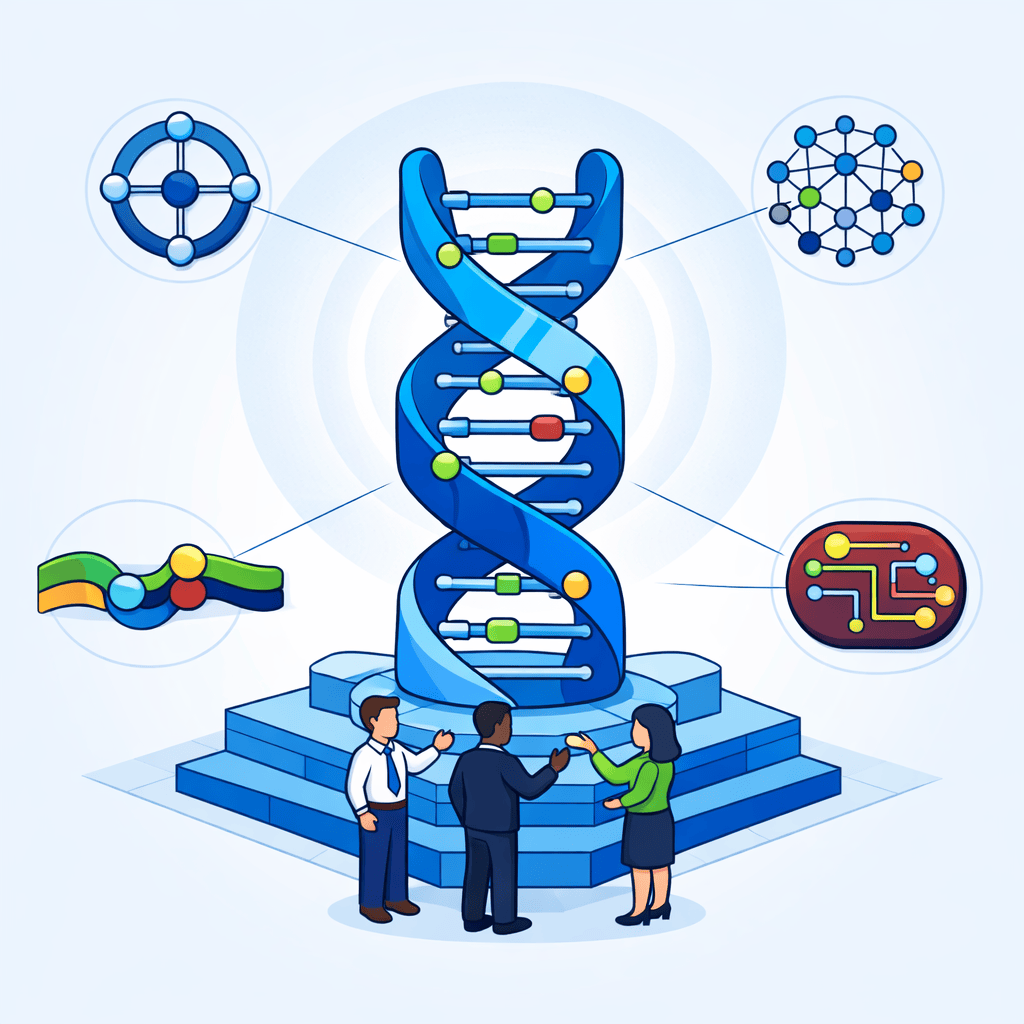
Enterprise DNA represents the underlying structure that defines how an organisation operates, connects, and evolves. It encompasses the fundamental design principles, core processes, and cultural elements that shape enterprise performance and adaptability. By aligning people, processes, technology, and governance, Enterprise DNA provides the foundation for resilience and growth in dynamic environments.
Its key focus areas include organisational models, decision-making structures, information flows, and digital capabilities. Together, these components enable enterprises to streamline operations, improve cross-functional collaboration, and embed continuous learning. Enterprise DNA applies across all industries and sectors, supporting both established corporations and rapidly scaling organisations.
By strengthening Enterprise DNA, organisations unlock measurable value—boosting productivity, fostering collaboration, supporting workforce well-being, and enabling digital workflows for on-site, hybrid, and remote teams. This creates coherence, agility, and sustainable impact across the enterprise.
Definition and Scope
Enterprise DNA refers to the inherent blueprint that determines how an organisation is structured, governed, and enabled to achieve its objectives. It encompasses the essential concepts of strategy alignment, process integration, cultural values, and technology enablement that together shape enterprise behaviour and outcomes. While it is broad in scope, it is not a substitute for detailed operational planning or specialised technical solutions; instead, it provides the overarching framework that guides these efforts.
The primary components of Enterprise DNA include organisational structure, decision-making models, digital platforms, data flows, and workforce engagement. These domains interact by aligning strategy with execution, embedding collaboration across teams, and ensuring that technology supports both operational efficiency and innovation. In this way, Enterprise DNA defines the boundaries of enterprise coherence while leaving space for tailored execution.
Why Enterprise DNA Matters
Enterprise DNA matters because it provides the structural foundation that enables organisations to translate strategy into execution with speed and precision. In a business environment shaped by rapid technological advances and shifting market dynamics, a well-defined Enterprise DNA ensures resilience, agility, and clarity of direction. It connects long-term ambitions with day-to-day operations, reducing complexity and enabling organisations to respond effectively to change.
By embedding coherent structures, information flows, and cultural norms, Enterprise DNA addresses common organisational challenges such as siloed operations, misaligned priorities, and inefficient decision-making. Executives benefit from clearer governance and oversight, managers gain tools to optimise processes, and employees experience smoother collaboration and improved digital workflows.
Examples of impact include:
• Informed Decision-Making: Executives access integrated data to steer enterprise strategy.
• Operational Efficiency: Managers coordinate resources and processes with greater transparency.
• Innovation Capacity: Teams collaborate seamlessly across locations to accelerate new solutions.
A strong Enterprise DNA is therefore critical for sustaining competitiveness, enabling innovation, and ensuring that every part of the organisation contributes to shared goals.
Business Case and Strategic Justification
The business case for Enterprise DNA is rooted in its ability to align corporate objectives with practical execution, ensuring that strategy is consistently translated into measurable outcomes. It addresses critical challenges such as organisational silos, inefficiencies, and lack of agility, while also enabling enterprises to capture opportunities from digital transformation and evolving market demands. By embedding a coherent structure, organisations can ensure that every initiative contributes to long-term growth and resilience.
The return on investment comes from tangible efficiency gains, reduced operating costs, enhanced decision-making, and improved innovation cycles. Benchmarks often include reduced time-to-market for new products, increased workforce productivity, and measurable improvements in customer and employee satisfaction. The cost of inaction—fragmented processes, duplicated efforts, and slow responses to change—underscores the importance of Enterprise DNA.
Typical benefits of Enterprise DNA include:
- Strategic alignment: Clear linkage between corporate objectives and daily execution.
- Operational efficiency: Streamlined processes that reduce waste and duplication.
- Agility: Faster adaptation to market, regulatory, or technological changes.
- Collaboration: Enhanced teamwork across geographies and functions.
- Innovation enablement: A structure that accelerates digital and business innovation.
Investing in Enterprise DNA provides both immediate and long-term returns, ensuring that organisations remain competitive, efficient, and future-ready while creating the foundation for sustainable growth.
DON’T REINVENT THE WHEEL!
Get access to our Enterprise Standards to Drive Performance, Minimise Cost and Maximise Value.
How is Enterprise DNA Used?
Enterprise DNA is applied through structured frameworks that ensure coherence between strategy, operations, and technology. Its use is best understood across three perspectives: the stages of applying Enterprise DNA, the pitfalls and challenges to avoid, and the leading practices that define outperformers. Together, these perspectives provide a balanced approach to both design and execution.
- The First Lens: Key Phases and Process Steps, clarifies how Enterprise DNA unfolds in practice, from initial assessment through execution and refinement.
- The Second: Identifying Pitfalls and Challenges, highlights common missteps and worst practices that undermine value.
- The Third: Learning from Outperformers, showcases best practices and leading approaches that strengthen results.
By considering these perspectives in combination, organisations gain both cautionary insights and proven methods, creating the conditions for sustainable, effective implementation of Enterprise DNA.
Key Phases and Process Steps
Applying Enterprise DNA follows a structured, end-to-end approach that ensures alignment, clarity, and execution discipline. The ten phases provide a logical sequence that guides organisations from initial understanding through long-term value realisation. Each step builds upon the previous, creating a coherent framework that can be adapted across industries and contexts.
1. Assessment
Evaluate current organisational structures, processes, and digital capabilities.
2. Visioning
Define the strategic ambition and role of Enterprise DNA in achieving goals.
3. Design Principles
Establish guiding rules that shape alignment, governance, and behaviours.
4. Capability Mapping
Identify required business, technology, and cultural capabilities.
5. Framework Development
Create the overarching Enterprise DNA model for the organisation.
6. Process Integration
Align workflows and decision flows to the defined framework.
7. Technology Enablement
Implement digital platforms and tools supporting the DNA.
8. Change Activation
Engage stakeholders and drive adoption across all levels.
9. Measurement
Define and track key performance indicators to ensure progress.
10. Continuous Improvement
Refine and evolve the Enterprise DNA based on feedback and results.
Together, these phases provide a comprehensive lifecycle, ensuring that Enterprise DNA delivers sustained organisational impact and adaptability.
Identifying Pitfalls and Challenges: Antipatterns and Worst Practices
When implementing Enterprise DNA, organisations often encounter recurring pitfalls that undermine effectiveness. These typically take the form of antipatterns—structural missteps that look efficient but create hidden problems—and worst practices, which are direct misapplications of methods and tools. Recognising and avoiding these issues is essential to ensure Enterprise DNA delivers its intended value.
5 Antipattern Examples:
5 Worst Practice Examples:
By avoiding these pitfalls, organisations can ensure their Enterprise DNA initiatives remain practical, adaptable, and value-driven.
Learning from Outperformers: Best Practices and Leading Practices
Organisations that excel with Enterprise DNA distinguish themselves by adopting proven best practices and advancing further with leading practices that set new benchmarks. These approaches ensure not only effective implementation but also sustained value creation across diverse business contexts.
5 Best Practice Examples:
5 Leading Practice Examples:
By combining these practices, organisations create Enterprise DNA that is resilient, innovative, and strategically aligned to outperform peers.
Who is Typically Involved with Enterprise DNA?
Enterprise DNA involves a wide spectrum of stakeholders whose coordinated roles are critical to its success. Understanding who participates, what responsibilities they hold, and how they collaborate ensures that the initiative is both strategically aligned and operationally effective. Clear accountability also reduces duplication of effort and strengthens adoption across the organisation.
Key roles typically engaged in Enterprise DNA include:
- Executive Sponsor: Provides strategic direction, secures resources, and champions the initiative at board level.
- Programme Lead: Oversees design and delivery, ensuring alignment with organisational objectives.
- Operations Manager: Translates frameworks into daily processes and coordinates adoption.
- Technology Lead: Integrates systems and digital platforms that enable Enterprise DNA.
- Change Manager: Drives stakeholder engagement, communication, and cultural adoption.
Examples of stakeholder influence and benefits include:
- Executives: Gain visibility and control through unified decision-making structures.
- Managers: Achieve efficiency by aligning resources with strategic priorities.
- Teams: Experience smoother collaboration and better digital workflows in daily operations.
By defining roles and clarifying responsibilities, organisations establish accountability, strengthen collaboration, and maximise the effectiveness of Enterprise DNA initiatives.
Where is Enterprise DNA Applied?
Enterprise DNA is applied across multiple organisational domains, ensuring that strategy, structure, and technology work in harmony. Its adaptability allows it to address both enterprise-wide initiatives and specific departmental challenges, making it relevant in diverse functions and contexts.
Key domains of application include:
- Finance: Enhances transparency and alignment of financial planning with strategic goals.
- IT: Provides the framework for integrating platforms, data flows, and digital governance.
- Operations: Streamlines processes to reduce inefficiencies and improve productivity.
- Human Resources: Embeds cultural values and well-being into organisational design.
- Customer Service: Aligns service delivery with enterprise objectives for improved experience.
Illustrative scenarios include:
- Digital Transformation Project: IT and operations teams use Enterprise DNA to align new systems with business objectives.
- Workforce Redesign Initiative: HR leverages Enterprise DNA to integrate employee well-being with organisational efficiency.
The versatility of Enterprise DNA ensures its relevance across industries and functions, providing a unified structure that supports performance, innovation, and sustainable growth.
When Should You Embrace Enterprise DNA?
The decision to embrace Enterprise DNA should be guided by both strategic timing and organisational readiness. Introducing it too early risks underutilisation, while adopting it too late can result in inefficiencies and missed opportunities. Understanding the signals and prerequisites ensures smoother implementation and stronger outcomes.
Key scenarios for adoption include:
- Enterprise Growth: Scaling requires structured processes to maintain agility and control.
- Market Disruption: Shifts in competition, regulation, or customer behaviour demand organisational adaptability.
- Technology Modernisation: Upgrading systems provides a natural point to align digital platforms with enterprise design.
- Organisational Restructuring: Mergers, acquisitions, or reorganisations call for a unified framework.
- Operational Challenges: Persistent inefficiencies or misaligned priorities signal the need for systemic change.
Essential prerequisites include:
- Alignment of leadership and stakeholder groups
- Sufficient resources and budget commitment
- Established maturity in core operational processes
- Clear governance and accountability structures
- A culture receptive to transformation and change
By responding to the right signals and meeting these prerequisites, organisations set the stage for Enterprise DNA to deliver meaningful, long-term impact.
Most Common Enterprise DNA Artefacts
Artefacts are essential enablers of Enterprise DNA, translating concepts into practical tools that guide execution and decision-making. They provide structure, clarity, and measurable outcomes, ensuring that the organisation’s design is consistently applied and refined. The most common artefacts focus on strategy alignment, process integration, and performance monitoring.
- Enterprise DNA Blueprint: A high-level model showing how strategy, structure, people, and technology interconnect.
- Capability Map: A visual framework identifying and linking organisational capabilities to strategic goals.
- Governance Model: Defines decision rights, accountability, and escalation paths across the enterprise.
- Process Integration Map: Outlines key workflows and interdependencies to reduce silos and improve efficiency.
- Performance Dashboard: Tracks progress using defined KPIs, enabling informed decision-making and adjustments.
Together, these artefacts enable organisations to design, implement, and continuously improve their Enterprise DNA. They provide both guidance and measurement, ensuring sustained alignment and impact across the enterprise.
The Artefacts Table
Artefacts play a central role in making Enterprise DNA actionable by translating abstract concepts into practical tools. They provide structure, ensure consistency, and allow organisations to measure progress in meaningful ways. The table below highlights the five most common artefacts, their purpose, and how they are applied in real scenarios.
| Artefact | Description | Practical use |
|---|---|---|
| Enterprise DNA Blueprint | A high-level model that illustrates the interconnection of strategy, people, processes, and technology. | Used to communicate the overall design of the enterprise to executives and teams, ensuring shared understanding. |
| Capability Map | A framework identifying and linking organisational capabilities to strategic goals. | Applied to prioritise investments and align business functions with corporate objectives. |
| Governance Model | A structure defining decision rights, roles, and accountability across the organisation. | Implemented to streamline decision-making and reduce conflicts across functions. |
| Process Integration Map | A visual outline of workflows and interdependencies across teams and systems. | Used to eliminate silos, optimise operations, and improve collaboration across departments. |
| Performance Dashboard | A monitoring tool that tracks key performance indicators and progress. | Deployed to provide executives and managers with real-time insights for informed decision-making. |
These artefacts form the backbone of effective Enterprise DNA practices, helping organisations translate strategy into tangible actions. By applying them consistently, enterprises gain alignment, transparency, and the ability to adapt quickly to changing business environments.