
Enterprise Management
Control Management incl. Evaluation & Audit
Reference Content ID: #LEAD-ES10006GO
Introduction to Control Management incl. Evaluation & Audit
Control Management incl. Evaluation & Audit is a structured approach to ensuring that business activities align with organisational goals, risk thresholds, and compliance obligations. It encompasses the design, implementation, and continuous improvement of internal controls, supported by evaluation and audit mechanisms that verify performance, detect deviations, and drive accountability. This discipline integrates governance, risk management, compliance (GRC), and assurance practices to create a cohesive control environment.
Its core components include control design and implementation, risk assessment, compliance monitoring, performance evaluation, internal and external audits, and continuous improvement. These elements work together to ensure operational integrity, regulatory adherence, and data accuracy. Through systematic evaluation and independent audit processes, organisations gain visibility into their operations and can act on evidence-based insights.
Applicable across all sectors—from finance and healthcare to manufacturing and public services—Control Management incl. Evaluation & Audit supports both centralised and decentralised operating models. It helps boost efficiency, strengthen collaboration across business units, support employee well-being through reduced uncertainty, and streamline digital workflows for hybrid, remote, and on-site teams.
Control Management incl. Evaluation & Audit provides the foundation for sustainable, compliant, and performance-driven operations. By enabling transparency and structured oversight, it equips organisations to manage complexity and change with confidence.
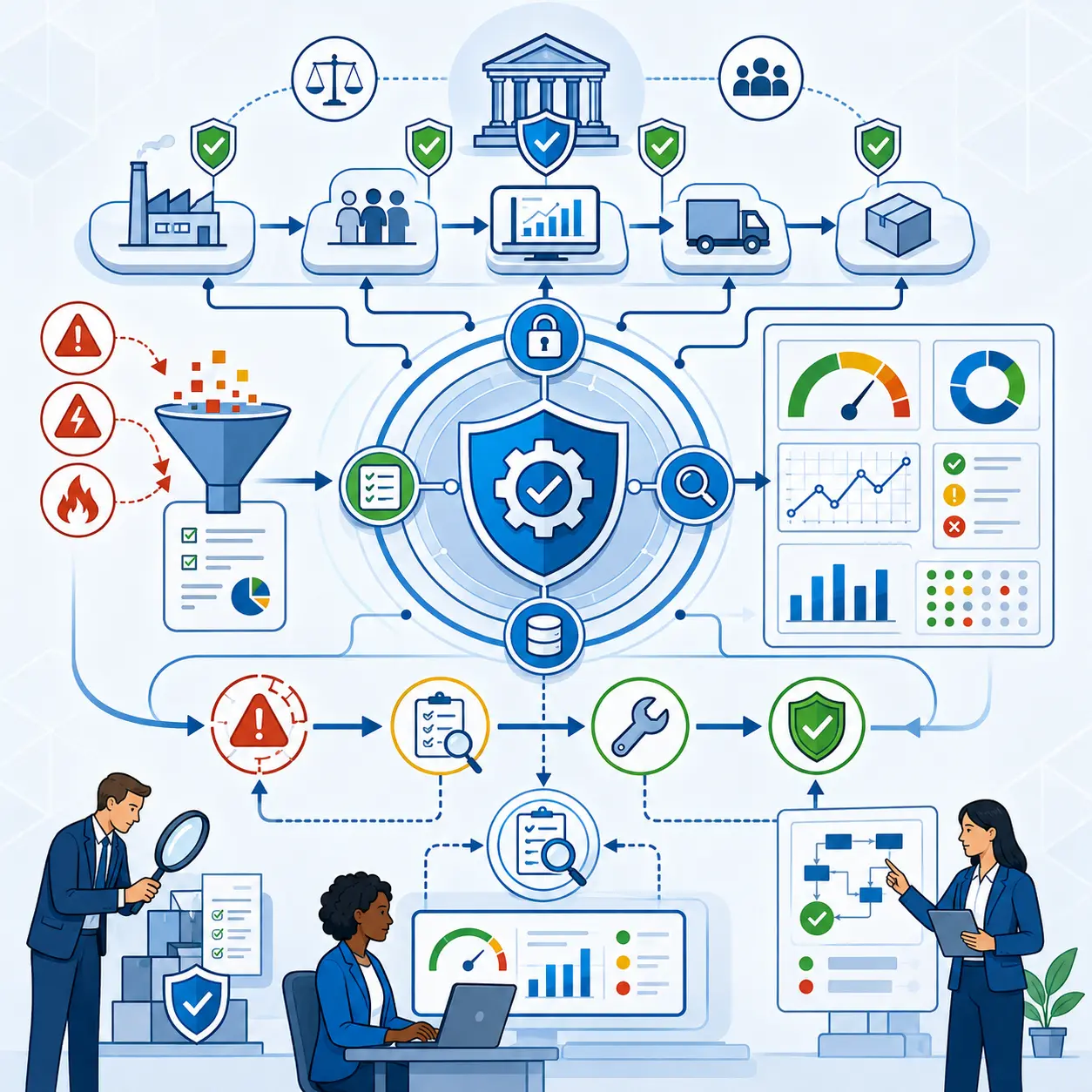
Definition and Scope
Control Management incl. Evaluation & Audit refers to the structured coordination of policies, procedures, and monitoring activities that ensure organisational operations remain compliant, controlled, and aligned with strategic objectives. It combines proactive control design with reactive assessment to detect, prevent, and correct issues in real time. This function forms the backbone of effective governance and risk assurance.
The scope includes internal controls, compliance checks, operational audits, process evaluations, and risk-based reviews. These components interact across business units and technology platforms to ensure that workflows are consistent, data is reliable, and regulations are upheld. It does not extend into unrelated business strategy or financial planning but remains closely linked to governance and operational excellence.
This discipline is both tactical and strategic, supporting risk mitigation, process improvement, and regulatory readiness. It defines clear boundaries around oversight, control design, and assurance, enabling organisations to operate with confidence and integrity.
Why Control Management incl. Evaluation & Audit Matters
Control Management incl. Evaluation & Audit plays a critical role in enabling organisations to maintain operational integrity, meet compliance obligations, and support strategic decision-making. It serves as a control framework that ensures consistency, reduces risk exposure, and enables responsiveness in fast-changing market or regulatory environments. As digitalisation expands and hybrid work structures become the norm, structured control mechanisms become increasingly vital.
It contributes to strategic alignment by embedding control and evaluation routines into key business processes, allowing for early risk detection, performance assurance, and continuous optimisation. The framework provides a clear governance structure, helping organisations navigate uncertainties such as technological disruptions, workforce decentralisation, or supply chain complexities. Additionally, it supports regulatory audits and enhances stakeholder confidence through transparency and traceability.
Stakeholders across the organisation benefit in distinct ways:
- Executives & Board Members: Gain confidence in compliance, risk posture, and control effectiveness for better strategic governance.
- Managers & Team Leads: Use audit insights and control data to improve process performance and workforce alignment.
- End Users & Staff: Experience clearer workflows and reduced ambiguity in daily operations, improving productivity and morale.
By institutionalising control mechanisms and audit-driven feedback loops, organisations position themselves to act faster, innovate securely, and sustain performance across complex, distributed environments. It is a foundational capability for managing uncertainty and achieving operational excellence.
Business Case and Strategic Justification
Organisations face increasing demands for operational transparency, regulatory compliance, and risk mitigation. Control Management incl. Evaluation & Audit provides a strategic mechanism to meet these expectations while enabling performance improvement and innovation. It aligns with corporate objectives such as governance, resilience, efficiency, and trust.
This capability helps resolve challenges like fragmented oversight, compliance gaps, and inefficiencies by embedding a control framework across critical processes. It also supports opportunities such as digital transformation, automation, and scalable governance. The return on investment includes reduced audit costs, fewer operational disruptions, better resource utilisation, and faster decision-making. Metrics often tracked include audit closure rates, compliance adherence, time-to-resolution of control gaps, and process throughput.
The most typical benefits include:
- Risk Reduction: Minimises financial, reputational, and operational risks through early issue detection and prevention.
- Regulatory Readiness: Improves compliance posture, enabling faster response to audits and policy changes.
- Operational Efficiency: Streamlines workflows by eliminating redundant controls and improving data quality.
- Decision Support: Enhances executive decision-making with reliable insights from evaluated processes.
- Digital Enablement: Supports automation and digital transformation by establishing control points within digital workflows.
A well-structured Control Management incl. Evaluation & Audit function delivers measurable business value across the enterprise. It enables consistent oversight, drives performance improvement, and prepares the organisation for future growth and change.
DON’T REINVENT THE WHEEL!
Get access to our Enterprise Standards to Drive Performance, Minimise Cost and Maximise Value.
How is Control Management incl. Evaluation & Audit Used?
Control Management incl. Evaluation & Audit is applied through a structured framework that integrates planning, execution, monitoring, and continuous improvement. Its practical use spans operational, compliance, and strategic layers, providing a comprehensive mechanism for governance and assurance across the organisation.
The framework operates through three key perspectives.
- The Key Phases & Process Steps: Define the lifecycle of control management, from control design to audit follow-up.
- Identifying Pitfalls & Challenges: Reveals common missteps and failure patterns that undermine effectiveness.
- Learning from Outperformers: Showcases proven methods and leading practices adopted by high-performing organisations.
Together, these perspectives provide a complete view of how to implement and sustain Control Management incl. Evaluation & Audit. They equip stakeholders to anticipate risks, avoid inefficiencies, and replicate success, forming the foundation for consistent and scalable control excellence.
Key Phases and Process Steps
The Control Management incl. Evaluation & Audit framework follows a structured, end-to-end approach designed to embed effective oversight into daily operations. The ten core phases provide a repeatable model for establishing, monitoring, and refining control environments across diverse functions and industries.
1. Control Objectives Definition
Establishes the purpose and desired outcomes of the control environment based on strategic and regulatory drivers.
2. Risk Assessment
Identifies and evaluates potential risks that may hinder the achievement of business or compliance objectives.
3. Control Design
Develops and documents the controls needed to mitigate identified risks and ensure process integrity.
4. Control Implementation
Integrates control activities into operational processes, systems, and user behaviours.
5. Monitoring and Reporting
Tracks control performance using defined metrics and dashboards to enable proactive oversight.
6. Evaluation and Testing
Validates control effectiveness through sampling, simulation, and formal assessments.
7. Internal Audit Execution
Conducts independent reviews to confirm adherence, uncover gaps, and verify outcomes.
8. Findings Management
Documents issues, assigns ownership, and ensures timely resolution of audit or control deficiencies.
9. Continuous Improvement
Enhances controls through feedback loops, analytics, and evolving best practices.
10. Governance and Oversight
Provides organisational alignment, accountability, and formal review of the control environment.
These ten phases form a cohesive lifecycle that enables transparency, consistency, and adaptability in control practices. Following the sequence supports proactive risk management and ensures ongoing compliance and performance improvement.
Identifying Pitfalls and Challenges: Antipatterns and Worst Practices
Despite its structured nature, Control Management incl. Evaluation & Audit is often undermined by poor execution habits and misaligned assumptions. Organisations frequently fall into patterns that weaken control effectiveness, increase risk exposure, and create inefficiencies. Recognising and avoiding these pitfalls is essential for sustainable implementation.
5 Antipattern Examples:
5 Worst Practice Examples:
Avoiding these missteps requires active governance, cross-functional engagement, and timely updates. Eliminating antipatterns and worst practices is key to maintaining credibility, performance, and compliance across the control environment.
Learning from Outperformers: Best Practices and Leading Practices
Organisations that excel in Control Management incl. Evaluation & Audit distinguish themselves through disciplined execution and forward-thinking enhancements. These outperformers embed control thinking into strategic decision-making and operational routines, creating a culture of proactive assurance and continuous improvement.
5 Best Practice Examples:
5 Leading Practice Examples:
Outperformers treat control management as a dynamic capability, not a static compliance task. These practices not only reduce risk but also enable agility, accountability, and innovation throughout the enterprise.
Who is Typically Involved with Control Management incl. Evaluation & Audit?
Successful Control Management incl. Evaluation & Audit relies on the collaboration of clearly defined roles across governance, operations, and technical functions. Understanding who is involved—and how they interact—is key to designing controls that are effective, actionable, and sustainable.
The most common roles include:
- Executive Sponsor: Sets the strategic direction and ensures alignment with enterprise risk and compliance objectives.
- Control Owner: Designs, implements, and maintains specific controls within their area of responsibility.
- Internal Auditor: Independently assesses control effectiveness, identifies gaps, and validates findings.
- Compliance Officer: Ensures that all control activities align with regulatory requirements and internal policies.
- Process Owner: Works closely with control owners to embed controls into daily operations and validate practical applicability.
Stakeholders benefit in different ways:
- Executives: Use control insights to manage strategic risk and guide governance decisions.
- Middle Management: Gain operational transparency and reduce uncertainty in process execution.
- Technical Teams: Implement automated control mechanisms that support secure, efficient digital workflows.
Clear accountability and collaboration across these roles ensure controls are both compliant and operationally effective. Well-defined responsibilities enable smoother audits, faster resolution of issues, and improved organisational resilience.
Where is Control Management incl. Evaluation & Audit Applied?
Control Management incl. Evaluation & Audit is widely applied across multiple organisational functions to ensure compliance, mitigate risk, and drive operational excellence. Its adaptability allows it to serve both strategic and operational needs across diverse departments and business scenarios.
The most common domains include:
- Finance: Ensures accuracy in financial reporting, fraud prevention, and adherence to accounting standards.
- IT & Cybersecurity: Manages access controls, monitors system integrity, and ensures compliance with data protection regulations.
- Operations: Tracks adherence to standard operating procedures and ensures consistency across supply chains and service delivery.
- Human Resources: Supports compliance with labour laws, internal policy adherence, and employee data protection.
- Procurement & Vendor Management: Verifies contract compliance, monitors supplier performance, and prevents leakage or fraud.
Examples of practical application include:
- Automated Monitoring: Enforces system access controls and detects policy violations in real time.
- Internal Audits: Validates SOX compliance and identifies control gaps for remediation.
The versatility of Control Management incl. Evaluation & Audit makes it relevant across all departments and process types. Whether ensuring regulatory compliance or improving internal performance, it brings structure and reliability to high-stakes operational areas.
When Should You Embrace Control Management incl. Evaluation & Audit?
Timing plays a critical role in the successful adoption of Control Management incl. Evaluation & Audit. Implementing it at the right organisational moment—backed by the right conditions—ensures greater impact, faster adoption, and stronger alignment with strategic priorities.
The most common triggers include:
- Rapid Organisational Growth: Increased complexity calls for structured oversight and scalable controls.
- Regulatory Change: New or updated compliance requirements necessitate robust audit and control mechanisms.
- Technology Transformation: System upgrades, migrations, or digitisation efforts introduce risks that require new control frameworks.
- Incident Recovery: Following data breaches, fraud, or audit failures, control maturity becomes a priority.
- Process Standardisation: When aligning global operations or centralising functions, unified control practices become essential.
Key prerequisites include:
- Stakeholder Alignment & Executive Sponsorship
- Clear Risk Management & Compliance Frameworks
- Availability of Process Documentation & Audit Trails
- Adequate Resources & Cross-Functional Support
- Foundational Process & Data Maturity
Recognising the right moment and preparing the groundwork for adoption helps avoid false starts and missed opportunities. These triggers and prerequisites enable a more integrated, proactive, and sustainable approach to control excellence.
Most Common Control Management incl. Evaluation & Audit Artefacts
Artefacts and tools are central to the successful execution of Control Management incl. Evaluation & Audit. They provide structure, traceability, and consistency across processes, enabling teams to monitor, evaluate, and improve control environments effectively.
The most commonly used artefacts include:
- Control Register: A centralised inventory of all controls, detailing their purpose, ownership, and assessment schedule.
- Risk & Control Matrix (RCM): Links identified risks to corresponding controls and defines testing procedures and frequencies.
- Audit Plan: A structured schedule outlining planned internal or external audits, including scope, timelines, and responsible auditors.
- Findings Log: Tracks control or audit issues, assigns remediation tasks, and monitors resolution progress.
- Compliance Dashboard: A real-time visual tool for tracking control status, audit results, and regulatory performance indicators.
These artefacts ensure clarity, accountability, and repeatability in managing controls and evaluations. When consistently used, they help embed control thinking into everyday business practices and strategic decision-making.
The Artefacts Table
The following table provides a structured overview of the most common artefacts used in Control Management incl. Evaluation & Audit. Each artefact plays a distinct role in supporting transparency, consistency, and control across business processes and compliance activities.
| Artefact | Description | Practical Use |
|---|---|---|
| Control Register | A master list of all controls including their purpose, owner, and lifecycle status. | Used by risk and compliance teams to track and maintain oversight of controls across departments. |
| Risk & Control Matrix (RCM) | Maps risks to their associated controls and specifies test procedures. | Applied during audits to validate risk coverage and assess control effectiveness. |
| Audit Plan | A schedule and scope definition of planned audit activities. | Guides internal audit teams in prioritising high-risk areas and maintaining audit frequency. |
| Findings Log | Tracks identified issues, assigns ownership, and monitors resolution progress. | Enables audit follow-up and ensures accountability in closing control gaps. |
| Compliance Dashboard | A visual summary of control performance and regulatory compliance indicators. | Used by management to monitor status in real time and support informed decision-making. |
These artefacts collectively strengthen the foundation of Control Management incl. Evaluation & Audit by enabling traceability, prioritisation, and accountability. Their consistent application ensures that organisations can proactively manage risk, enhance control quality, and drive continuous improvement.