
Enterprise Information & Technology
Data Management
Reference Content ID: #LEAD-ES50045ADPLIN
Introduction to Data Management
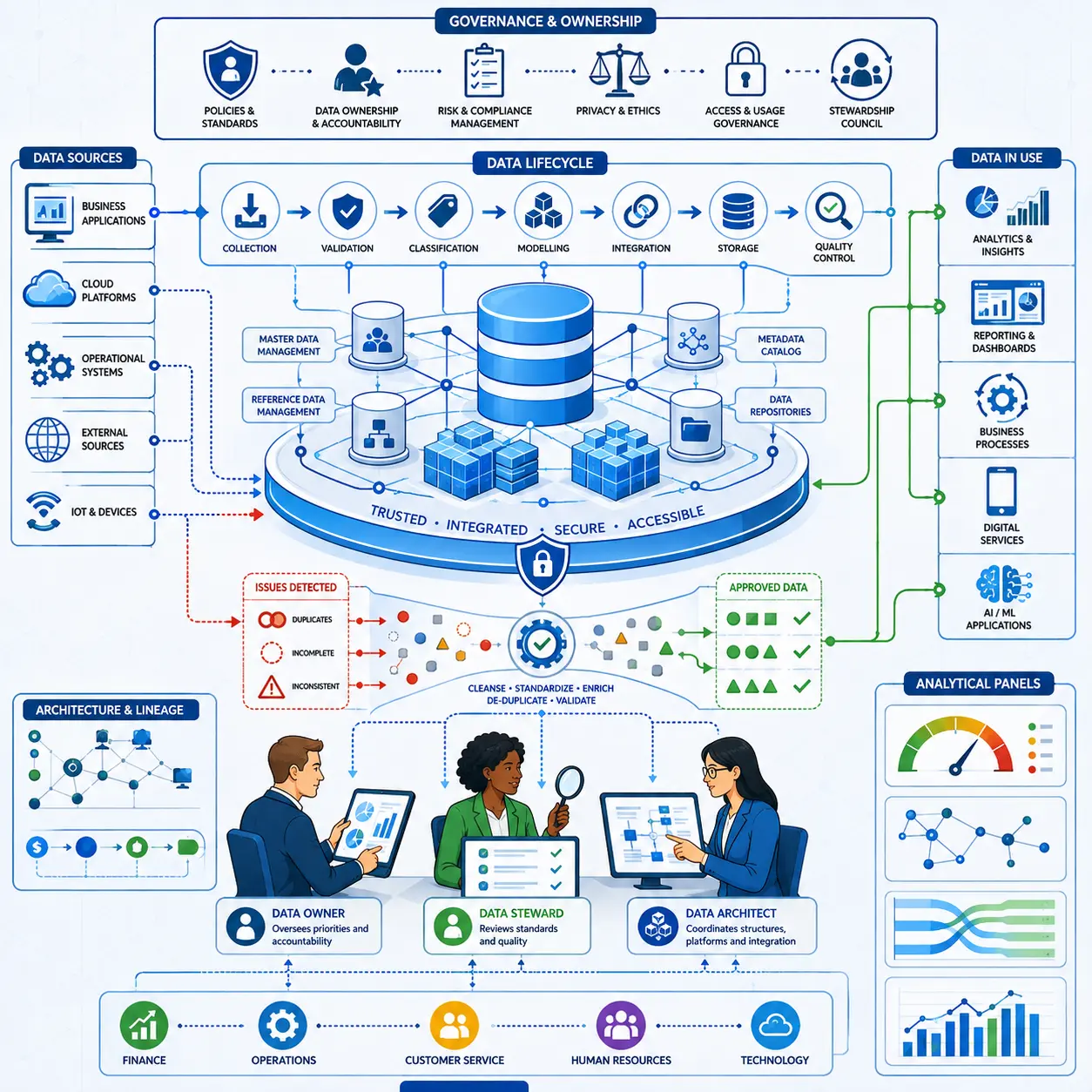
Data Management provides a structured approach for governing, organising, protecting, and using data throughout its lifecycle. It helps organisations ensure that data remains accurate, accessible, secure, and fit for business use.
Its core principles include clear ownership, quality, consistency, governance, security, compliance, and lifecycle control. Key focus areas include data architecture, modelling, integration, storage, master data, metadata, quality, and governance.
Data Management applies across industries, functions, and operating models, supporting operational, analytical, and digital activities. It enables on-site, hybrid, and remote teams to work with trusted information, improving productivity, collaboration, employee well-being, and digital workflows.
Used consistently, Data Management strengthens decision-making, operational control, and business performance. It creates a dependable foundation for scalable and effective enterprise information use.
Definition and Scope
Data Management encompasses the policies, practices, responsibilities, and technologies used to control data throughout its lifecycle. Its scope covers how data is created, structured, stored, protected, maintained, shared, and used across the organisation.
Core domains include data governance, architecture, modelling, integration, storage, master and reference data, metadata, data quality, security, and lifecycle management. These domains work together to ensure consistent, reliable, accessible, and controlled information across business processes and technology environments. Data Management does not replace broader business governance, application management, or infrastructure management, although it interacts closely with each.
Its scope therefore extends across functions, systems, platforms, and operating models. Effective Data Management provides the common foundation required for trusted and responsible enterprise data use.
Why Digital Sovereignty Matters
Data Management is essential for turning enterprise data into a reliable business asset. It supports strategic objectives while improving operational consistency, control, and responsiveness.
Organisations depend on trusted data to respond to market change, digital transformation, regulatory demands, and growing information volumes. Effective management reduces duplication, inconsistency, and fragmented decision-making.
Different stakeholders gain practical benefits:
- Executives: Gain trusted information for strategic decisions and performance oversight.
- Managers: Improve coordination, efficiency, and operational decision-making.
- End Users: Access consistent information that supports productive digital work and innovation.
Data Management connects reliable information with business priorities across organisational levels. It strengthens decision-making, efficiency, adaptability, and the organisation’s ability to create value from data.
Business Case and Strategic Justification
Investing in Data Management strengthens the organisation’s ability to use information as a trusted business asset. It aligns data practices with strategic priorities, governance, digital transformation, and operational performance.
Data Management addresses fragmented information, duplication, poor quality, compliance exposure, and inefficient manual work. Returns may include lower costs, less rework, faster decisions, higher productivity, and improved customer outcomes, measured through data quality, processing time, error reduction, compliance performance, and cost savings.
Typical benefits include:
- Better Decisions: Improves access to accurate and timely information.
- Higher Efficiency: Reduces duplication, rework, and manual handling.
- Lower Risk: Strengthens governance, security, compliance, and accountability.
- Greater Agility: Supports faster responses to business and technology change.
- Value Creation: Enables analytics, innovation, and improved digital services.
Data Management therefore supports strategic and operational priorities. Investment should focus on measurable outcomes, clear ownership, and continual improvement.
DON’T REINVENT THE WHEEL!
Get access to our Enterprise Standards to Drive Performance, Minimise Cost and Maximise Value.
How is Data Management Used?
Data Management is applied through structured practices that guide how data is governed, controlled, maintained, and used across the organisation. Effective implementation combines defined processes, awareness of common risks, and proven practices.
Key Phases and Process Steps explain the main activities required to establish and operate Data Management consistently. Identifying Pitfalls and Challenges highlights antipatterns and poor practices that can weaken quality, accountability, or adoption. Learning from Outperformers presents best and leading practices that improve maturity, efficiency, and business value.
Together, these perspectives provide a practical framework for implementation and continual improvement. They help organisations apply Data Management consistently while avoiding recurring problems and adopting approaches that support reliable, secure, and effective data use.
Key Phases and Process Steps
Data Management follows a structured lifecycle that connects strategic direction with operational execution. The following ten phases provide a practical sequence for managing data consistently across the enterprise.
1. Define Strategy
Establish objectives, priorities, principles, and expected business outcomes.
2. Establish Governance
Assign ownership, decision rights, policies, standards, and accountability.
3. Assess Data
Identify data assets, requirements, quality issues, risks, and dependencies.
4. Design Architecture
Define structures, models, flows, platforms, and integration requirements.
5. Acquire Data
Capture or obtain data from approved internal and external sources.
6. Store Data
Maintain data securely within appropriate repositories and platforms.
7. Integrate Data
Connect and synchronise data across systems and processes.
8. Manage Quality
Monitor accuracy, completeness, consistency, and reliability.
9. Protect Data
Apply security, privacy, access, retention, and compliance controls.
10. Use & Improve
Enable effective use while monitoring performance and improving practices.
Together, these phases create an end-to-end management framework. Their sequence supports control, reliability, accessibility, and continual improvement.
Identifying Pitfalls and Challenges: Antipatterns and Worst Practices
Data Management initiatives can underperform when governance, ownership, quality, or adoption are weak. Recognising recurring mistakes helps organisations protect data value and maintain effective practices.
5 Antipattern Examples:
5 Worst Practice Examples:
Avoiding these practices strengthens reliability, accountability, security, and long-term Data Management effectiveness.
Learning from Outperformers: Best Practices and Leading Practices
Outperforming organisations strengthen Digital Sovereignty by combining disciplined governance with adaptable technology and continuous improvement. Effective practices balance control, resilience, compliance, and operational flexibility.
5 Best Practice Examples:
5 Leading Practice Examples:
Together, these practices support sustainable, resilient, and strategically aligned Digital Sovereignty.
Who is Typically Involved with Data Management?
Understanding who participates in Data Management clarifies accountability and collaboration. Effective outcomes depend on coordinated business and technical ownership.
Primary roles include:
- Executive Sponsor: Provides direction, funding, and organisational support.
- Data Owner: Defines accountability, priorities, and acceptable data use.
- Data Steward: Maintains definitions, quality, standards, and issue resolution.
- Data Architect: Designs structures, flows, integration, and technology alignment.
- Data Operations Lead: Coordinates implementation, controls, monitoring, and improvement.
Stakeholder impacts include:
- Executives: Gain trusted information for strategic decisions.
- Managers: Improve operational control, efficiency, and accountability.
- Technical Teams & End Users: Enable reliable systems, workflows, and data access.
Clear responsibilities strengthen governance and collaboration. Well-defined roles help organisations manage data consistently and achieve dependable outcomes.
Where is Data Management Applied?
Data Management applies wherever data supports decisions, processes, services, or compliance. Its role varies by context while strengthening reliability, accessibility, and control.
Primary domains include:
- Finance: Supports reporting, forecasting, controls, and regulatory compliance.
- Information Technology: Governs architecture, integration, storage, security, and access.
- Operations: Improves process consistency, monitoring, and resource planning.
- Customer Service: Maintains reliable customer information across channels and interactions.
- Human Resources: Supports workforce records, analytics, planning, and privacy.
Illustrative scenarios include:
- System Integration: IT teams standardise data when connecting applications.
- Performance Reporting: Finance and operations teams consolidate trusted data for management reporting.
Data Management supports both functional and cross-enterprise needs. Its versatility enables consistent and trusted information across organisational settings.
When Should You Embrace Data Management?
Organisations should adopt Data Management when growing complexity, risk, or transformation makes reliable information increasingly important. Readiness depends on both clear business drivers and suitable organisational foundations.
Key adoption signals include:
- Rapid Growth: Increasing data volumes require stronger control and scalability.
- Digital Transformation: New platforms demand consistent data structures and governance.
- System Integration: Connected applications require reliable and standardised information.
- Regulatory Pressure: Compliance obligations increase requirements for control and traceability.
- Poor Data Quality: Persistent errors and duplication hinder decisions and efficiency.
Essential prerequisites include:
- Stakeholder Alignment: Ensure shared support for Data Management objectives and priorities.
- Clear Ownership: Define responsibility and accountability for data and related decisions.
- Adequate Resources: Provide sufficient people, budget, time, and expertise.
- Defined Objectives: Establish clear business goals and expected outcomes.
- Appropriate Technology: Ensure suitable platforms, tools, and infrastructure are available.
- Process Maturity: Maintain sufficiently developed governance and operational processes.
Recognising these signals helps organisations adopt Data Management at the right time. Strong foundations improve implementation, adoption, and long-term value.
Most Common Data Management Artefacts
Data Management artefacts provide practical structures for governing, organising, controlling, and improving enterprise data. They support consistent execution, accountability, and communication across business and technology teams.
Common artefacts include:
- Data Governance Framework: Defines roles, decision rights, policies, standards, and oversight mechanisms.
- Data Catalogue: Documents available data assets, ownership, definitions, sources, and usage.
- Data Model: Represents data structures, relationships, attributes, and business concepts.
- Data Quality Dashboard: Tracks accuracy, completeness, consistency, timeliness, and identified quality issues.
- Data Management Policy: Establishes requirements for creating, storing, accessing, protecting, retaining, and using data.
Together, these artefacts translate Data Management principles into repeatable practices. They improve transparency, control, quality, and consistent enterprise-wide data use.
The Artefacts Table
The table below summarises five common Data Management artefacts and their practical use. Each supports consistent governance, control, and effective use of enterprise data.
| Artefact | Description | Practical use |
|---|---|---|
| Data Governance Framework | Defines roles, policies, standards, and decision rights. | Guides accountability and governance decisions. |
| Data Catalogue | Documents data assets, ownership, definitions, and sources. | Helps users locate and understand trusted data. |
| Data Model | Defines data structures and relationships. | Supports system design and integration. |
| Data Quality Dashboard | Tracks data quality measures and issues. | Supports monitoring and corrective action. |
| Data Management Policy | Defines requirements for managing data. | Guides compliant and consistent data handling. |
Together, these artefacts provide practical mechanisms for managing data consistently. They strengthen transparency, quality, accountability, and operational control.